
Short Answer
Definition of Dark Matter
Dark matter is a mysterious and invisible form of matter that constitutes approximately 27% of the total mass-energy content of the universe. Unlike ordinary matter, which makes up stars, planets, and living beings, dark matter does not interact with electromagnetic radiation-meaning it neither emits, absorbs, nor reflects light. This invisibility makes it undetectable by conventional observational tools such as telescopes. Its presence is inferred primarily through its gravitational effects on visible matter, radiation, and the large-scale structure of the cosmos.
Fundamental Characteristics of Dark Matter
- Non-luminous:
Dark matter does not emit or interact with light, rendering it invisible to electromagnetic detection methods. - Gravitational influence:
It exerts gravitational forces that affect the motion of stars, galaxies, and galaxy clusters, providing indirect evidence of its existence. - Weak interaction with ordinary matter:
Dark matter particles rarely interact with baryonic matter, primarily through forces weaker than electromagnetism, such as the weak nuclear force.
Why Detecting Dark Matter Is Challenging
The primary difficulty in detecting dark matter stems from its elusive nature and minimal interaction with ordinary matter. Since it does not engage with light, traditional detection methods relying on electromagnetic signals are ineffective. Instead, scientists depend on indirect approaches, such as observing gravitational effects or attempting to capture rare interactions between dark matter particles and atomic nuclei.
Moreover, the probability of dark matter particles interacting with detectors-known as the interaction cross-section-is extraordinarily low. This rarity is akin to detecting a tiny pebble’s splash in a vast ocean, where natural background noise from cosmic rays and other particles can easily obscure the faint signals researchers seek. To overcome this, experiments are conducted deep underground in ultra-pure environments to minimize interference and enhance sensitivity.
Theoretical Models and Detection Strategies
Current leading theories propose that dark matter consists of weakly interacting massive particles (WIMPs). These hypothetical particles interact so infrequently with normal matter that capturing a direct event requires highly sensitive detectors and prolonged observation periods. To this end, scientists have developed sophisticated instruments placed in shielded underground laboratories to reduce background noise and increase the chances of detecting these rare collisions.
Despite decades of effort, no conclusive detection of WIMPs has been made, prompting researchers to explore alternative candidates such as axions, sterile neutrinos, or other exotic particles. Each of these possibilities demands unique detection methods, expanding the experimental landscape and complicating the search.
Cosmological Evidence and Observational Techniques
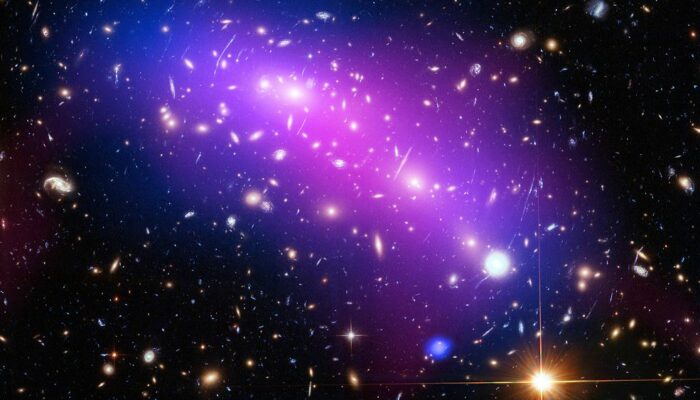
Dark matter’s influence is most evident on cosmic scales, where it shapes the large-scale structure of the universe. The cosmic web-a vast network of galaxies and voids-is sculpted by the gravitational pull of dark matter over billions of years. One of the most powerful observational tools is gravitational lensing, where massive objects bend the path of light from distant sources, revealing the distribution of dark matter indirectly.
However, gravitational lensing and other cosmological observations provide only a macroscopic view of dark matter’s presence. These methods require extensive data collection, complex modeling, and the integration of multiple astronomical surveys to construct a coherent map of dark matter’s distribution, yet they do not reveal its fundamental particle nature.
Alternative Theories and Paradigm Shifts
Given the persistent lack of direct detection, some scientists are considering more radical explanations for dark matter. One such idea is that dark matter might not be a particle at all but rather a manifestation of modified gravity or a new field permeating spacetime. This approach suggests that the phenomena attributed to dark matter could arise from subtle deviations in gravitational behavior on cosmic scales.
This perspective challenges traditional detection methods and calls for a redefinition of what it means to detect dark matter, shifting the focus from particle searches to precision measurements of gravitational effects and spacetime properties.
Technological Advances and Future Prospects
Emerging technologies offer hope for breakthroughs in the dark matter quest. Innovations in quantum sensing, cryogenic detectors, and space-based observatories are enhancing the sensitivity and scope of experiments. Alongside these technological improvements, the interplay between theoretical insights and experimental design continues to evolve, refining search strategies and expanding the frontiers of detection.
As detection instruments become more sophisticated and data analysis techniques improve, the faint signals of dark matter interactions may eventually be distinguished from background noise, potentially leading to a landmark discovery that transforms our understanding of the universe.
Significance of Detecting Dark Matter
Unraveling the mystery of dark matter is crucial for advancing fundamental physics and cosmology. It holds the key to understanding the universe’s composition, the formation and evolution of cosmic structures, and the fundamental laws governing matter and energy. Detecting dark matter would not only fill a major gap in the Standard Model of particle physics but also open new avenues for exploring the nature of reality itself.
Common Misconceptions About Dark Matter
Dark matter is simply “dark” because it is cold or hidden.
Dark matter is invisible because it does not interact with light at all, not merely because it is dark or obscured.
Dark matter can be detected easily with telescopes.
Since dark matter does not emit or reflect electromagnetic radiation, telescopes cannot detect it directly; its presence is inferred through gravitational effects.
Dark matter is the same as dark energy.
Dark matter and dark energy are distinct phenomena; dark matter exerts gravitational attraction, while dark energy is responsible for the accelerated expansion of the universe.
FAQ
What is dark matter?
Dark matter is a form of matter that does not interact with light, making it invisible, and it constitutes a significant part of the universe's total mass-energy.
Why is dark matter difficult to detect?
It does not emit or reflect light and interacts very weakly with ordinary matter, making traditional detection methods ineffective.
What are the current theories about dark matter?
Leading theories suggest dark matter consists of weakly interacting massive particles (WIMPs), but other candidates like axions and sterile neutrinos are also being explored.



Leave a Reply