
Short Answer
Definition of Magnetic Resonance Imaging (MRI)
Magnetic Resonance Imaging (MRI) is a cutting-edge, non-invasive diagnostic technique that produces highly detailed images of the internal structures of the human body. Unlike traditional imaging methods such as X-rays or computed tomography (CT) scans, MRI does not use ionizing radiation. Instead, it leverages powerful magnetic fields and radiofrequency waves to visualize soft tissues with exceptional clarity, making it indispensable for examining organs like the brain, spinal cord, muscles, and joints.
Fundamental Principles Behind MRI
The core mechanism of MRI revolves around the behavior of hydrogen nuclei (protons) within the body. Since hydrogen atoms are abundant in water and fat, they serve as natural markers for imaging. When a patient is placed inside the MRI scanner, a strong and uniform magnetic field aligns these protons along its direction. Subsequently, a radiofrequency (RF) pulse is applied, disturbing this alignment.
As the RF pulse stops, the protons gradually return to their original orientation in a process called relaxation. During relaxation, the protons emit RF signals, which are captured by the MRI’s receiver coils. These signals undergo mathematical processing, primarily Fourier transformation, to reconstruct detailed images of the body’s internal anatomy.
Key Components of an MRI System
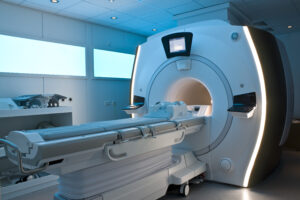
The MRI apparatus is composed of several sophisticated parts, each essential for the imaging process:
- Main Magnet:
This is the heart of the MRI machine, generating a strong, stable magnetic field typically between 1.5 and 3 Tesla in clinical settings. The magnet’s strength is crucial for aligning protons and achieving high-resolution images. Research is ongoing to develop even stronger magnets to enhance imaging capabilities further. - Radiofrequency (RF) Coils:
These coils transmit RF pulses to the patient and receive the emitted signals during proton relaxation. Different coils are designed for specific body regions-such as head, knee, or breast coils-to optimize image quality for targeted anatomical areas. - Gradient Coils:
Located inside the main magnet, gradient coils create slight variations in the magnetic field across different spatial locations. This spatial encoding is vital for differentiating tissues and constructing precise images. Gradient coils also enable various imaging sequences, broadening the diagnostic applications of MRI. - Computer System:
Acting as the control center, the computer processes the received signals, applies complex algorithms to reconstruct images, and displays them for clinical interpretation. Advanced software also supports features like motion correction and three-dimensional image rendering. - Patient Table:
This movable platform supports and positions the patient within the scanner bore, ensuring the targeted body part is accurately centered in the magnetic field. Ergonomic design enhances patient comfort during often lengthy scanning sessions.
How MRI Technology Operates
The MRI process begins with the alignment of hydrogen protons in the body by the strong magnetic field. When the RF pulse is applied, it tips these protons out of alignment. As they relax back to their equilibrium state, they emit RF signals that vary depending on the tissue type and environment. These signals are spatially encoded by gradient coils, allowing the system to map the location of the signals within the body. The computer then reconstructs these signals into detailed cross-sectional images, revealing the internal anatomy with remarkable contrast and resolution.
Mathematical and Physical Basis of MRI
The MRI signal generation and image formation rely on principles of nuclear magnetic resonance (NMR) and signal processing:
- Larmor Frequency (ω):
ω = γB
where γ is the gyromagnetic ratio (a constant specific to the proton), and B is the magnetic field strength. This frequency determines the resonance condition for protons in the magnetic field. - Relaxation Times:
T1 (longitudinal relaxation time) and T2 (transverse relaxation time) describe how quickly protons return to equilibrium after excitation. Different tissues have distinct T1 and T2 values, which contribute to image contrast. - Fourier Transform:
Converts the time-domain RF signals into spatial frequency data, enabling the reconstruction of spatial images from the raw signal.
Practical Applications of MRI
MRI is widely used in clinical practice due to its ability to provide detailed images without radiation exposure. Common applications include:
- Neurology:
Imaging the brain and spinal cord to detect tumors, strokes, multiple sclerosis, and other neurological disorders. - Musculoskeletal System:
Evaluating muscles, ligaments, joints, and cartilage for injuries or degenerative diseases. - Cardiology:
Assessing heart structure and function, including blood flow and tissue viability. - Oncology:
Detecting and monitoring tumors in various organs with high soft tissue contrast.
Common Misunderstandings About MRI
- Misconception: MRI uses harmful ionizing radiation.
Correction: MRI employs magnetic fields and radio waves, which do not involve ionizing radiation, making it safer than X-rays or CT scans. - Misconception: MRI scans are always quick and comfortable.
Correction: MRI procedures can be lengthy and require the patient to remain still inside a confined space, which may cause discomfort or claustrophobia for some individuals. - Misconception: All MRI machines produce the same image quality.
Correction: Image quality varies depending on magnet strength, coil design, and software capabilities, with higher-field magnets generally providing better resolution.
Significance of MRI in Modern Medicine
MRI has profoundly impacted medical diagnostics by offering unparalleled visualization of soft tissues without the risks associated with ionizing radiation. Its ability to differentiate between various tissue types aids in early disease detection, treatment planning, and monitoring therapeutic outcomes. Furthermore, ongoing advancements in MRI technology continue to expand its applications, improve patient comfort, and reduce scan times, underscoring its vital role in healthcare and biomedical research.
FAQ
What is MRI?
MRI stands for Magnetic Resonance Imaging, a technique used to create detailed images of the inside of the body using magnetic fields and radio waves.
How does MRI work?
MRI works by aligning hydrogen protons in the body with a strong magnetic field, then using radiofrequency pulses to disturb this alignment. The emitted signals are detected and converted into images.
What are the parts of an MRI machine?
The key parts include the magnet, radiofrequency coils, gradient coils, computer system, and the patient table.
Is MRI safe?
Yes, MRI does not use ionizing radiation and is generally considered safe, though patients with certain implants or metal objects may not be eligible.



Leave a Reply