
Short Answer
Definition of Unanswered Questions in Physics
Physics, the fundamental science that deciphers the laws governing the natural world, is continuously confronted with profound mysteries that defy current understanding. These unresolved questions challenge the completeness of existing theories and push the boundaries of human knowledge. They encompass phenomena that remain elusive despite advanced experimental techniques and sophisticated theoretical frameworks, inviting deeper inquiry into the nature of reality.
Dark Matter: The Invisible Mass
Dark matter is a mysterious form of matter that neither emits nor absorbs electromagnetic radiation, rendering it invisible to conventional detection methods. It accounts for roughly 27% of the universe’s total mass-energy composition. Its existence is inferred primarily through gravitational influences on visible celestial bodies, such as the anomalous rotation speeds of galaxies and gravitational lensing effects on light from distant stars.
- Nature:
The exact composition of dark matter remains unknown. Leading hypotheses suggest it may consist of Weakly Interacting Massive Particles (WIMPs), axions, or other undiscovered elementary particles. - Detection Challenges:
Because dark matter does not interact electromagnetically, it evades direct observation, making its study reliant on indirect gravitational evidence.
Dark Energy and Cosmic Expansion
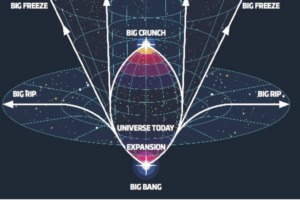
Dark energy is an enigmatic force believed to drive the accelerated expansion of the universe, constituting about 68% of its total energy content. Discovered through observations in the late 1990s, its precise nature remains a subject of intense research and debate.
- Cosmological Constant vs. Dynamic Field:
Dark energy might be a constant property of space itself, known as the cosmological constant, or a dynamic field that changes over time. - Cosmic Fate:
The behavior of dark energy influences the ultimate destiny of the universe, potentially leading to scenarios such as the “Big Rip,” where the universe tears apart, or a gradual collapse if dark energy diminishes.
Quantum Gravity: Bridging the Theoretical Divide
The quest for a unified theory of quantum gravity aims to reconcile the principles of quantum mechanics, which govern the microscopic realm, with general relativity, the theory describing gravitation and large-scale structures. These frameworks are currently incompatible under extreme conditions like black holes and the Big Bang.
- Leading Theories:
String theory and loop quantum gravity propose fundamentally different models of spacetime, including the possibility that spacetime is quantized into discrete units rather than continuous. - Significance:
Achieving a coherent quantum gravity theory would revolutionize our understanding of space, time, and causality.
The Black Hole Information Paradox
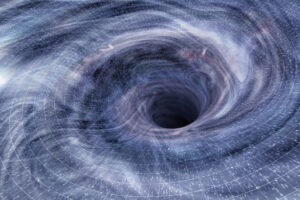
Black holes present a paradox concerning the fate of information that falls into them. Classical physics suggests that this information is lost forever, conflicting with quantum mechanics, which asserts that information must be conserved.
- Proposed Resolutions:
Hypotheses include the preservation of information on the event horizon or its encoding in Hawking radiation, though a definitive explanation remains elusive. - Implications:
Resolving this paradox could unify aspects of quantum theory and general relativity, shedding light on the quantum structure of spacetime.
Neutrinos: Ghost Particles with Mass
Neutrinos are nearly massless, neutral particles that permeate the universe, passing through matter with minimal interaction. Their ability to oscillate between different types, or “flavors,” indicates they possess mass, challenging the original assumptions of the Standard Model of particle physics.
- Mass Scale and Nature:
The absolute masses of neutrinos and whether they are Majorana particles (their own antiparticles) remain open questions. - Cosmological Impact:
Understanding neutrino properties could explain the matter-antimatter imbalance in the universe, a fundamental aspect of our existence.
The Arrow of Time and Entropy
The directionality of time, often referred to as the “arrow of time,” is a fundamental question linked to entropy and thermodynamics. While most physical laws are time-symmetric, our experience of time is unidirectional, moving from past to future.
- Entropy and Time’s Flow:
The Second Law of Thermodynamics, which states that entropy tends to increase, is commonly associated with this temporal asymmetry. - Origin of Low Entropy:
The reason the universe began in a low-entropy state, enabling this irreversible progression, remains a profound mystery possibly connected to spacetime geometry or quantum gravity.
The Hierarchy Problem in Particle Physics
The hierarchy problem addresses the puzzling disparity between the mass of the Higgs boson and the Planck scale, where gravitational effects become significant. Without new physics, this difference appears unnaturally fine-tuned.
- Potential Solutions:
Theories such as supersymmetry propose mechanisms to naturally explain this scale difference. - Importance:
Resolving the hierarchy problem could reveal deeper insights into the fundamental structure of particle masses and forces.
Origins of the Universe: Beyond the Big Bang
The initial cause of the Big Bang remains one of the most profound mysteries in cosmology. While the evolution of the universe after the Big Bang is well-modeled, the singular event itself is not fully understood.
- Singularity or Transition:
The Big Bang might represent a true singularity or a phase transition from a prior cosmological state. - Modern Theories:
Concepts such as quantum cosmology suggest a “bounce” scenario, while multiverse theories propose our universe is one among many.
Why These Questions Are Crucial
The collection of these unresolved issues illustrates a fundamental paradox in physics: expanding knowledge simultaneously broadens the scope of the unknown. These mysteries inspire curiosity and drive scientific progress, encouraging innovative thinking and rigorous experimentation. Understanding these phenomena is essential not only for advancing theoretical physics but also for comprehending our place in the cosmos.
Conclusion: The Endless Quest for Understanding
Physics transcends the mere study of matter and energy; it is a profound endeavor to grasp the essence of existence within an enigmatic universe. The most significant unanswered questions push the limits of human cognition and technological capability, compelling us to explore deeper, ask more profound questions, and venture further into the vast unknown that defines reality.
FAQ
What is dark matter?
Dark matter is a form of matter that does not emit light or energy, making it invisible and detectable only through its gravitational effects on visible matter.
What is the significance of quantum gravity?
Quantum gravity seeks to unify quantum mechanics and general relativity, providing a comprehensive understanding of gravity at quantum scales.

Leave a Reply