
Short Answer
Definition of Beta Decay
Beta decay is a form of radioactive transformation occurring within unstable atomic nuclei, where a nucleus changes its composition by emitting a beta particle. This process alters the identity of the element by modifying its atomic number. Beta decay manifests in two primary types: beta-minus (β–) decay and beta-plus (β+) decay, each involving distinct particles and nuclear changes.
- Beta-minus decay:
An unstable neutron inside the nucleus converts into a proton, releasing an electron (the beta particle) and an antineutrino. - Beta-plus decay:
A proton transforms into a neutron, emitting a positron (the beta particle’s antimatter equivalent) and a neutrino.
Mechanism Behind Beta Decay
At the core of beta decay lies the weak nuclear force, one of the four fundamental forces in nature. Unlike the electromagnetic or strong nuclear forces, the weak force facilitates changes in the flavor of quarks-the elementary constituents of protons and neutrons. This interaction enables the conversion of a neutron into a proton or vice versa through the exchange of W bosons, the force carriers responsible for mediating these transformations.
In beta-minus decay, a down quark within a neutron changes into an up quark, turning the neutron into a proton and releasing an electron and an antineutrino. Conversely, in beta-plus decay, an up quark in a proton converts into a down quark, producing a neutron, a positron, and a neutrino. These processes result in the emission of beta particles, which carry away energy and momentum from the nucleus.
Mathematical Description and Energy Considerations
The energy released during beta decay is governed by Einstein’s mass-energy equivalence principle, expressed as:
E = mc²
- E: Energy released
- m: Mass difference between initial and final nuclear states
- c: Speed of light in vacuum
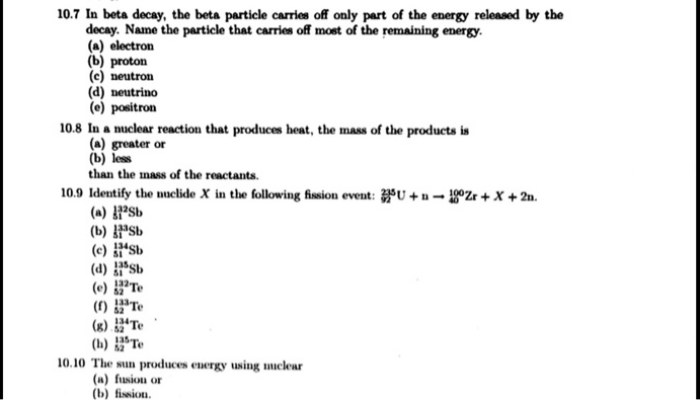
This equation explains how the mass difference between the parent and daughter nuclei converts into kinetic energy carried by the emitted beta particle and neutrino or antineutrino. The kinetic energy spectrum of beta particles is continuous due to the shared energy with neutrinos, distinguishing beta decay from other radioactive processes.
Applications and Real-World Significance
Beta decay has profound implications across various scientific and technological fields:
- Nuclear Medicine:
Positron emission tomography (PET) scans utilize beta-plus decay, where emitted positrons annihilate with electrons, producing gamma rays that create detailed images of metabolic activity in the body. - Nuclear Energy:
Beta particles emitted during radioactive decay contribute to the energy output in nuclear reactors, particularly through the decay of uranium and other isotopes. - Astrophysics and Nucleosynthesis:
Beta decay plays a crucial role in the formation of elements within stars. During stellar evolution and supernova explosions, beta decay processes help synthesize heavier elements, shaping the chemical composition of the universe.
Beta Decay Asymmetry and Its Mysteries
One intriguing aspect of beta decay is the phenomenon known as beta decay asymmetry, where the distribution of emitted beta particles exhibits directional preferences that challenge existing theoretical models. This asymmetry highlights subtle violations of symmetry principles in particle physics, particularly involving neutrinos, and continues to be an active area of research. Understanding these anomalies may provide deeper insights into the fundamental forces and the behavior of subatomic particles.
Common Misconceptions About Beta Decay
Beta particles are always electrons.
Beta particles can be either electrons (in beta-minus decay) or positrons (in beta-plus decay), depending on the type of decay.
Beta decay changes the mass number of the nucleus.
Beta decay alters the atomic number by one but leaves the mass number unchanged, as a neutron converts to a proton or vice versa.
Beta decay is governed by the strong nuclear force.
Beta decay is mediated by the weak nuclear force, which is responsible for quark flavor changes within nucleons.
Importance of Beta Decay in Science and Technology
Beta decay is fundamental to our understanding of nuclear physics and the behavior of matter at the subatomic level. It provides critical insights into the weak nuclear force and the nature of antimatter. Beyond theoretical significance, beta decay underpins practical technologies such as medical imaging and nuclear power generation. Moreover, its role in cosmic element formation connects it to the broader narrative of the universe’s evolution, emphasizing its indispensable place in both scientific inquiry and everyday applications.
FAQ
What is beta decay?
Beta decay is a form of radioactive transformation in unstable atomic nuclei, emitting a beta particle and changing the atomic number of the element.
What are the types of beta decay?
The two types of beta decay are beta-minus (β-) decay, which emits an electron, and beta-plus (β+) decay, which emits a positron.
What role does the weak nuclear force play in beta decay?
The weak nuclear force facilitates the conversion of quarks, enabling the transformation of neutrons to protons and vice versa during beta decay.






Leave a Reply