
Short Answer
Definition of the Strong Nuclear Force
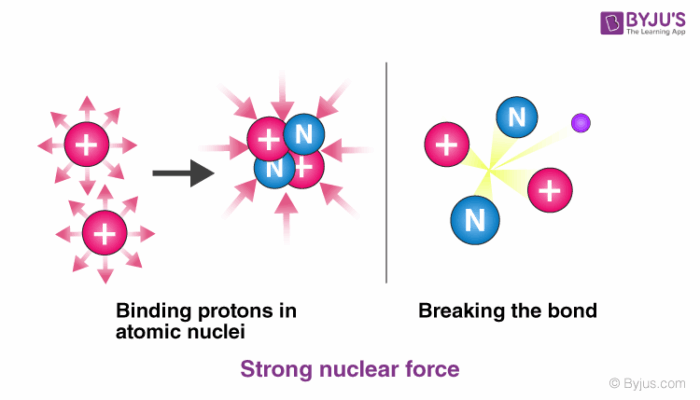
The strong nuclear force, often referred to as the strong interaction, is a fundamental force responsible for binding protons and neutrons within an atomic nucleus. It plays a crucial role in maintaining the stability of matter by counteracting the repulsive electromagnetic forces between positively charged protons. This force is essential not only for the integrity of atomic nuclei but also for various cosmic phenomena, including the processes that power stars and the synthesis of elements.
Origin and Theoretical Framework
The strong nuclear force originates from the principles of quantum chromodynamics (QCD), a theory describing the interactions of quarks and gluons. Quarks, the elementary constituents of protons and neutrons, interact by exchanging gluons, which act as the force carriers of the strong interaction. This gluon exchange binds quarks together, forming composite particles such as baryons (including protons and neutrons) and mesons, thereby ensuring the cohesion of atomic nuclei.
Characteristics and Range
- Strength:
The strong nuclear force is extraordinarily powerful, approximately 100 times stronger than the electromagnetic force, enabling it to overcome the repulsion between protons within the nucleus. - Range:
Despite its strength, this force operates over an extremely short distance, roughly 1 femtometer (10-15 meters). Beyond this range, its influence rapidly diminishes, a phenomenon known as confinement, which restricts quarks to exist only within composite particles.
Role in Nuclear Stability
The stability of atomic nuclei depends on a delicate balance between the strong nuclear force, electromagnetic repulsion, and the weak nuclear force. This interplay determines whether an isotope remains stable or undergoes radioactive decay. The concept of the “valley of stability” illustrates the range of isotopes that maintain equilibrium between these forces, resulting in resistance to decay processes such as alpha and beta decay.
Strong Nuclear Force in Nuclear Reactions
Nuclear Fusion
Nuclear fusion is a process where light nuclei, such as hydrogen, combine to form heavier nuclei like helium. In stellar cores, extreme temperatures and pressures enable protons to overcome their electrostatic repulsion, allowing the strong nuclear force to bind them together. This fusion releases tremendous energy, sustaining stars and facilitating the creation of heavier elements essential to the universe.
Nuclear Fission
In nuclear fission, heavy atomic nuclei (e.g., uranium-235 or plutonium-239) absorb neutrons, causing them to become unstable. When the strong nuclear force can no longer maintain nuclear cohesion, the nucleus splits into smaller fragments, releasing energy and additional neutrons. This process underpins nuclear reactors and atomic weapons, demonstrating the practical applications of the strong interaction.
Advanced Insights from Particle Physics
High-energy particle collider experiments have revealed the existence of quark-gluon plasma, a state of matter where quarks and gluons exist in a deconfined phase. This plasma is believed to have existed moments after the Big Bang, providing critical insights into the behavior of the strong nuclear force under extreme conditions. These findings deepen our understanding of the early universe and the fundamental structure of matter.
Practical Applications of the Strong Nuclear Force
Beyond theoretical physics, the strong nuclear force has significant technological implications. Nuclear energy production relies on harnessing fission and fusion reactions governed by this force. Additionally, medical technologies such as radiation therapy utilize nuclear interactions to treat diseases, highlighting the force’s importance in both energy and healthcare sectors.
Common Misconceptions
The strong nuclear force acts over long distances.
The strong force is effective only at very short ranges (~1 femtometer) and rapidly weakens beyond this scale.
The strong nuclear force only binds protons and neutrons.
It fundamentally binds quarks inside protons and neutrons, and also acts between nucleons to hold the nucleus together.
Significance of the Strong Nuclear Force
The strong nuclear force is a cornerstone of the physical universe, underpinning the stability of matter and enabling the formation of elements through nuclear reactions. Its influence extends from the microscopic scale of quarks to the macroscopic scale of stars and galaxies. Understanding this force not only enriches our knowledge of atomic and cosmic phenomena but also drives advancements in energy production, medicine, and fundamental physics research.
FAQ
What is the strong nuclear force?
It is the fundamental force that holds protons and neutrons together in an atomic nucleus, overcoming electromagnetic repulsion.
How does the strong nuclear force work?
It operates via the exchange of gluons between quarks inside protons and neutrons, binding them tightly.
Why is the strong nuclear force important?
It is essential for the stability of matter, enabling atomic nuclei to exist and for processes like nuclear fusion in stars.
What is the range of the strong nuclear force?
It acts over a very short range of about 1 femtometer (10⁻¹⁵ meters), beyond which it rapidly diminishes.
What practical applications rely on the strong nuclear force?
Applications include nuclear power generation, medical radiation therapies, and understanding fundamental particle physics.






Leave a Reply