
Short Answer
Understanding Exotic States of Matter
Condensed matter physics has captivated scientists and enthusiasts for decades, yet recent discoveries suggest we are on the verge of a revolutionary shift in this field. What exactly constitutes these newly identified states of matter, and how do they challenge the long-standing classifications that have shaped our understanding? Exploring these questions requires a comprehensive look at the scientific principles and broader significance behind these phenomena.
Definition and Traditional Classification of Matter
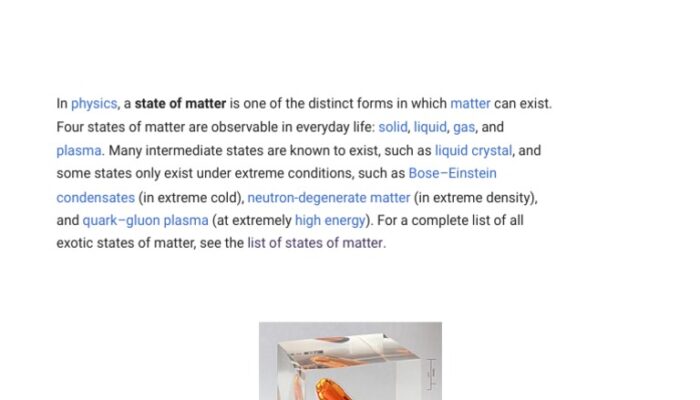
Matter has conventionally been divided into four primary categories: solids, liquids, gases, and plasma. These states are distinguished by their distinct physical properties and behaviors under various conditions. However, advances in quantum mechanics and thermodynamics have revealed a spectrum of unconventional states that defy these classical boundaries.
- Solids:
Characterized by fixed shapes and volumes due to tightly packed particles. - Liquids:
Possess definite volume but adapt their shape to containers. - Gases:
Expand to fill available space with particles in constant, random motion. - Plasma:
Ionized gases with free electrons, exhibiting unique electromagnetic properties.
Emergence of Novel Quantum States
Recent research has uncovered states of matter that arise from complex quantum interactions, often under extreme or finely tuned conditions. These exotic phases challenge the classical thermodynamic framework and open new avenues for understanding the fundamental nature of matter.
Time Crystals: A New Temporal Order
One of the most groundbreaking discoveries is the concept of time crystals. Unlike ordinary crystals, which exhibit periodic patterns in space, time crystals display a repeating structure in time. This means they oscillate indefinitely without energy input, seemingly violating traditional thermodynamic equilibrium principles.
Time crystals have been experimentally realized by manipulating quantum bits (qubits) subjected to periodic external forces. This temporal periodicity mirrors the spatial periodicity of conventional crystals but occurs along the time axis, prompting a reevaluation of energy conservation laws and the nature of time itself.
Quantum Spin Liquids: Magnetic Disorder at Absolute Zero
Another fascinating state is the quantum spin liquid, which emerges from strong magnetic interactions. Unlike typical magnetic solids that exhibit ordered spin alignment, quantum spin liquids maintain a disordered, fluid-like spin configuration even at temperatures approaching absolute zero. This defies the classical expectation of magnetic order in such conditions.
Predicted theoretically and observed in certain organic compounds, quantum spin liquids exhibit complex phenomena such as entanglement and fractionalization. These properties suggest potential applications in developing novel materials and quantum technologies.
Quantum Foam: The Fabric of Spacetime
At the intersection of quantum mechanics and cosmology lies the concept of quantum foam. This theory proposes that at incredibly small scales, spacetime is not smooth but instead fluctuates dynamically, resembling a frothy, turbulent foam. Such a model challenges the classical view of spacetime as a continuous fabric and has profound implications for understanding black holes and the universe’s fundamental structure.
Mechanisms Behind Exotic Matter States
The formation of these unconventional states is deeply rooted in quantum mechanical principles and thermodynamic interactions. For instance, time crystals rely on periodic driving forces that induce temporal symmetry breaking, while quantum spin liquids result from frustrated magnetic interactions preventing conventional ordering.
Mathematical Framework and Formulas
The behavior of these states can be described using advanced quantum mechanical models:
- Time Crystals:
Governed by Floquet theory, where the system’s Hamiltonian ( H(t) ) is periodic in time: ( H(t + T) = H(t) ). The system exhibits discrete time-translation symmetry breaking. - Quantum Spin Liquids:
Modeled using spin Hamiltonians such as the Heisenberg model with frustration terms, e.g., ( H = J sum_{langle i,j rangle} mathbf{S}_i cdot mathbf{S}_j + text{frustration terms} ), where ( J ) is the exchange interaction and ( mathbf{S}_i ) are spin operators. - Quantum Foam:
Described conceptually through quantum gravity frameworks, where spacetime metrics fluctuate at the Planck scale (( sim 10^{-35} ) meters).
Practical Implications and Applications
The discovery of these exotic states is not purely theoretical; they hold promise for transformative technological advancements:
- Quantum Computing:
Time crystals could enhance quantum coherence times, potentially improving error correction and stability in quantum processors. - Material Science:
Quantum spin liquids may lead to the development of materials with novel magnetic and electronic properties, useful in next-generation electronics. - Fundamental Physics:
Understanding quantum foam could provide insights into quantum gravity and the unification of general relativity with quantum mechanics.
Addressing Common Misunderstandings
- Misconception: Time crystals violate the law of energy conservation.
Correction: Time crystals do not create energy; their oscillations occur without energy input due to non-equilibrium conditions and periodic driving forces. - Misconception: Quantum spin liquids are simply disordered magnets.
Correction: They represent a highly entangled quantum state with no long-range magnetic order, distinct from classical magnetic disorder. - Misconception: Quantum foam is purely speculative with no experimental basis.
Correction: While direct observation is challenging, quantum foam is supported by theoretical models and indirect evidence from high-energy physics and cosmology.
Significance in Science and Technology
These newly identified states of matter expand our comprehension of the physical universe, challenging established theories and inspiring innovative research. Their study not only deepens fundamental physics but also drives technological progress, particularly in quantum information science and advanced materials. Embracing these discoveries encourages a dynamic scientific mindset, ready to adapt and evolve with emerging knowledge.
Future Directions and Exploration
As experimental techniques and theoretical models continue to advance, the landscape of condensed matter physics is poised for further groundbreaking revelations. The ongoing investigation into exotic states like time crystals, quantum spin liquids, and quantum foam underscores the vastness of the unknown and the potential for revolutionary insights into the nature of reality.
FAQ
What are time crystals?
Time crystals are states of matter that exhibit periodic structure in time, oscillating indefinitely without energy input.
What is a quantum spin liquid?
A quantum spin liquid is a state of matter that maintains a disordered spin configuration even at absolute zero temperature.
What is quantum foam?
Quantum foam refers to the idea that spacetime is not smooth at extremely small scales, resembling a fluctuating foam.



Leave a Reply