
Short Answer
Definition of E8 Symmetry
E8 symmetry is a highly intricate and exceptional mathematical structure classified within the realm of Lie groups and algebraic geometry. It is renowned for its extraordinary complexity, encompassing 248 dimensions, making it one of the most sophisticated symmetrical objects studied in mathematics and theoretical physics. Lie groups like E8 provide essential frameworks for describing symmetries that govern particle interactions and fundamental forces in the universe.
- Lie Groups:
Continuous groups that describe symmetries in mathematical physics, crucial for understanding particle behavior and force interactions. - E8 Characteristics:
A unique, highly symmetrical structure with 248 dimensions, representing one of the largest and most complex exceptional Lie groups.
Ultracold Magnets: An Overview
Ultracold magnets are materials cooled to temperatures approaching absolute zero, where thermal agitation is minimized, allowing quantum mechanical phenomena to dominate. At these extremely low temperatures, magnetic properties exhibit unusual behaviors, such as quantum entanglement and novel spin interactions. These conditions enable the study of exotic phases of matter, including spin liquids and topological states, which are otherwise inaccessible at higher temperatures.
- Temperature Effects:
Near absolute zero, thermal fluctuations are suppressed, revealing quantum effects in magnetic systems. - Quantum Phenomena:
Enhanced quantum entanglement and spin dynamics emerge, facilitating the exploration of new magnetic phases.
Interconnection Between E8 Symmetry and Ultracold Magnets
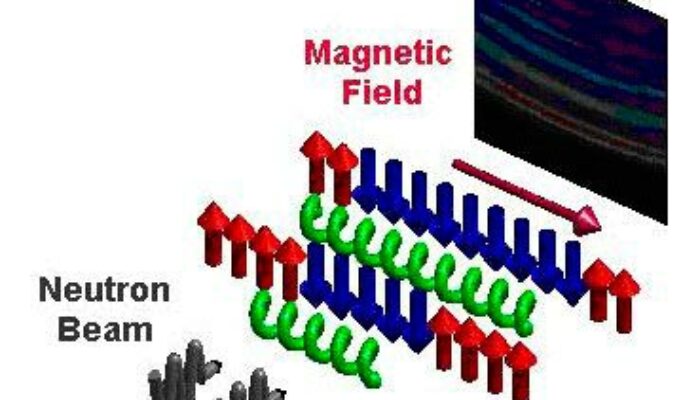
The recent discovery of E8 symmetry within ultracold magnetic systems bridges abstract mathematical theory and experimental physics. This connection suggests that ultracold magnets can serve as physical platforms to observe and analyze the complex symmetries described by E8, providing insights into the fundamental principles that govern quantum matter. Such findings have profound implications for both theoretical understanding and practical applications, including advancements in quantum computing.
Magnetic Ordering and Ground States
In ultracold magnets exhibiting E8 symmetry, the magnetic moments of particles interact to form highly ordered ground states. Unlike conventional localized magnetic order, these systems display global patterns governed by affine group dynamics, where the symmetry extends throughout the entire material. This global magnetic ordering allows multiple magnetic phases to coexist, revealing the rich complexity of E8 symmetry in physical systems.
Temperature, Fluctuations, and Phase Transitions
Close to critical phase transitions, thermal energy induces complex magnetic fluctuations that resonate with the stability properties of E8 symmetry. This symmetry provides robustness against perturbations, enabling many-body quantum interactions to thrive. Understanding this interplay enhances theoretical models and guides experimental efforts to realize materials with highly symmetric magnetic phases.
Experimental Realization and Techniques
Empirical studies of E8 symmetry in ultracold magnets utilize advanced experimental setups such as optical lattices and magnetic traps. These tools allow precise manipulation of external parameters, enabling researchers to finely tune magnetic interactions and observe emergent phenomena associated with E8. Measurements of magnetization, susceptibility, and other observables help identify the unique signatures of E8 symmetry under varying conditions, demonstrating the synergy between theoretical predictions and laboratory findings.
Implications for Physics and Technology
The manifestation of E8 symmetry in ultracold magnets extends beyond pure scientific curiosity, offering promising avenues for technological innovation. In quantum information science, materials with E8 symmetry may support zero-energy localized states that enhance the stability and coherence of qubits, essential for fault-tolerant quantum computing. This integration of complex symmetry into material design paves the way for novel quantum devices and improved information processing techniques.
Broader Significance in Theoretical Physics
Beyond condensed matter physics, E8 symmetry holds potential significance in unifying fundamental forces and understanding the fabric of spacetime. The exceptional symmetry properties of E8 may contribute to reconciling discrepancies between general relativity and quantum mechanics, offering a unified framework for high-energy physics and cosmology. Investigations into E8 could illuminate the underlying structure of the universe at both microscopic and cosmological scales.
Common Misconceptions About E8 Symmetry
E8 symmetry is purely a mathematical curiosity with no physical relevance.
Recent experimental evidence in ultracold magnets demonstrates that E8 symmetry can manifest in tangible physical systems, linking abstract mathematics to observable phenomena.
Ultracold magnets are only of interest for low-temperature physics.
Ultracold magnets provide a unique platform to explore fundamental quantum symmetries like E8, with implications for quantum computing and high-energy physics.
Why Understanding E8 Symmetry Matters
Grasping the nature of E8 symmetry enriches our comprehension of the fundamental laws that govern the universe. It deepens insights into complex magnetic interactions and quantum phases, while also driving forward experimental and theoretical research. The discovery of E8 symmetry in ultracold magnets exemplifies the profound interplay between mathematics and physics, opening new frontiers in technology and expanding our understanding of reality at its most fundamental level.
FAQ
What is E8 symmetry?
E8 symmetry is a highly intricate mathematical structure with 248 dimensions, important in the study of particle interactions.
Why are ultracold magnets significant?
Ultracold magnets exhibit unique quantum phenomena that can help in understanding complex magnetic interactions and advancing technology.
How does E8 symmetry relate to ultracold magnets?
Recent discoveries show that E8 symmetry can manifest in ultracold magnets, bridging theoretical concepts with experimental observations.



Leave a Reply