
Short Answer
Understanding Magnetic Domain Walls
Magnetic domain walls are narrow transition zones separating regions within a magnetic material where the magnetic moments are uniformly aligned but oriented differently from one domain to the next. These boundaries play a critical role in the magnetic behavior of materials, influencing how magnetic information is stored and manipulated. Their unique physical characteristics and dynamic responses to external magnetic fields make them essential components in technologies such as magnetic memory devices, spintronic applications, and magnetic switches.
- Definition:
Magnetic domain walls are interfaces between domains with distinct magnetic orientations. - Functionality:
They enable the movement and reconfiguration of magnetic states under applied fields. - Technological relevance:
Their controlled manipulation is vital for data storage and magnetic logic devices.
Challenges in Observing Domain Walls
Due to their nanoscale size and the complexity of the surrounding magnetic environment, directly imaging and characterizing magnetic domain walls has historically been a formidable challenge. Conventional microscopy techniques often lack the resolution or sensitivity required to capture the subtle variations in magnetic orientation at these boundaries, limiting the ability to study their behavior in detail.
Diamond Defects as a Novel Imaging Tool
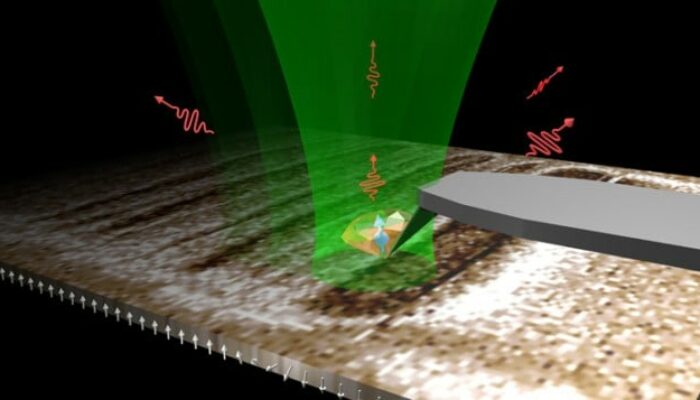
Recent breakthroughs have introduced the use of diamond defects, specifically nitrogen-vacancy (NV) centers, as highly sensitive probes for magnetic imaging. Synthetic diamonds can be engineered to contain these NV centers, which exhibit exceptional sensitivity to local magnetic fields. When integrated with ferromagnetic materials, NV centers interact with the magnetic environment, enabling researchers to visualize domain walls with remarkable spatial resolution and clarity.
- Nitrogen-Vacancy Centers:
Atomic-scale defects in diamond that respond to magnetic fields through changes in their spin states. - Imaging Capability:
NV centers allow for nanoscale mapping of magnetic fields via spin-dependent photoluminescence. - Advantages:
High thermal stability and compatibility with various magnetic materials enhance their utility.
Techniques for Imaging Magnetic Domain Walls Using NV Centers
The imaging process leverages a combination of electron spin resonance (ESR) and optical methods. NV centers exhibit spin-dependent photoluminescence, meaning their emitted light intensity varies with the local magnetic field. By measuring these variations, scientists can construct detailed images of the magnetic landscape, revealing both the position and dynamic behavior of domain walls at the nanoscale.
- Electron Spin Resonance (ESR):
Used to manipulate and detect the spin states of NV centers. - Optical Detection:
Photoluminescence intensity changes provide a direct readout of magnetic field variations. - Data Correlation:
The linear relationship between emitted light and magnetic state enables precise mapping.
Implications for Magnetic Research and Technology
The ability to visualize magnetic domain walls with such precision opens new pathways for both theoretical and experimental advancements. The detailed empirical data can refine existing models of domain wall dynamics and stability under varying conditions, such as temperature and magnetic field strength. Experimentally, this enhanced insight facilitates the design of materials with tailored magnetic properties, potentially accelerating innovations in quantum computing, high-density data storage, and spintronic devices.
Reevaluating the Role of Defects in Materials Science
Traditionally, defects in crystal lattices have been viewed as detrimental to material performance. However, the successful application of diamond NV centers to probe magnetic phenomena challenges this notion. Instead of being mere imperfections, these defects can serve as powerful tools for investigating and manipulating material properties, suggesting a paradigm shift in how defects are perceived and utilized in solid-state physics and materials engineering.
Future Directions and Open Questions
As research progresses, several intriguing questions emerge regarding the broader applicability of defect-based imaging techniques. Could similar approaches be adapted to study other complex materials, such as superconductors or ferroelectrics? What insights might this provide into exotic magnetic structures like skyrmions, which hold promise for next-generation data storage technologies? Exploring these avenues could significantly deepen our understanding of condensed matter systems and inspire novel technological applications.
Significance of Diamond Defect Imaging in Magnetism
The integration of diamond defect technology with magnetic domain wall research exemplifies the dynamic evolution of condensed matter physics. This innovative approach not only enhances our fundamental comprehension of magnetism at the nanoscale but also paves the way for transformative technological breakthroughs. By enabling precise control and visualization of magnetic states, diamond NV centers are poised to become indispensable tools in the development of future magnetic and quantum devices.
FAQ
What are magnetic domain walls?
Magnetic domain walls are narrow transition zones that separate regions within a magnetic material where the magnetic moments are aligned differently.
How do nitrogen-vacancy centers help in imaging magnetic domain walls?
NV centers in diamonds respond to local magnetic fields, allowing for high-resolution imaging of magnetic domain walls.
What implications does this research have?
It could lead to advancements in data storage technologies and a deeper understanding of magnetism in condensed matter physics.



Leave a Reply