
Short Answer
Definition of the Atomic Nucleus
The atomic nucleus is a central, dense region within an atom, composed primarily of protons and neutrons, collectively known as nucleons. Despite the positive charges of protons, which naturally repel each other due to electromagnetic forces, the nucleus remains intact. This stability arises from a complex balance of fundamental forces that govern the interactions between nucleons, ensuring the cohesion of the nucleus.
Fundamental Forces Governing the Nucleus
The Strong Nuclear Force
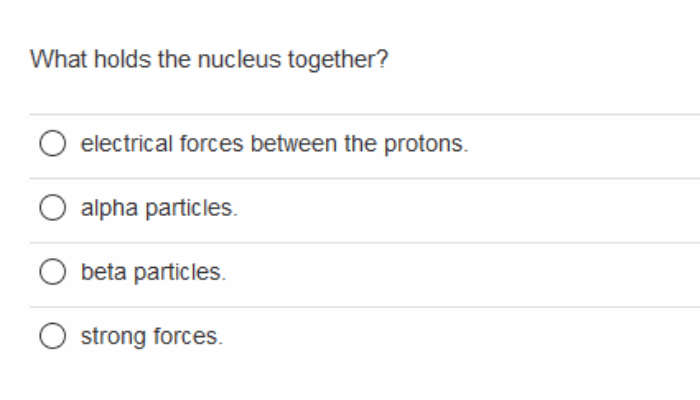
The dominant force responsible for holding the nucleus together is the strong nuclear force. Operating over extremely short distances-on the scale of femtometers (1 femtometer = 10-15 meters)-this force is immensely powerful, effectively counteracting the electromagnetic repulsion between protons. It is mediated by gluons, which bind quarks inside protons and neutrons. Each nucleon consists of three quarks held together by gluon exchange, and the strong force extends beyond individual nucleons to bind them collectively within the nucleus.
The Weak Nuclear Force
In contrast to the strong force, the weak nuclear force plays a subtler but crucial role in nuclear processes. It governs phenomena such as beta decay, where a neutron transforms into a proton or vice versa, facilitating changes in the nucleus’s composition. Although weaker than the strong force, the weak interaction is essential for nuclear transmutations and influences the stability of isotopes by enabling radioactive decay pathways.
Nuclear Binding Energy and Mass Defect
Understanding Binding Energy
Nuclear binding energy is the energy required to separate a nucleus into its individual protons and neutrons. This energy arises from the strong nuclear force acting between nucleons and serves as a measure of nuclear stability. Nuclei with higher binding energies per nucleon, such as iron-56, are more stable and less prone to radioactive decay. Conversely, nuclei with lower binding energies tend to be unstable and more likely to undergo decay.
Mass Defect Explained
The concept of mass defect is closely linked to binding energy. According to Einstein’s mass-energy equivalence principle (E=mc2), the total mass of a nucleus is less than the sum of the masses of its constituent nucleons. This difference in mass, known as the mass defect, corresponds to the energy released when nucleons bind together. The mass defect quantitatively reflects the binding energy and highlights the intrinsic relationship between mass and energy in nuclear physics.
Models of Nuclear Structure
The Liquid Drop Model
This model conceptualizes the nucleus as a droplet of incompressible fluid, emphasizing the collective behavior of nucleons. It accounts for factors such as surface tension and volume energy, which influence the overall binding energy and stability of the nucleus. The liquid drop model helps explain phenomena like nuclear fission and the energy released during nuclear reactions.
The Shell Model
The shell model describes nucleons as occupying discrete energy levels within the nucleus, similar to electrons in atomic orbitals. This framework explains the existence of “magic numbers” – specific numbers of protons or neutrons that result in exceptionally stable nuclei. The shell model provides insight into nuclear stability patterns and the arrangement of nucleons within the nucleus.
Factors Influencing Nuclear Stability
The stability of a nucleus depends on several key factors, including the neutron-to-proton ratio. Stable nuclei generally maintain a balanced ratio, while an excess of neutrons or protons can lead to instability and radioactive decay. Common decay modes include alpha decay, beta decay, and gamma decay, each representing different pathways through which unstable nuclei achieve more stable configurations.
Applications and Significance of Nuclear Stability
Understanding the forces that maintain nuclear cohesion is critical not only for theoretical physics but also for practical applications. Insights into nuclear stability underpin the development of nuclear power, nuclear weapons, and medical technologies such as radiation therapy for cancer treatment. Moreover, studying nuclear forces enhances our comprehension of the universe’s fundamental structure, as atomic interactions shape the matter that constitutes all known cosmic phenomena.
Summary
The atomic nucleus’s stability is the result of a delicate balance between the strong nuclear force, the weak nuclear force, and the energy dynamics described by binding energy and mass defect. These interrelated factors explain how nucleons remain bound despite electromagnetic repulsion and provide a foundation for understanding nuclear reactions, decay processes, and the broader implications for science and technology.
FAQ
What is the strong nuclear force?
The strong nuclear force is the dominant force that holds the atomic nucleus together, counteracting the electromagnetic repulsion between protons.
What is nuclear binding energy?
Nuclear binding energy is the energy required to separate a nucleus into its individual protons and neutrons, indicating nuclear stability.
What is mass defect?
Mass defect is the difference between the total mass of a nucleus and the sum of its individual nucleons’ masses, reflecting the energy released during nucleon binding.





Leave a Reply