
Short Answer
Definition of Particle Accelerators
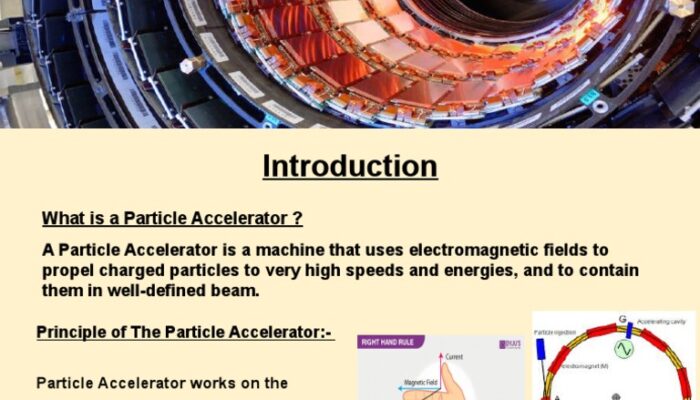
Particle accelerators are advanced scientific instruments designed to propel charged particles, such as protons and electrons, to extremely high velocities-often approaching the speed of light. These devices function as experimental platforms where the fundamental constituents of matter are examined under conditions that mimic the early universe or extreme cosmic events. By accelerating particles to immense energies and facilitating their collisions, accelerators enable researchers to explore the underlying principles of physics and uncover new particles and forces.
Fundamental Principles of Particle Acceleration
The operation of particle accelerators is grounded in the concept of imparting kinetic energy to subatomic particles through electromagnetic fields. Analogous to a race car accelerating from the starting line, particles are injected into the accelerator and guided by precisely controlled magnetic and electric fields. These fields work in concert to increase the particles’ momentum, orchestrating their movement in a highly coordinated manner that maximizes energy gain.
Types and Pathways of Particle Accelerators
Particle accelerators typically employ either circular or linear trajectories to boost particle energies:
- Circular Accelerators:
In devices such as the Large Hadron Collider (LHC), particles travel along a closed-loop path. Magnetic fields continuously steer and accelerate the particles as they orbit, allowing them to reach velocities exceeding 99.99% of the speed of light. This circular motion can be likened to a cosmic carousel, where particles revolve endlessly under the influence of electromagnetic forces. - Linear Accelerators:
In contrast, linear accelerators propel particles along a straight path, using a series of electric fields to incrementally increase their speed before collision or experimentation.
Mechanism of Particle Collisions
Once particles attain their peak velocities, they are synchronized to collide with one another. These high-energy impacts resemble cosmic events such as star collisions, producing conditions that allow scientists to probe the fundamental structure of matter. The collisions generate a variety of short-lived particles, providing a snapshot of the quantum realm and revealing phenomena that are otherwise inaccessible.
Energy-Mass Transformation in Collisions
The interactions during particle collisions are governed by Einstein’s mass-energy equivalence principle, expressed by the equation E=mc². This relationship illustrates that energy can be converted into mass and vice versa. In the context of particle physics, the immense energy released during collisions can materialize as new, exotic particles that exist only momentarily before decaying. This dynamic transformation highlights the ever-changing nature of matter and energy in the universe.
Significance of the Higgs Boson Discovery
One of the landmark achievements facilitated by particle accelerators is the detection of the Higgs boson, often referred to as the “God particle.” The Higgs boson is associated with the Higgs field, which imparts mass to fundamental particles. The discovery of this particle validated a crucial component of the Standard Model of particle physics and represented a monumental milestone in humanity’s quest to comprehend the origins of mass and the fabric of reality.
Exploring New Frontiers in Physics
Particle accelerators serve as portals to previously uncharted territories in physics. By generating particles that exist for infinitesimal durations, these machines enable the study of exotic states of matter such as quark-gluon plasma-a form of matter believed to have existed shortly after the Big Bang. Additionally, accelerators provide opportunities to investigate theoretical particles predicted by extensions of the Standard Model, including supersymmetric particles, which could revolutionize our understanding of the universe.
Practical Applications Beyond Fundamental Research
Beyond their role in advancing theoretical physics, particle accelerators have significant practical applications. The synchrotron radiation emitted by accelerated charged particles is harnessed in various fields:
- Medicine:
Techniques such as advanced medical imaging and targeted cancer therapies benefit from the precise radiation produced in accelerators. - Materials Science:
Researchers use synchrotron light to analyze the atomic and molecular structure of materials, enabling innovations in nanotechnology and engineering. - Industry and Academia:
Accelerators provide tools for probing the microscopic properties of substances, facilitating breakthroughs across multiple scientific disciplines.
Common Misconceptions About Particle Accelerators
Particle accelerators create dangerous black holes.
The energies produced, while immense on a subatomic scale, are insufficient to generate black holes or pose any threat to Earth.
Accelerators only serve theoretical physics.
They have broad practical applications in medicine, industry, and technology, impacting everyday life.
Importance of Particle Accelerators in Science and Society
Particle accelerators represent a pinnacle of human ingenuity and scientific endeavor. They not only deepen our understanding of the universe’s fundamental laws but also drive technological advancements that improve health, industry, and knowledge. By enabling the exploration of questions about the nature of reality and the forces that govern existence, these instruments embody humanity’s relentless pursuit of discovery and enlightenment.
FAQ
What is a particle accelerator?
A particle accelerator is a device that propels charged particles to high speeds for scientific research.
What are the main types of particle accelerators?
The main types are circular accelerators, like the Large Hadron Collider, and linear accelerators.
What are the practical applications of particle accelerators?
They are used in medicine for imaging and cancer therapies, materials science, and various industrial applications.






Leave a Reply