

Short Answer
Overview of Particle Physics and Astrophysics
Particle physics and astrophysics are two captivating branches of physics that explore the universe from vastly different scales yet remain deeply interconnected. While particle physics investigates the smallest building blocks of matter, astrophysics examines the grandest cosmic structures and phenomena. Together, these disciplines address fundamental questions about the universe’s composition, the forces governing it, and the underlying nature of reality.
Fundamentals of Particle Physics
Particle physics focuses on identifying and understanding the elementary particles that constitute all matter. At the subatomic level, particles such as quarks and leptons form the foundation of the material world. Quarks combine to create protons and neutrons, which in turn make up atomic nuclei, while leptons include electrons and neutrinos. The Standard Model serves as the theoretical framework describing these particles and three of the four fundamental forces: electromagnetism, the weak nuclear force, and the strong nuclear force.
Key Questions in Particle Physics
- Origin of Mass:
Why do particles have mass? The discovery of the Higgs boson, often called the “God particle,” provided insight into this question by confirming the Higgs mechanism, which endows particles with mass. - Particle Interactions:
What governs the interactions between elementary particles? Understanding these forces is crucial for explaining the behavior of matter at the smallest scales.
Experimental Advances: The Large Hadron Collider
The Large Hadron Collider (LHC) at CERN is a pivotal facility where protons are accelerated to velocities near the speed of light and collided. These high-energy collisions simulate conditions similar to those just after the Big Bang, enabling physicists to probe the fundamental properties of matter and energy. Research at the LHC extends beyond validating theoretical models; it also explores mysteries such as dark matter, which constitutes about 27% of the universe but remains undetected, and the asymmetry between matter and antimatter, which challenges current understanding and suggests physics beyond the Standard Model.
Astrophysics: Exploring the Universe at Large
Astrophysics investigates celestial phenomena and the large-scale structure of the cosmos. This field studies stars, galaxies, black holes, and cosmic background radiation to understand the universe’s evolution and composition. A central focus is stellar nucleosynthesis, the process by which stars generate heavier elements from primordial hydrogen and helium formed shortly after the Big Bang.
Black Holes and Their Mysteries
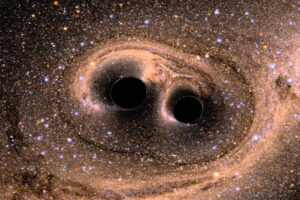
Black holes are regions in space-time with gravitational pulls so strong that nothing, not even light, can escape. They challenge conventional physics and prompt investigations into the nature of space, time, and singularities. The interplay between Einstein’s general relativity and quantum mechanics is crucial in addressing paradoxes such as the information loss problem, raising profound questions about the fabric of reality.
Gravitational Waves and Multi-Messenger Astronomy
First observed in 2015, gravitational waves are ripples in space-time predicted by Einstein’s theory of general relativity. These waves provide a revolutionary method for detecting cosmic events like black hole and neutron star mergers. The advent of gravitational wave astronomy has fostered multi-messenger approaches, combining gravitational data with electromagnetic signals to offer a more complete understanding of astrophysical phenomena.
Interconnection Through Cosmic Rays
Cosmic rays, high-energy particles originating from sources such as supernovae and active galactic nuclei, form a bridge between particle physics and astrophysics. These particles, which include protons, heavier nuclei, and possibly exotic particles, bombard Earth’s atmosphere at incredible speeds. Studying cosmic rays allows scientists to explore physics beyond terrestrial experiments and gain insights into the fundamental forces and particles that permeate the universe.
Emerging Interdisciplinary Frontiers
The convergence of particle physics and astrophysics has given rise to interdisciplinary fields like quantum gravity, which aims to unify quantum mechanics with general relativity. This collaboration among physicists, cosmologists, and mathematicians exemplifies the complex and profound nature of questions these sciences seek to answer, fostering innovative approaches and expanding our understanding of the cosmos.
Significance and Impact
The exploration of particle physics and astrophysics is central to humanity’s quest to comprehend the universe and our place within it. These fields tackle essential questions about existence, the fundamental forces, and the structure of reality. As technological advancements continue and scientific boundaries blur, the insights gained from these disciplines promise to deepen our knowledge and inspire future discoveries that could transform science and technology.
FAQ
What is particle physics?
Particle physics is the branch of physics that studies the fundamental particles and the forces that govern their interactions.
What does astrophysics study?
Astrophysics examines celestial objects and phenomena in the universe, including stars, galaxies, black holes, and cosmic radiation.
How are particle physics and astrophysics related?
Both fields intersect in studying the fundamental nature of the universe, from subatomic particles to cosmic structures, often collaborating on topics like dark matter and cosmic rays.
What is the significance of the Higgs boson?
The Higgs boson is a particle that provides mass to other particles through the Higgs mechanism, a key element of the Standard Model.
What are gravitational waves?
Gravitational waves are ripples in space-time caused by massive cosmic events, such as merging black holes or neutron stars, confirming predictions made by Einstein's theory of general relativity.




Leave a Reply