
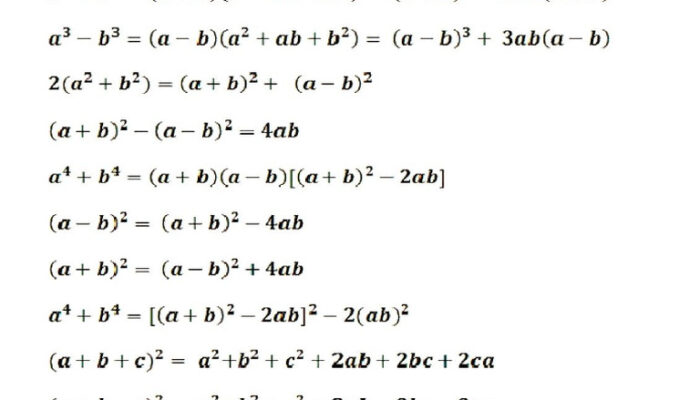
Short Answer
Definition of Self-Made Formulas in Mathematics
Self-made formulas are unique mathematical expressions crafted by individuals based on their personal understanding and insights into specific problems. Unlike universally accepted formulas, these personalized constructs allow for tailored approaches that reflect the context and nuances of particular mathematical challenges. They serve as innovative tools that extend beyond traditional methods, enabling deeper engagement with mathematical concepts.
Foundations and Creation Process
Developing a self-made formula begins with a solid grasp of fundamental mathematical principles. This involves analyzing existing theories, theorems, and standard formulas to identify core elements that can be adapted or restructured. For example, by examining the quadratic formula, one can explore alternative forms or applications that suit different problem settings. This process of deconstruction and reassembly fosters a more profound comprehension of the underlying mathematics.
Algebraic Innovations
In algebra, self-made formulas often arise from modifying known identities to fit unique scenarios. Consider the Pythagorean theorem: while it is a staple in Euclidean geometry, a mathematician might develop a customized version incorporating variables that address specific constraints or conditions. Such adaptations enable the formula to solve problems that classical versions may not directly cover.
Calculus and Personalized Applications
Calculus offers fertile ground for creating individualized formulas, especially through differentiation. By contextualizing functions within real-world problems-such as optimizing production processes-one can derive formulas tailored to capture the precise rates of change relevant to those situations. This blend of theoretical knowledge and practical application exemplifies how self-made formulas bridge abstract concepts with tangible outcomes.
Statistical Customization
In statistics, crafting custom formulas can enhance data interpretation. For instance, a unique formula might be designed to calculate averages that better account for outliers than traditional measures like standard deviation. Incorporating weighted averages or additional parameters can provide a more nuanced understanding of data sets, transforming the formula into a powerful analytical lens.
Mechanism Behind Self-Made Formulas
The creation of self-made formulas involves a cycle of observation, hypothesis, and validation. Initially, one identifies the problem’s specific requirements and constraints. Then, by manipulating known mathematical components or inventing new relationships, a formula is constructed to address these needs. Finally, rigorous testing against established problems ensures the formula’s accuracy and reliability, confirming its practical utility.
Benefits of Developing Personal Formulas
- Enhanced Understanding:
Crafting formulas deepens comprehension of mathematical principles by encouraging active engagement rather than passive memorization. - Creative Problem-Solving:
It nurtures innovation, allowing individuals to approach challenges from fresh perspectives. - Contextual Adaptability:
Personalized formulas can be tailored to specific scenarios, making them more effective in real-world applications. - Collaborative Growth:
Sharing and refining formulas within academic or peer groups fosters collective advancement and diverse insights.
Encouraging Innovation Through Collaboration
Collaboration plays a pivotal role in the evolution of self-made formulas. Engaging with peers through discussions, joint problem-solving, and idea exchange can spark novel approaches and refinements. This communal environment acts as a catalyst for creativity, highlighting the interconnected nature of mathematical discovery and emphasizing that innovation often flourishes through shared efforts.
Common Misconceptions About Self-Made Formulas
Self-made formulas lack rigor and are unreliable.
When properly tested and validated, these formulas adhere to mathematical standards and can be as dependable as traditional ones.
Only experts can create effective formulas.
With foundational knowledge and curiosity, learners at various levels can develop meaningful and useful formulas.
Established formulas are always superior.
Personalized formulas can offer advantages in specific contexts where standard formulas may fall short.
Real-World Applications of Self-Made Formulas
Self-made formulas find practical use across diverse fields:
- Engineering:
Custom formulas optimize design parameters tailored to unique project requirements. - Economics:
Personalized models analyze market trends considering specific variables not covered by standard equations. - Data Science:
Tailored statistical measures improve data interpretation by addressing dataset peculiarities. - Education:
Students develop formulas to better understand and solve problems, enhancing learning outcomes.
Importance of Self-Made Formulas in Mathematics and Beyond
Self-made formulas represent a shift from passive learning to active creation, fostering ownership and confidence in mathematical exploration. They encourage a mindset that values innovation and adaptability, essential traits in scientific research, technology development, and everyday problem-solving. By embracing this approach, individuals contribute to the dynamic evolution of mathematics, enriching the discipline with fresh perspectives and practical solutions.
FAQ
What is a self-made formula in mathematics?
A self-made formula is a mathematical expression created by an individual based on their understanding to solve specific problems or tailor existing formulas.
How do self-made formulas differ from standard formulas?
Standard formulas are universally accepted and widely used, while self-made formulas are personalized adaptations or new constructs for specific contexts.
Why is validation important for self-made formulas?
Validation ensures that the formula produces accurate and reliable results consistent with mathematical principles.
Can self-made formulas contribute to formal mathematics?
Yes, if rigorously tested and proven valid, they can offer new insights and methods within mathematical research.
How can I start creating my own formulas?
Begin by thoroughly understanding existing formulas and principles, then experiment with adapting or combining them to suit specific problems.





Leave a Reply