
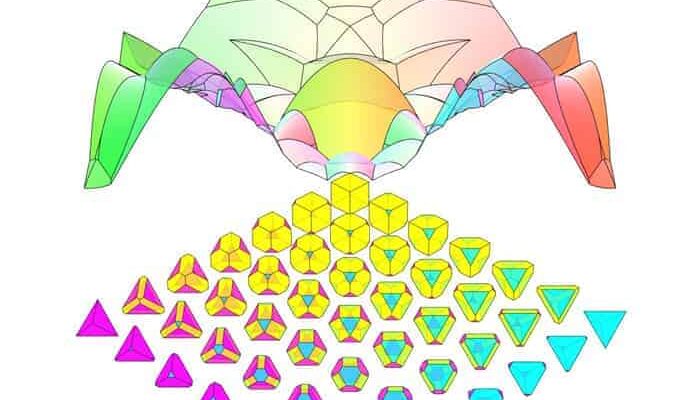
Short Answer
Definition of Polyhedral Packing
Polyhedral packing refers to the study and arrangement of three-dimensional solid shapes known as polyhedra within a confined space, aiming to maximize the occupied volume without any overlaps. Polyhedra are geometric solids characterized by flat polygonal faces, straight edges, and vertices. These shapes range from simple convex forms like cubes and regular tetrahedra to more intricate structures such as truncated icosahedrons. Each variety introduces distinct challenges and opportunities when it comes to their spatial organization.
- Polyhedra:
Solid figures bounded by flat polygonal faces. - Packing Density:
The ratio of the volume occupied by polyhedra to the total available volume. - Regular vs. Irregular Packing:
Regular packing involves congruent shapes arranged in repeating patterns, while irregular packing deals with variations in size and shape.
Mathematical Foundations and Theoretical Frameworks
The mathematical investigation of polyhedral packing primarily draws from discrete geometry and combinatorial optimization. The simplest scenario involves identical polyhedra arranged in uniform lattices, such as cubes stacked perfectly to fill space with 100% efficiency. However, when dealing with non-identical or irregular polyhedra, the problem becomes significantly more complex, requiring advanced mathematical tools and computational methods to approximate optimal configurations.
Computational Techniques in Polyhedral Packing
Modern research leverages computational algorithms to explore and optimize polyhedral arrangements. Methods such as Monte Carlo simulations, genetic algorithms, and various optimization models are instrumental in tackling complex packing problems that lack closed-form analytical solutions. These approaches enable the exploration of vast configuration spaces, especially for irregular or heterogeneous polyhedral sets.
Packing Density and Its Significance
Packing density quantifies how efficiently polyhedra fill a given volume, minimizing the interstitial voids or empty spaces between units. High packing densities are desirable in many applications, as they reflect optimal use of space. Although sphere packing is a classical problem distinct from polyhedral packing, its principles regarding volume occupation and spatial efficiency provide valuable insights applicable to polyhedral arrangements.
Types of Polyhedral Packing
- Regular Packing:
Involves identical polyhedra arranged in repeating, congruent patterns, often yielding high theoretical packing densities. - Irregular Packing:
Accounts for variations in shape and size, reflecting more realistic scenarios such as nanoparticle aggregation or cargo storage, where adaptability is crucial despite potentially lower packing efficiencies.
Applications Across Disciplines
The principles of polyhedral packing extend far beyond theoretical geometry, impacting numerous scientific and industrial fields:
- Materials Science:
Understanding nanoscale polyhedral aggregation aids in designing materials with specific properties, influencing catalysis, semiconductor manufacturing, and composite development. - Logistics and Storage:
Efficient packing strategies optimize cargo arrangement in shipping containers, enhancing load capacity and reducing transportation costs. - Advanced Manufacturing:
Innovations in 3D printing and computer-aided design enable the fabrication of complex polyhedral structures, facilitating experimental designs and practical implementations.
Technological Innovations Enhancing Polyhedral Packing
Recent advancements in parametric modeling and machine learning have revolutionized the study of polyhedral packing. Parametric design tools allow for extensive geometric experimentation, fostering the discovery of novel packing configurations. Meanwhile, machine learning algorithms analyze large datasets to uncover hidden patterns and develop heuristic solutions, improving upon traditional optimization techniques and expanding the scope of feasible packing arrangements.
Challenges and Ongoing Research
Despite progress, several obstacles remain in the field of polyhedral packing. The phenomenon of jamming-where particles become locked in place, preventing further optimization-poses significant difficulties in achieving ideal arrangements without compromising structural stability. Additionally, as packing problems grow in complexity, the computational demands escalate, necessitating the development of more efficient algorithms and innovative problem-solving strategies.
Importance and Future Directions
The study of polyhedral packing is a multidisciplinary endeavor with profound implications for both theoretical understanding and practical applications. By refining packing techniques and expanding knowledge of spatial arrangements, ongoing research promises to unlock new capabilities in material design, logistics, and manufacturing. The future of this field holds the potential to transform diverse technological and scientific domains through enhanced efficiency and novel structural insights.
FAQ
What is the significance of packing density?
Packing density measures how efficiently polyhedra fill a volume, with higher densities indicating better space utilization.
What challenges exist in polyhedral packing?
Challenges include jamming and the complexity of computational demands for optimal arrangements.





Leave a Reply