
Short Answer
Understanding Dark Matter
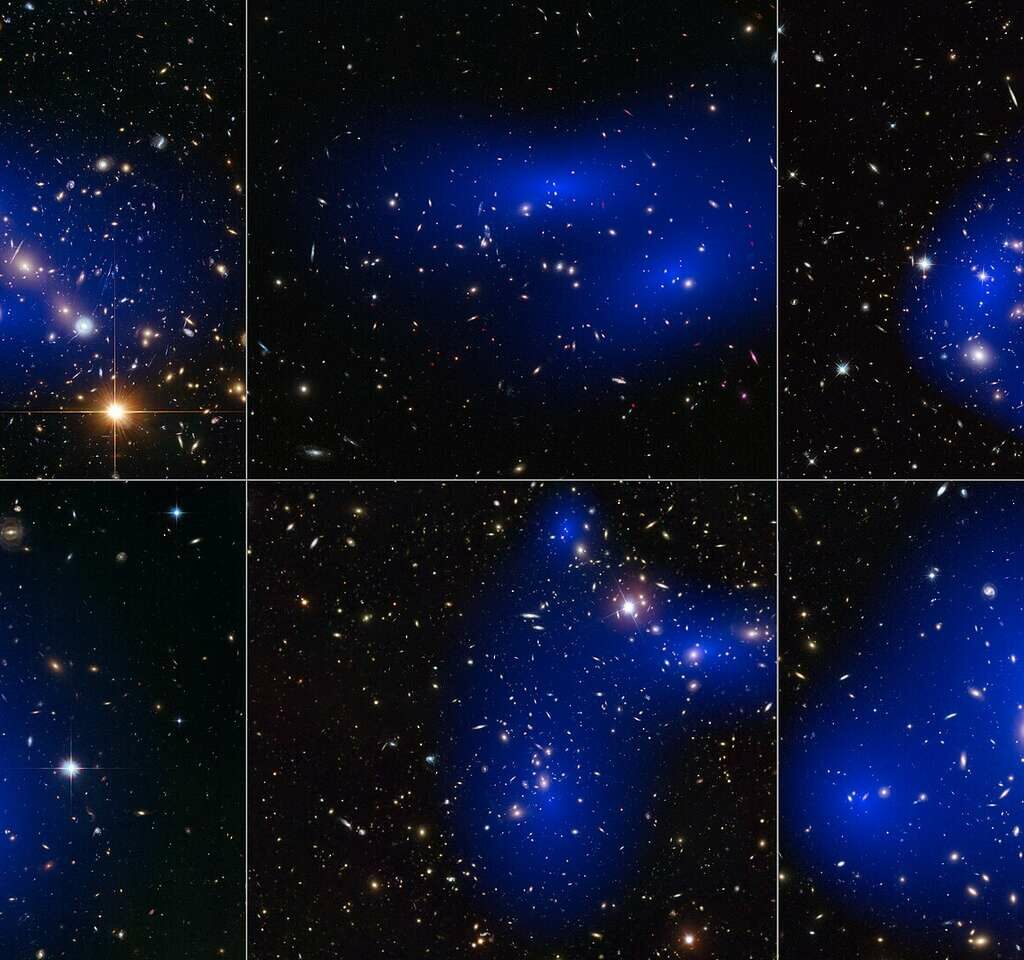
Dark matter is a mysterious and invisible substance hypothesized to exist in the universe, inferred primarily through its gravitational effects rather than direct observation. It neither emits nor absorbs light or other electromagnetic radiation, making it undetectable by conventional telescopes. Despite this invisibility, dark matter is believed to constitute about 27% of the universe’s total mass-energy, vastly outweighing the ordinary matter that forms stars, planets, and living beings, which accounts for only about 5%.
Origins of the Dark Matter Hypothesis
The concept of dark matter arose from astronomical observations that visible matter alone could not explain. For instance, stars in galaxies orbit their centers at speeds too high to be held by the gravitational pull of observable matter. Similarly, galaxy clusters exhibit gravitational binding stronger than what luminous matter can justify. These discrepancies led scientists to propose an unseen form of matter exerting gravitational influence, thereby shaping the large-scale structure of the cosmos.
Challenges in Detecting Dark Matter
Despite its critical role in cosmological models, dark matter has eluded direct detection. Numerous experiments have sought to identify particles that could constitute dark matter, such as weakly interacting massive particles (WIMPs), axions, and sterile neutrinos. However, these searches have yet to yield definitive evidence. This absence of direct proof has prompted some researchers to question whether dark matter is a physical entity or a theoretical construct devised to reconcile observational anomalies.
Alternative Theories: Modified Gravity
In response to the challenges of detecting dark matter, alternative explanations have emerged that modify our understanding of gravity itself. One prominent example is Modified Newtonian Dynamics (MOND), which proposes adjustments to Newton’s laws at very low accelerations, typical of galactic outskirts. Other theories, such as emergent gravity, suggest that gravity behaves differently on cosmic scales than predicted by classical physics. While these models have had some success explaining certain phenomena without invoking dark matter, they have not yet replaced the dark matter paradigm entirely.
Scientific and Philosophical Implications
The debate over dark matter’s existence extends beyond astrophysics into the philosophy of science. It highlights the interplay between empirical data and theoretical interpretation, illustrating how gaps in knowledge can lead to conceptual frameworks that may or may not correspond to physical reality. This tension challenges scientists to continually refine their models and remain open to revolutionary ideas that could reshape our understanding of the universe.
Impact on Cosmology and Human Understanding
Dark matter research is central to modern cosmology, influencing models of cosmic evolution, galaxy formation, and the universe’s overall composition. The quest to understand dark matter also reflects human curiosity and humility, acknowledging that much of the cosmos remains hidden from direct observation. This pursuit drives technological innovation, from underground detectors shielded from cosmic noise to high-energy particle colliders probing fundamental physics.
Observational Limitations and the Nature of Cosmic Illusions
Our perception of the universe is inherently limited by the capabilities of our instruments and the theoretical lenses through which we interpret data. Just as optical illusions exploit human sensory processing, cosmic illusions may arise from the frameworks scientists use to reconstruct reality from faint or indirect signals. Recognizing these limitations is crucial for advancing scientific knowledge and avoiding premature conclusions.
Current Status and Ongoing Debate
The prevailing cosmological model, known as Lambda Cold Dark Matter (ΛCDM), incorporates dark matter as a fundamental component explaining large-scale structure and cosmic microwave background observations. Nonetheless, the lack of direct detection and the partial successes of modified gravity theories sustain an active and vibrant scientific debate. This ongoing discourse exemplifies the dynamic nature of scientific inquiry, where competing hypotheses coexist and evolve.
Future Directions in Dark Matter Research
Resolving the mystery of dark matter requires a multidisciplinary approach, combining astrophysics, particle physics, observational astronomy, and philosophy of science. Future experiments aim to improve detection sensitivity and explore new theoretical frameworks. Whether dark matter is ultimately confirmed as a real substance or reinterpreted as a cosmic illusion, the pursuit itself enriches our understanding of the universe and our place within it.
Summary: The Significance of the Dark Matter Question
The question of whether dark matter is a genuine component of the cosmos or a sophisticated mathematical artifact remains one of the most profound in contemporary science. It challenges foundational assumptions, inspires innovative research, and symbolizes humanity’s relentless drive to explore the unknown. This enduring enigma reminds us that the universe is far more complex and mysterious than what meets the eye, inviting continual exploration beyond the visible horizon.


Leave a Reply