
Short Answer
Definition of Dark Matter and Its Gravitational Role
Dark matter constitutes a mysterious and invisible component of the universe, detectable only through its gravitational effects. Although it neither emits nor absorbs light, its existence is inferred from the gravitational influence it exerts on visible matter and the structure of the cosmos. The fundamental question arises: does dark matter possess mass, generate gravity, or both? Understanding this relationship is crucial for grasping the forces shaping cosmic evolution.
Observational Evidence Supporting Dark Matter’s Mass and Gravity
Several astronomical observations provide compelling evidence for dark matter’s gravitational presence:
- Galaxy Rotation Curves:
Galaxies rotate at speeds that, according to classical Newtonian mechanics, should cause them to disintegrate due to insufficient visible mass to hold them together. The fact that they remain intact implies an unseen mass contributing gravitational pull. - Gravitational Lensing:
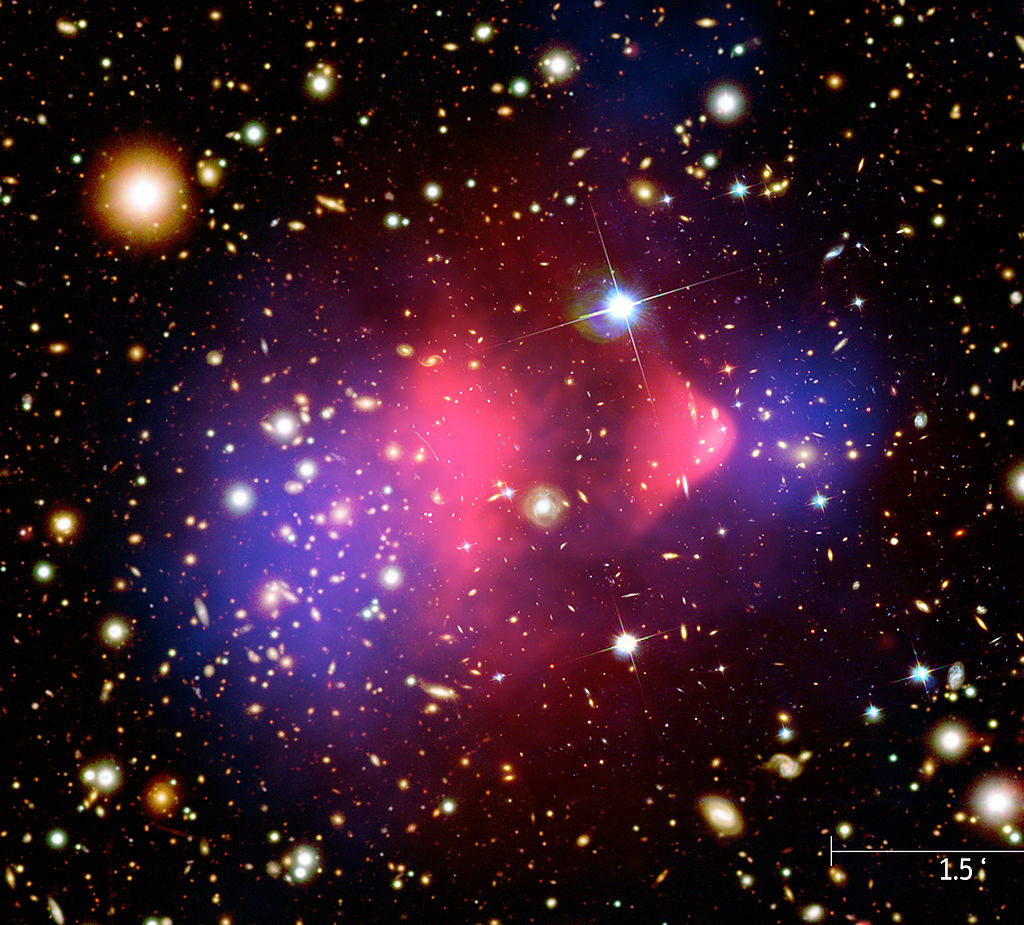
Light from distant celestial objects bends around massive galaxy clusters more than visible matter alone can explain, indicating additional mass in the form of dark matter. - Galaxy Cluster Dynamics:
The motion of galaxies within clusters suggests the presence of a substantial gravitational source beyond observable matter.
Mass and Gravity: Fundamental Concepts in Physics
Mass is a physical property that imparts inertia and generates gravitational fields. Objects with mass influence the motion of other bodies through gravity and resist changes in their state of motion. Dark matter’s gravitational effects on visible matter and spacetime curvature demonstrate that it behaves as if it possesses mass, despite its invisibility to electromagnetic detection methods.
Nature of Dark Matter’s Mass and Its Detection Challenges
Unlike ordinary (baryonic) matter composed of protons, neutrons, and electrons, dark matter does not interact via electromagnetic forces. It neither emits nor reflects light, making direct measurement of its mass impossible with traditional telescopes. Instead, scientists infer its mass indirectly by observing its gravitational impact on visible matter and light paths, highlighting gravity as the primary tool for revealing dark matter’s presence.
Gravity as a Manifestation of Mass-Energy Curvature
According to Einstein’s general relativity, gravity arises from the warping of spacetime caused by mass and energy. Dark matter, by virtue of its mass, curves spacetime, producing observable phenomena such as gravitational lensing. This curvature affects the trajectory of light and the motion of celestial bodies, providing tangible evidence of dark matter’s gravitational influence.
Dual Role of Dark Matter in Gravitational Interactions
Dark matter simultaneously acts as a source and a responder to gravity:
- As a Source:
Its mass generates gravitational fields that affect the motion of stars, galaxies, and other matter. - As a Responder:
Dark matter moves along geodesics shaped by the gravitational landscape, influenced by other masses and energy distributions.
This reciprocal relationship enables dark matter to shape cosmic structures such as galaxy clusters and influence phenomena like the cosmic microwave background anisotropies.
Hypothesized Particle Candidates for Dark Matter
The exact particle nature of dark matter remains unknown, but several theoretical candidates have been proposed:
- Weakly Interacting Massive Particles (WIMPs):
Hypothetical particles that interact via gravity and weak nuclear forces but not electromagnetically. - Axions:
Ultra-light particles proposed to solve certain quantum chromodynamics problems, potentially constituting dark matter. - Sterile Neutrinos:
Hypothetical neutrinos that do not interact via the standard weak force, making them difficult to detect.
Despite their differences, these candidates share the common trait of exerting gravitational influence, underscoring the importance of mass in dark matter’s cosmic role.
Philosophical and Scientific Significance of Dark Matter’s Mass and Gravity
The dominance of an invisible mass over visible matter in the universe raises profound questions about the nature and fate of all cosmic constituents. Gravity, a classical force understood for centuries, remains the key to unlocking the secrets of this elusive matter. This interplay highlights the deep interconnectedness of natural laws and fuels ongoing scientific and philosophical inquiry into the universe’s fundamental composition.
Advancements in Research and Detection Efforts
Modern cosmology and particle physics continue to push the boundaries of understanding dark matter:
- Direct Detection Experiments:
Efforts to observe rare interactions between dark matter particles and ordinary matter persist despite significant challenges. - Gravitational Wave Observations:
These provide new avenues to study mass distributions and gravitational effects on cosmic scales. - High-Resolution Cosmological Surveys:
Mapping the large-scale structure of the universe refines knowledge of dark matter’s distribution and influence.
Each breakthrough enhances the synergy between theoretical models and empirical data, gradually illuminating dark matter’s elusive nature.
Conclusion: The Interdependence of Mass and Gravity in Dark Matter
Dark matter undeniably possesses mass and manifests gravitational effects, acting as a silent architect of the universe’s large-scale structure. Although invisible to electromagnetic detection, its mass is revealed through gravity’s inescapable pull. This dual characteristic confirms dark matter’s existence and frames one of the most profound cosmic mysteries. As research progresses, the hope remains that dark matter will eventually be fully understood, shedding light on the hidden forces that govern the cosmos.
FAQ
Does dark matter have mass?
Yes, dark matter is believed to possess mass, which contributes to its gravitational effects on visible matter.
How is dark matter detected?
Dark matter cannot be detected directly; its presence is inferred through its gravitational effects on visible matter and light.


Leave a Reply