
Short Answer
Definition of Particle Accelerators
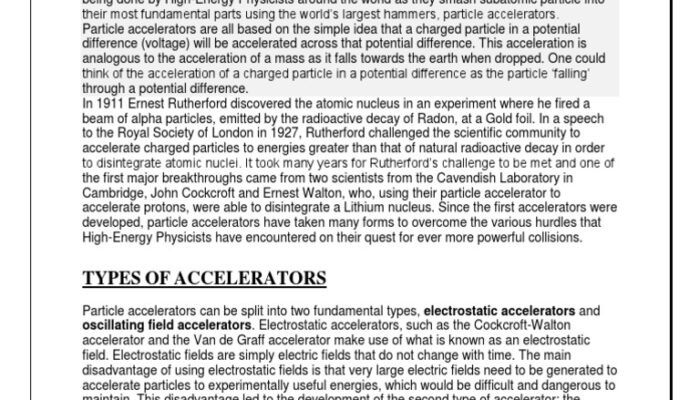
Particle accelerators are advanced devices designed to propel charged particles, such as protons or electrons, to extremely high speeds. These machines enable scientists to investigate the fundamental properties of matter by creating high-energy collisions that mimic conditions similar to those just moments after the Big Bang. Beyond their role in fundamental physics, particle accelerators have broad applications spanning medicine, industry, and scientific research.
Applications in High-Energy Physics
One of the most prominent uses of particle accelerators is in the realm of high-energy physics. Facilities like CERN’s Large Hadron Collider (LHC) accelerate particles to near-light speeds and collide them to recreate the extreme environments of the early universe. These experiments allow physicists to explore the building blocks of matter, understand the forces governing particle interactions, and investigate elusive phenomena such as dark matter and dark energy. A landmark achievement of the LHC was the discovery of the Higgs boson, a fundamental particle responsible for imparting mass to other particles, which has significantly advanced our comprehension of the universe’s fundamental structure.
Role in Medical Treatments and Diagnostics
Particle Therapy for Cancer
Particle accelerators have revolutionized cancer treatment through particle beam therapies, including proton and heavy ion therapy. Unlike traditional X-ray radiation, which can damage healthy tissues surrounding a tumor, these therapies utilize charged particles that deliver energy precisely at the tumor site. This precision is due to the Bragg peak effect, where particles deposit the majority of their energy directly within the tumor, minimizing harm to adjacent healthy cells and improving patient outcomes. Consequently, many hospitals worldwide are adopting particle accelerator technology to enhance their oncological treatment capabilities.
Production of Medical Isotopes
Accelerators are also essential in generating medical isotopes used in diagnostic imaging and therapy. For example, positron emission tomography (PET) scans depend on isotopes produced through nuclear reactions facilitated by accelerators. These isotopes emit positrons upon decay, which interact with electrons to produce gamma rays detectable by PET scanners. This imaging technique is invaluable in fields such as oncology, cardiology, and neurology, as it enables visualization of metabolic activity within the body.
Industrial and Materials Science Applications
Beyond healthcare, particle accelerators contribute significantly to materials science and industrial processes. Ion implantation, a technique where accelerated ions bombard a material’s surface, alters its physical and chemical properties to enhance performance. This method is crucial in semiconductor manufacturing, where it helps tailor the electrical characteristics of electronic components. Additionally, accelerators support advanced materials analysis through methods like X-ray diffraction and electron beam melting, which provide detailed insights into material microstructures and phase compositions.
Fundamental Scientific Research and Synchrotron Studies
Particle accelerators are indispensable tools for probing rare physical phenomena and studying particle behavior under extreme conditions. Synchrotron facilities, which use accelerators to generate intense X-rays, enable detailed examination of atomic and molecular structures. These investigations reveal the complexities of chemical reactions and phase transitions, deepening our understanding of fundamental science and aiding the development of innovative materials and technologies.
Educational and Outreach Contributions
Particle accelerators also play a vital role in education and public engagement. Many research institutions offer tours, workshops, and outreach programs that explain particle physics concepts and highlight the significance of accelerator research. These initiatives inspire students and the general public, fostering interest in STEM (Science, Technology, Engineering, and Mathematics) fields and encouraging the next generation of scientists and engineers.
Challenges in Construction and Operation
Despite their numerous benefits, particle accelerators require substantial financial investment and logistical coordination. Large-scale projects often depend on international partnerships, pooling resources from multiple countries and organizations. The construction of these complex machines can take years or even decades, demanding long-term commitment and collaboration among global scientific communities. Justifying the costs involves demonstrating tangible scientific advancements and societal benefits.
Emerging Technologies and Future Prospects
The future of particle accelerator technology is promising, with innovative approaches on the horizon. Plasma wakefield acceleration, for instance, offers the potential to accelerate particles to high energies over much shorter distances than conventional accelerators, potentially making particle physics research more accessible. Additionally, efforts to develop compact and cost-effective accelerators aim to broaden their applications across science, medicine, and industry, making this technology more versatile and widely available.
Significance and Impact of Particle Accelerators
Particle accelerators are far more than instruments for exploring subatomic particles; they are engines of progress across multiple disciplines. From unlocking the secrets of the universe to advancing cancer therapies and enhancing industrial processes, their diverse applications underscore their critical role in modern science and technology. As research continues and new innovations emerge, particle accelerators will remain at the forefront of expanding human knowledge and technological capability.
FAQ
What is a particle accelerator?
A particle accelerator is a device that propels charged particles to high speeds for research and applications in physics, medicine, and industry.
How are particle accelerators used in medicine?
Particle accelerators are used in cancer treatment through particle beam therapies and in the production of medical isotopes for imaging.
What is the significance of the Large Hadron Collider?
The Large Hadron Collider is a major particle accelerator that has contributed to significant discoveries in high-energy physics, including the Higgs boson.





Leave a Reply