

Short Answer
Definition of Quantum Computing
Quantum computing represents a revolutionary advancement in computational technology, leveraging the principles of quantum mechanics to perform calculations far beyond the capabilities of classical computers. Unlike traditional computing systems that use binary bits, quantum computers utilize quantum bits or qubits, which can exist in multiple states simultaneously, enabling a fundamentally different approach to processing information.
- Quantum Bits (Qubits):
Unlike classical bits restricted to 0 or 1, qubits exploit superposition, allowing them to represent both states at once. - Quantum Mechanics Principles:
Core phenomena such as superposition and entanglement underpin the operation of quantum computers, facilitating complex computational processes.
Fundamental Principles Behind Quantum Computing
At the heart of quantum computing lies the exploitation of quantum mechanical effects. Superposition allows qubits to be in multiple states simultaneously, vastly expanding the computational space. Entanglement, another key quantum property, links qubits in such a way that the state of one instantly influences the state of another, regardless of distance. These phenomena enable quantum computers to process a multitude of possibilities concurrently, offering exponential speed-ups for certain problem classes compared to classical machines.
Technological Foundations and Qubit Implementations
Building a functional quantum computer requires sophisticated engineering to maintain qubit coherence and minimize errors. Two leading qubit technologies are superconducting circuits and trapped ions:
- Superconducting Qubits:
These use superconducting materials cooled to near absolute zero to create quantum states, favored for their scalability and integration with existing semiconductor technologies. - Trapped Ion Qubits:
Individual ions are confined and manipulated using electromagnetic fields, offering high-fidelity operations but presenting challenges in scaling.
Overcoming issues such as decoherence-where qubits lose their quantum state due to environmental interference-and error rates remains a central focus in advancing quantum hardware.
Quantum Supremacy: A Milestone Achievement
Quantum supremacy refers to the point at which a quantum computer performs a calculation that is practically impossible for classical supercomputers to complete within a reasonable timeframe. In 2019, Google announced it had reached this landmark by solving a specific problem in approximately 200 seconds, a task estimated to require thousands of years on the most powerful classical systems. This breakthrough has sparked widespread discussion about the future capabilities and implications of quantum computing.
Applications and Impact Across Industries
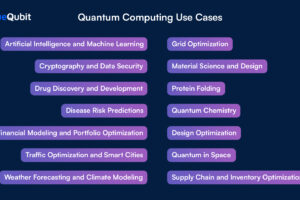
The transformative potential of quantum computing spans multiple sectors:
- Cryptography:
Quantum computers threaten to break many current encryption schemes, necessitating the development of quantum-resistant cryptographic methods to secure data. - Pharmaceuticals and Material Science:
Quantum simulations enable precise modeling of molecular interactions, accelerating drug discovery and the design of novel materials. - Artificial Intelligence:
Enhanced computational power could improve machine learning algorithms, enabling more sophisticated AI systems.
Challenges in Quantum Computing Development
Despite its promise, quantum computing faces significant hurdles:
- Error Correction and Decoherence:
Quantum states are fragile and prone to errors, requiring advanced error-correcting codes and robust qubit designs. - Scalability:
Expanding quantum systems to a large number of qubits while maintaining coherence is a complex engineering challenge. - Environmental Sensitivity:
Quantum devices must be isolated from external disturbances to preserve information integrity.
Ethical and Societal Considerations
As quantum computing technology progresses, it raises important ethical questions and societal impacts:
- Privacy and Security:
The ability to break existing encryption could compromise sensitive information, demanding new security paradigms. - Workforce Displacement:
Automation driven by quantum-enhanced technologies may disrupt job markets, necessitating proactive workforce planning. - Responsible Innovation:
Balancing technological advancement with ethical frameworks is essential to ensure beneficial outcomes.
Education and Interdisciplinary Collaboration
To fully harness quantum computing’s potential, cultivating a knowledgeable workforce is critical. This requires integrating quantum science into educational curricula and fostering collaboration among physicists, computer scientists, and engineers. Such interdisciplinary efforts will drive innovation and deepen understanding, enabling society to navigate the complexities of this emerging field.
Philosophical Implications and the Future of Computation
Quantum computing challenges traditional conceptions of computation, inviting a reevaluation of how information is processed and understood. Beyond technical advancements, it prompts a shift in the philosophical foundations of computing, encouraging new ways to conceptualize problems and data. This paradigm shift holds the promise of unlocking novel computational strategies and expanding the horizons of scientific inquiry.
Conclusion: The Quantum Computing Revolution
The emergence of the first operational quantum computers marks a significant chapter in the evolution of technology. With the capacity to revolutionize diverse fields and reshape our understanding of computation, quantum computing stands at the forefront of scientific progress. Moving forward, it is imperative to address both the technical challenges and ethical considerations through collaborative research, education, and open dialogue. By doing so, the profound insights of quantum mechanics can be transformed into practical innovations that benefit humanity in the information age.
FAQ
What is quantum computing?
Quantum computing is a form of computation that uses quantum bits (qubits) to perform calculations that are beyond the reach of classical computers.
How does quantum computing differ from classical computing?
While classical computing uses binary bits (0s and 1s), quantum computing utilizes qubits that can represent both 0 and 1 simultaneously due to superposition.
What is quantum supremacy?
Quantum supremacy is the point at which a quantum computer can perform a calculation that is infeasible for classical computers.
What are the practical applications of quantum computing?
Quantum computing can revolutionize fields such as cryptography, pharmaceuticals, and artificial intelligence by providing enhanced computational capabilities.

Leave a Reply