

Short Answer
Definition of Dark Energy
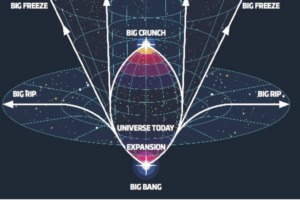
Dark energy is a mysterious and pervasive force believed to be responsible for the accelerated expansion of the universe. It is thought to constitute approximately 68% of the total energy density of the cosmos, acting as a repulsive influence that drives galaxies apart at an increasing rate. Despite its significant role in cosmology, the true nature of dark energy remains elusive, challenging scientists to explore beyond conventional theories.
Traditional Understanding and Emerging Questions
Conventionally, dark energy is modeled as a constant property of space itself, often referred to as the cosmological constant. This concept assumes a uniform and unchanging energy permeating the vacuum of space, exerting a repulsive pressure that counteracts gravitational attraction. However, this simplistic view is increasingly questioned as new observations suggest that dark energy might be more complex, potentially varying over time or interacting with other cosmic components.
Observational Clues and Cosmic Phenomena
Evidence for dark energy arises from multiple astrophysical observations:
- Large-Scale Structure:
The distribution and clustering of galaxies across vast cosmic distances provide insights into the influence of dark energy on the growth of cosmic structures. - Cosmic Microwave Background (CMB):
Minute temperature fluctuations in the CMB radiation offer a snapshot of the early universe, helping to constrain models of dark energy. - Gravitational Lensing:
The bending of light by massive objects reveals the underlying mass distribution and the effects of dark energy on spacetime curvature.
The Hubble Tension and Its Implications
One of the most intriguing puzzles in modern cosmology is the discrepancy in measurements of the universe’s expansion rate, known as the Hubble constant. Observations from distant supernovae and the early universe’s afterglow yield conflicting values, a phenomenon termed the “Hubble tension.” This inconsistency may hint that dark energy is not static but evolves over time or interacts with dark matter and spacetime in unexpected ways, prompting a reevaluation of standard cosmological models.
Dynamic Dark Energy Models
Recent theoretical developments propose that dark energy might be a dynamic entity rather than a fixed cosmological constant. Models such as quintessence describe dark energy as a scalar field that changes over time, potentially governed by exotic physics. These frameworks aim to explain observed anomalies and provide a more flexible understanding of cosmic acceleration, suggesting that dark energy’s properties could vary across different epochs of the universe.
Technological Advances in Dark Energy Research
Cutting-edge instruments and missions are revolutionizing our ability to probe dark energy:
- Dark Energy Spectroscopic Instrument (DESI):
Mapping millions of galaxies to chart the cosmic web with unprecedented precision. - Space-Based Observatories:
Dedicated missions focusing on precision cosmology to detect subtle patterns and anisotropies in the universe’s expansion.
These technological strides enable scientists to detect faint signals and complex interactions that were previously obscured, potentially revealing temporal variations or non-trivial couplings involving dark energy.
Alternative Theories: Modified Gravity
Some physicists explore the possibility that the observed cosmic acceleration might not require dark energy at all. Modified gravity theories suggest that Einstein’s General Relativity could behave differently on cosmological scales, altering gravitational dynamics without invoking an unknown energy component. These hypotheses challenge the orthodox view and open new avenues for understanding the universe’s expansion through fundamental changes in gravitational physics.
Interactions Between Dark Energy and Other Cosmic Components
The relationship between dark energy and other constituents of the universe-such as dark matter, ordinary matter, and radiation-remains an active area of research. Emerging evidence points to potential interactions that could influence the formation and evolution of cosmic structures. If dark energy couples with dark matter, it might affect the growth rate of galaxies and the ultimate fate of the cosmos, adding layers of complexity to the cosmic narrative.
Philosophical and Scientific Challenges
Beyond empirical data, the study of dark energy raises profound questions about the foundations of cosmology. Current models, while mathematically elegant, may rest on assumptions that limit our understanding. Uncovering the hidden nature of dark energy might require a paradigm shift in how we conceptualize space, time, and energy, moving beyond incremental improvements to embrace radically new perspectives.
Significance of Understanding Dark Energy
Deciphering the true essence of dark energy is crucial for multiple reasons:
- Cosmic Evolution:
It shapes the past, present, and future dynamics of the universe. - Fundamental Physics:
Insights into dark energy could reveal new physics beyond the Standard Model and General Relativity. - Technological Progress:
Advancements in observational tools driven by dark energy research benefit broader scientific fields.
Conclusion: The Ongoing Quest
The enigma of dark energy continues to captivate astronomers and physicists alike. Each new observation and theoretical insight adds pieces to a complex puzzle, gradually refining our cosmic understanding. Whether dark energy remains an inscrutable mystery or yields to human inquiry, the pursuit itself exemplifies the spirit of scientific exploration-embracing uncertainty, challenging assumptions, and expanding the horizons of knowledge.
FAQ
What is dark energy?
Dark energy is a force that contributes to the accelerated expansion of the universe, making up about 68% of its energy density.
How does dark energy affect the universe?
It causes galaxies to move apart at an accelerating rate, influencing cosmic structure formation.
What are the current theories regarding dark energy?
Current theories include the cosmological constant, quintessence, and modified gravity.
Why is dark energy important?
Understanding dark energy is crucial for deciphering the universe's evolution and revealing new physics.

Leave a Reply