What is missing from our understanding of particle physics?

Particle physics, a fundamental branch of the physical sciences, seeks to unravel the complexities of matter at its most basic level. Despite significant advancements, numerous profound questions and enigmas persist. This article addresses some of these uncertainties in particle physics, delineating the multifaceted landscape that continues to challenge scientists and inspire inquiry. One significant area […]

Read More →

Why do scientists study particle physics?

Particle physics, a branch of physics that delves into the fundamental constituents of matter and radiation, captivates scientists around the globe for a multitude of reasons. This field is not merely an abstract pursuit; it underpins our understanding of the universe at a most elementary level. Scientists engage with particle physics for several compelling motivations, […]

Read More →

What is fascinating about Neutrinos?

Neutrinos, often described as the elusive particles, have captivated physicists and cosmologists alike since their postulation. These nearly massless entities, with their remarkable ability to traverse vast expanses of matter with minimal interaction, present an extraordinary opportunity to probe the fundamental workings of the universe. While they are abundantly produced in processes such as nuclear […]

Read More →

What is the Higgs Boson and why is it important?

The Higgs boson, often dubbed the “God particle,” has captivated physicists and the public alike since its theoretical inception in the 1960s and subsequent discovery in 2012. This particle is a fundamental component of the standard model of particle physics, a framework that describes the known elementary particles and the forces governing their interactions. Understanding […]

Read More →

How much math does a particle physicist need?

Particle physics, an area of study dedicated to understanding the fundamental constituents of matter and their interactions, inherently demands a sophisticated mathematical foundation. Aspiring particle physicists often find themselves contemplating the extent of mathematical proficiency required to navigate this complex field. This inquiry encapsulates not only a matter of academic preparedness but also a reflection […]

Read More →

What is Higgs boson simply?

The Higgs boson is often described as a fundamental particle that serves as a keystone in the Standard Model of particle physics. Essentially, it is an excitation of the Higgs field, which permeates the universe. Understanding the Higgs boson involves traversing various concepts and theories that underpin modern physics, including the nature of mass, the […]

Read More →

How can we detect neutrinos

Neutrinos are elementary particles that have garnered significant attention within the field of particle physics and cosmology. Their elusive nature and weak interaction with matter render them both particularly challenging to study and profoundly interesting. This article delineates various methodologies employed to detect neutrinos, touching on the fundamental principles that underpin these techniques while also […]

Read More →

Why is an atom not considered an elementary particle?

Atoms, the building blocks of matter, are often misconceived as elementary particles, akin to the fundamental bricks from which the vast edifice of the universe is constructed. However, such a perception, while simplistic, obscures the profound complexity underlying atomic structure. To elucidate why atoms are not classified as elementary particles, one must delve into the […]

Read More →

Can neutrinos be used to transmit data?

Neutrinos, enigmatic subatomic particles renowned for their elusive nature, have captured the attention of physicists and engineers alike in recent years. As neutral and nearly massless particles, they possess an unparalleled capacity to traverse matter with minimal interaction. This unique characteristic raises an intriguing proposition: could neutrinos be harnessed as a medium for data transmission? […]

Read More →

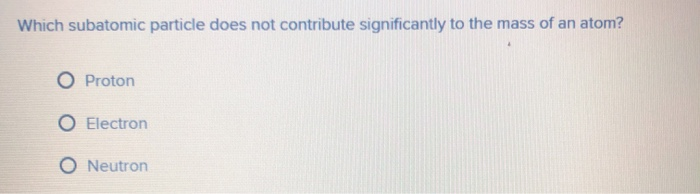
What is an example of subatomic particles?

Subatomic particles serve as the fundamental building blocks of matter, representing an intricate world where the mechanics of nature transcend the ordinary. As we delve into the microscopic realm, we encounter various subatomic entities, including quarks, leptons, and bosons, each exhibiting a unique behavior that defines the fabric of our universe. To elucidate the essence […]

Read More →