
Short Answer
Definition of the Lagrangian in Particle Physics
In particle physics, the term “Lagrangian” refers to a fundamental function that encapsulates the dynamics governing physical systems. Originating from analytical mechanics, the Lagrangian provides a framework to describe how particles and fields evolve over time. It is typically symbolized as L and defined as the difference between a system’s kinetic energy (T) and potential energy (V):
L = T – V
This formulation shifts the focus from forces and accelerations, as emphasized in Newtonian mechanics, to the energies involved in motion, offering a more comprehensive perspective on physical phenomena.
Historical and Theoretical Background
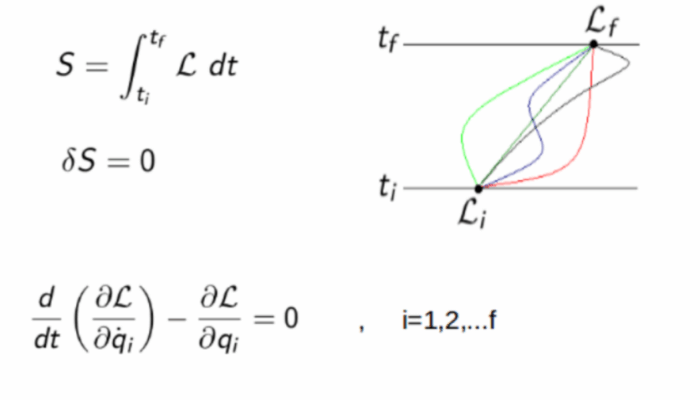
The Lagrangian approach is deeply rooted in the principle of least action, also known as Hamilton’s principle. This principle asserts that the actual trajectory a system follows between two states is the one that minimizes the action, which is the time integral of the Lagrangian. This elegant concept suggests that natural processes are governed by an optimization principle rather than direct force interactions.
Mathematical Framework and Euler-Lagrange Equations
The power of the Lagrangian formalism lies in its ability to derive equations of motion through the Euler-Lagrange equations. These equations emerge from applying variational calculus to the action integral, providing a systematic method to determine particle trajectories:
(frac{d}{dt} left( frac{partial L}{partial dot{q}_i} right) – frac{partial L}{partial q_i} = 0)
- (q_i): Generalized coordinates describing the system’s configuration.
- (dot{q}_i): Time derivatives of the generalized coordinates (velocities).
- L: The Lagrangian function.
This approach not only simplifies the derivation of motion equations but also reveals deep connections between different physical systems.
Role in Relativistic and Quantum Theories
With the advent of special relativity, the classical Lagrangian was extended to accommodate relativistic effects, ensuring compatibility with Einstein’s postulates. The relativistic Lagrangian incorporates energy-momentum relations and maintains the invariance of the speed of light across all inertial frames.
In quantum field theory, the Lagrangian becomes a cornerstone for describing particle interactions and field dynamics. It encodes the behavior of fundamental particles and their forces, serving as the foundation for constructing models such as the Standard Model of particle physics.
Symmetries, Conservation Laws, and Noether’s Theorem
The Lagrangian framework is instrumental in uncovering the symmetries inherent in physical laws. According to Noether’s theorem, every continuous symmetry of the Lagrangian corresponds to a conservation law:
- Time translation symmetry: Leads to conservation of energy.
- Spatial translation symmetry: Results in conservation of momentum.
- Rotational symmetry: Corresponds to conservation of angular momentum.
This profound link between symmetry and conservation principles provides a unifying language to describe fundamental interactions.
Application in Gauge Theories and the Standard Model
Gauge theories, which form the backbone of the Standard Model, rely heavily on the Lagrangian formalism. The Lagrangian encodes the symmetries of electromagnetic, weak, and strong forces, explaining how particles acquire mass and interact via force carriers like photons, W and Z bosons, and gluons. This mathematical structure elegantly captures the complex interplay of particles and fields that constitute the universe’s fundamental fabric.
Extensions and Modern Developments
The conceptual framework of the Lagrangian has inspired numerous advancements beyond classical and quantum mechanics. Effective field theories, string theory, and attempts to unify gravity with quantum mechanics all build upon or generalize the Lagrangian approach. These cutting-edge theories continue to push the boundaries of our understanding, exploring phenomena at the smallest and largest scales.
Practical Examples in Physics
- Simple Harmonic Oscillator:
The Lagrangian for a mass on a spring is expressed as the difference between kinetic and potential energies, enabling straightforward derivation of its motion. - Electromagnetic Field:
The Lagrangian density describes the dynamics of electric and magnetic fields, forming the basis for Maxwell’s equations in field theory. - Particle Interactions:
In the Standard Model, the Lagrangian encodes interactions between quarks, leptons, and gauge bosons, predicting outcomes verified by particle accelerators.
Common Misunderstandings About the Lagrangian
- Misconception: The Lagrangian is just a mathematical trick.
Correction: It is a fundamental physical quantity that reveals deep principles like symmetry and conservation laws. - Misconception: The Lagrangian only applies to classical mechanics.
Correction: It is equally essential in quantum mechanics, field theory, and modern particle physics. - Misconception: The Lagrangian replaces forces entirely.
Correction: It provides an alternative but equivalent description of dynamics, focusing on energy rather than forces.
Significance of the Lagrangian in Science and Technology
The Lagrangian formalism is a cornerstone of theoretical physics, offering a unified language to describe diverse phenomena from planetary motion to subatomic particle interactions. Its ability to connect symmetries with conservation laws has profound implications for understanding the universe’s fundamental structure. Moreover, the Lagrangian approach underpins many technological advances, including particle accelerators, quantum computing, and materials science, by providing the theoretical foundation necessary for innovation.
FAQ
What is the Lagrangian?
The Lagrangian is a function that summarizes the dynamics of a system, defined as the difference between kinetic and potential energy.
How does the Lagrangian relate to conservation laws?
According to Noether’s theorem, every symmetry in the Lagrangian corresponds to a conservation law, such as conservation of energy and momentum.
Can the Lagrangian be applied in quantum mechanics?
Yes, the Lagrangian is essential in quantum mechanics and field theory, describing particle interactions and dynamics.





Leave a Reply