
Short Answer
Definition of Subatomic Particles
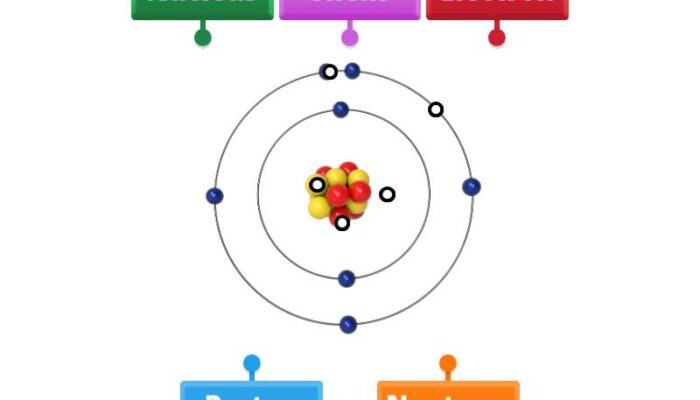
Subatomic particles are the essential components that constitute atoms, which in turn form all matter in the universe. These particles exist within atoms and are characterized by intrinsic properties such as mass, electric charge, and spin. They serve as the foundational elements that determine the structure and behavior of matter at the most fundamental scale.
- Protons:
Positively charged particles located in the atomic nucleus, defining the element’s identity through their count, known as the atomic number. - Neutrons:
Electrically neutral particles also found in the nucleus, contributing to nuclear stability by offsetting repulsive forces between protons. - Electrons:
Negatively charged particles orbiting the nucleus in defined energy levels, crucial for chemical bonding and electrical phenomena. - Gauge Bosons:
Force-carrying particles that mediate fundamental interactions between matter particles.
Classification of Subatomic Particles
Subatomic particles are broadly divided into two main groups based on their spin and statistical behavior: fermions and bosons. This classification is fundamental to understanding their roles in matter and forces.
Fermions: The Building Blocks of Matter
Fermions are particles that constitute matter and are characterized by half-integer spins (e.g., 1/2, 3/2). They obey the Pauli exclusion principle, which prohibits identical fermions from occupying the same quantum state simultaneously. This principle underlies the structure of atoms and the diversity of chemical elements.
- Protons:
Composite particles made of three quarks held together by the strong force, with a mass roughly 1836 times that of an electron. - Neutrons:
Also composed of quarks, neutrons have a mass similar to protons but carry no electric charge, playing a key role in nuclear reactions and stability. - Electrons:
Fundamental particles with negligible mass compared to nucleons, electrons orbit the nucleus and are vital for chemical interactions and electricity.
Bosons: Mediators of Fundamental Forces
Bosons are particles that facilitate the fundamental forces of nature. Unlike fermions, bosons have integer spins (0, 1, 2, etc.) and can occupy the same quantum state, enabling them to act as force carriers between matter particles.
- Photon:
A massless boson responsible for electromagnetic interactions, including light and other forms of electromagnetic radiation. - W and Z Bosons:
Massive particles that mediate the weak nuclear force, which is involved in radioactive decay and particle transformations. - Gluon:
The carrier of the strong nuclear force, gluons bind quarks together within protons and neutrons and hold nucleons together in the nucleus. - Higgs Boson:
Associated with the Higgs field, this particle imparts mass to other particles through the Higgs mechanism, a cornerstone of the Standard Model.
Fundamental Forces and Particle Interactions
Subatomic particles interact through four fundamental forces, each mediated by specific bosons. These forces govern the behavior and stability of matter at the microscopic level.
- Gravitational Force:
The weakest force at the subatomic scale, it causes attraction between masses but has negligible effects on particles like electrons and quarks. - Electromagnetic Force:
Acts between charged particles, responsible for electric and magnetic phenomena, and crucial for atomic structure and chemical bonding. - Weak Nuclear Force:
Governs processes such as beta decay, enabling particle transformations and playing a vital role in nuclear reactions. - Strong Nuclear Force:
The most powerful force at short ranges, it binds quarks into nucleons and holds the atomic nucleus together.
Mathematical Framework: The Standard Model
The Standard Model of particle physics provides a comprehensive theoretical framework describing subatomic particles and their interactions. It incorporates quantum field theory and symmetry principles to explain particle behavior.
Key elements include:
- Spin: Intrinsic angular momentum of particles, quantized in half-integers for fermions and integers for bosons.
- Quantum States: Defined by quantum numbers that specify properties like energy, spin orientation, and charge.
- Gauge Symmetries: Mathematical symmetries that dictate the interactions mediated by gauge bosons.
Practical Applications and Examples
Understanding subatomic particles has led to numerous technological and scientific advancements:
- Medical Imaging:
Techniques such as PET scans utilize positrons (antiparticles of electrons) to visualize internal body structures. - Particle Accelerators:
Facilities like the Large Hadron Collider probe subatomic interactions, leading to discoveries such as the Higgs boson. - Electronics:
The behavior of electrons underpins semiconductor technology, essential for computers and communication devices. - Nuclear Energy:
Manipulation of neutrons and protons in nuclear reactions provides a powerful energy source.
Common Misunderstandings About Subatomic Particles
- Misconception: Protons and neutrons are fundamental particles.
Correction: Both are composite particles made of quarks, not elementary particles. - Misconception: Bosons are matter particles.
Correction: Bosons are force carriers, not constituents of matter. - Misconception: Electrons orbit the nucleus like planets around the sun.
Correction: Electrons exist in probabilistic clouds or orbitals defined by quantum mechanics, not fixed paths.
Significance in Science and Technology
The exploration of subatomic particles is fundamental to advancing physics, chemistry, and cosmology. Insights into particle behavior have deepened our understanding of the universe’s origin, structure, and evolution. Moreover, the principles governing these particles enable innovations in technology, medicine, and energy, demonstrating their profound impact on both theoretical knowledge and practical applications.
Conclusion
Subatomic particles form the intricate foundation of all matter and forces in the universe. By studying their properties, classifications, and interactions, scientists unravel the complexities of the physical world from the smallest scales upward. This ongoing research continues to illuminate the fundamental laws of nature, driving progress across multiple scientific disciplines and enhancing our grasp of reality itself.
FAQ
What are subatomic particles?
Subatomic particles are the building blocks of atoms, including protons, neutrons, and electrons.
What role do bosons play?
Bosons are force carriers that mediate interactions between fermions.






Leave a Reply