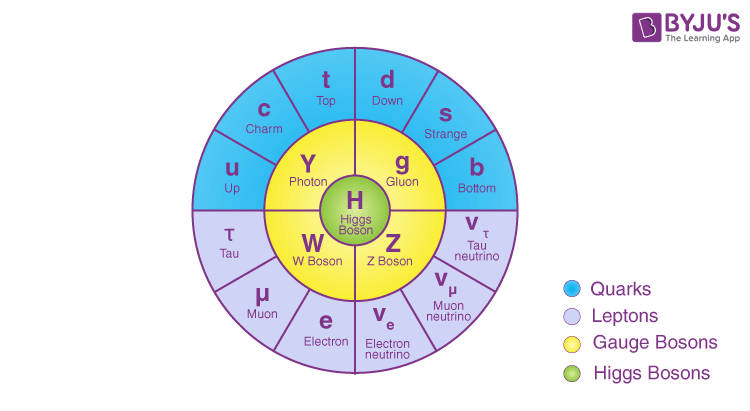
What are the differences between hadrons and leptons?

In the fascinating realm of particle physics, the classification of fundamental particles serves as a cornerstone for our understanding of the universe. Among these classifications, hadrons and leptons are two principal groups that stand out due to their contrasting properties and behaviors. This article delves into the differences between hadrons and leptons, illuminating their intrinsic […]

Read More →

What are neutrinos and where do they come from?

Neutrinos are enigmatic subatomic particles that elude easy categorization. Despite being abundant in the universe, their elusive nature compels scientists and researchers to unearth their multiplicities and intricate properties. Born from the cataclysmic events in stellar environments and the decay of radioactive elements, neutrinos are pivotal to our understanding of particle physics and cosmology. At […]

Read More →

CERN Discovers Higgs-like Boson: But Is It the Real Deal?

The announcement by CERN regarding the discovery of a Higgs-like boson in July 2012 sent ripples through the scientific community and ignited fervent discussions among physicists and philosophers alike. The excitement was palpable as researchers scoured through reams of data, verifying that the particle exhibited characteristics analogous to the long-predicted Higgs boson envisioned in the […]

Read More →

How Is a ‘Hole’ a Particle? Welcome to the Bizarre World of Quasiparticles

In the realm of condensed matter physics, the concept of quasiparticles often incites a mixture of intrigue and bafflement. Among these quasiparticles, perhaps the most enigmatic is the ‘hole.’ What is a hole, after all? How can something that is, by definition, an absence—essentially a missing particle—be considered a particle itself? This question invites us […]

Read More →

What is it like to work at Fermilab?

To work at Fermilab is akin to residing in the heart of a cosmic orchestra, where each particle colliding in the vast abyss of a collider resonates with the symphony of the universe. Nestled in Batavia, Illinois, this premier particle physics laboratory serves as a crucible of innovation, collaboration, and existential inquiry, channeling the fervor […]

Read More →

How deep do cosmic rays penetrate the Earth?

Cosmic rays are an enigmatic and fascinating aspect of our universe, originating predominantly from distant astrophysical phenomena. These high-energy particles, encompassing protons, atomic nuclei, and various other subatomic entities, precipitate from stellar explosions like supernovae and active galactic nuclei. They travel across the cosmos and, upon encountering Earth’s atmosphere, become a subject of both interest […]

Read More →