What is the Kondo problem in condensed matter physics?

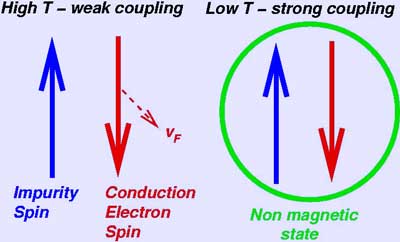
Definition of the Kondo Problem The Kondo problem is a fundamental challenge in condensed matter physics that explores the interaction between localized magnetic moments and conduction electrons within metallic materials. It addresses the puzzling behavior of magnetic impurities embedded in metals, particularly how these impurities influence electron scattering and electrical resistance at low temperatures. This […]

Read More →

Why is condensed matter physics interesting?

Overview of Condensed Matter Physics Condensed matter physics (CMP) stands as one of the most dynamic and engaging branches of modern physics, attracting a wide spectrum of researchers and enthusiasts. This discipline investigates the physical properties of matter in its various forms-solids, liquids, and disordered phases-at both macroscopic and microscopic scales. While it may initially […]

Read More →

What Is a Polaron in Condensed Matter Physics? A Particle’s Identity Crisis

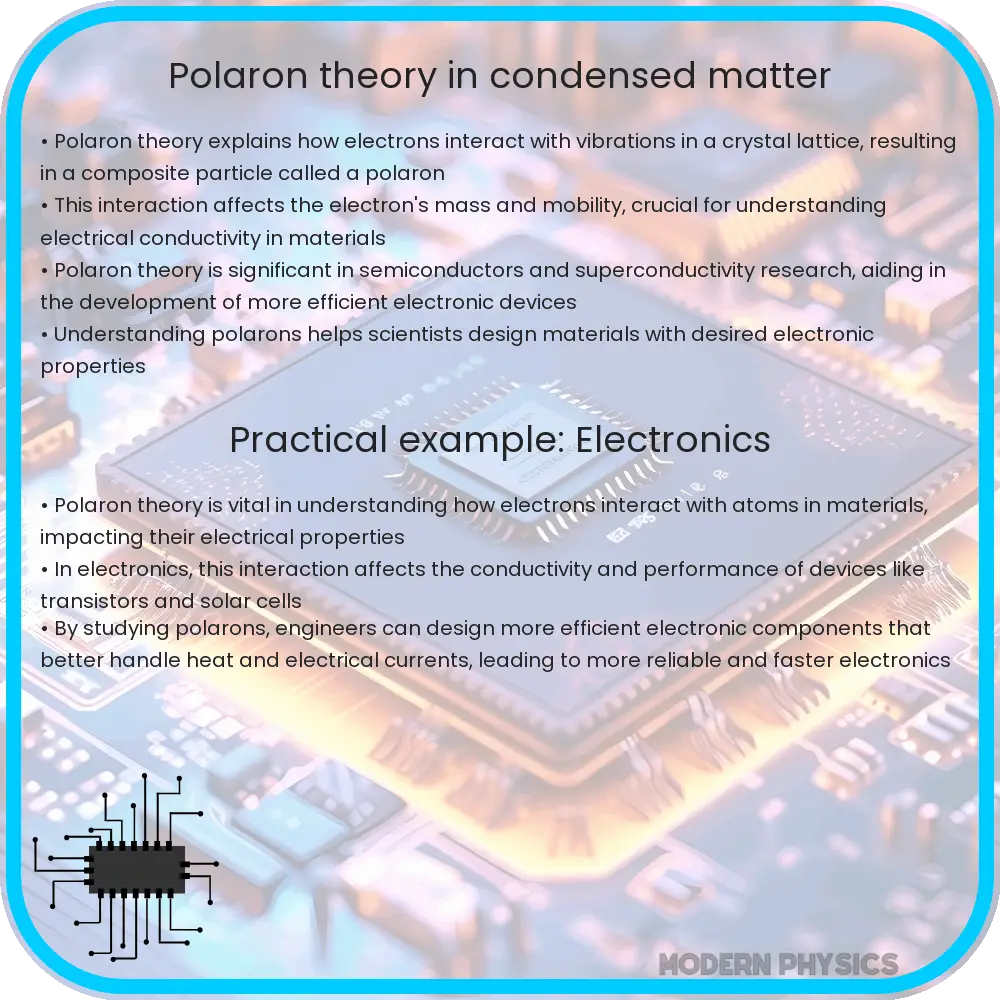
Definition of a Polaron A polaron is a quasiparticle that emerges when an electron or hole interacts with the lattice vibrations (phonons) in a crystalline solid. This interaction causes the charge carrier to become surrounded by a distortion cloud of the crystal lattice, effectively modifying its properties. The polaron thus represents a composite entity combining […]

Read More →

What does a typical condensed matter experiment look like?

Overview of Condensed Matter Physics Experiments Condensed matter physics is a fundamental area of physics that investigates the microscopic structure and behavior of various materials. This field encompasses a wide range of substances, including insulators, superconductors, semiconductors, and magnetic materials. Conducting experiments in condensed matter physics involves a sophisticated arrangement of components and techniques, requiring […]

Read More →

What is condensed matter physics and why is it important?

Definition of Condensed Matter Physics Condensed matter physics is a fundamental branch of physics dedicated to studying the physical properties and behaviors of matter in its solid and liquid states. This field investigates the collective interactions among vast assemblies of particles, primarily electrons and atoms, to understand the emergent phenomena that arise from these interactions. […]

Read More →

Where do I start if I want to learn about topological insulators?

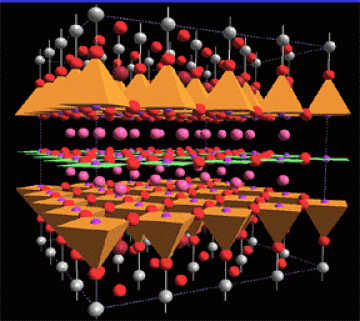
Definition of Topological Insulators Topological insulators are a fascinating class of materials that exhibit unique electronic characteristics, bridging the gap between the mathematical field of topology and condensed matter physics. These materials behave as insulators in their interior while supporting conducting states on their surfaces or edges, which are remarkably resistant to impurities and defects. […]

Read More →

Spin Textures in Condensed Matter: A Quantum Hairdo Explained

Definition of Spin Textures Spin textures refer to the spatially varying arrangements of magnetic moments or electron spins within a material. Unlike uniform magnetization, these configurations display intricate patterns resulting from the interplay of quantum mechanical properties and many-body interactions. Such spin arrangements significantly influence a material’s magnetic behavior, electrical transport, and topological features, making […]

Read More →

Condensed Matter Physics: Where Theory Meets the Tangible World

Overview of Condensed Matter Physics Condensed matter physics occupies a pivotal position at the intersection of theoretical frameworks and observable phenomena, focusing on the complex behaviors of matter across both macroscopic and microscopic scales. This scientific discipline aims to unravel the intrinsic properties of matter, providing insights that extend to the fundamental understanding of the […]

Read More →

How is a hole a quasiparticle in condensed matter physics?

Definition of a Hole as a Quasiparticle In condensed matter physics, a hole is a conceptual quasiparticle that represents the absence of an electron within an atomic lattice. Although it might initially appear counterintuitive to treat a missing electron as a physical entity, holes behave as positively charged particles with distinct properties. This abstraction provides […]

Read More →