
Short Answer
Definition of the Kondo Problem
The Kondo problem is a fundamental challenge in condensed matter physics that explores the interaction between localized magnetic moments and conduction electrons within metallic materials. It addresses the puzzling behavior of magnetic impurities embedded in metals, particularly how these impurities influence electron scattering and electrical resistance at low temperatures. This problem bridges key concepts in solid-state physics and quantum mechanics, revealing complex many-body phenomena that defy classical expectations.
Historical Background and Origin
First identified in the 1960s, the Kondo problem arose from experimental observations of unusual electrical resistivity in metals containing dilute magnetic impurities. Contrary to the typical metallic trend where resistivity decreases as temperature drops-due to reduced lattice vibrations-these metals exhibited an unexpected increase in resistance at low temperatures. This anomaly, later termed the Kondo effect, challenged existing theories and prompted deeper investigation into electron-impurity interactions.
Mechanism Behind the Kondo Effect
The Kondo effect emerges when a single magnetic impurity, characterized by its spin, interacts with the surrounding conduction electrons. This coupling causes enhanced scattering of electrons off the impurity’s magnetic moment as temperature decreases, leading to a rise in resistivity. The phenomenon is inherently complex, requiring advanced many-body physics and quantum field theory to fully describe the non-linear interactions and emergent ground states involved.
Mathematical Framework: The Kondo Hamiltonian
The theoretical description of the Kondo problem is encapsulated in the Kondo Hamiltonian, which models the system’s spin interactions. It comprises three principal terms:
- Kinetic Energy Term:
Represents the free conduction electrons moving through the metal. - Localized Spin Term:
Describes the magnetic impurity’s localized moment. - Exchange Interaction Term:
Captures the coupling between the conduction electrons and the impurity spin.
This Hamiltonian highlights the necessity of non-perturbative approaches, as simple perturbation theory fails to capture the strong correlations and the formation of non-trivial ground states characteristic of the Kondo effect.
Screening and the Kondo Resonance
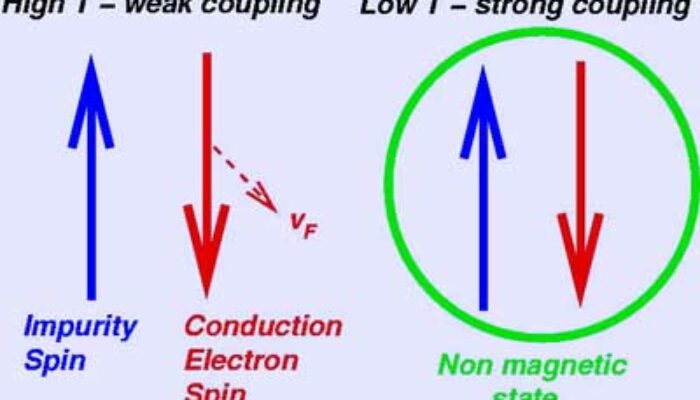
At the heart of the Kondo effect lies the concept of spin screening. When conduction electrons interact with the magnetic impurity, their spins tend to align or anti-align due to the exchange interaction, quantified by the Kondo coupling constant. This many-body interaction leads to the screening of the impurity’s magnetic moment by the surrounding electron cloud, effectively reducing the localized spin at low temperatures. The result is the formation of a sharp peak in the electronic density of states at the Fermi level, known as the Kondo resonance, which dominates the system’s low-temperature behavior.
Temperature Dependence of Resistivity
The hallmark of the Kondo effect is its distinctive influence on electrical resistivity as temperature varies. At high temperatures, magnetic impurity scattering is minimal, and the metal exhibits conventional behavior with decreasing resistivity. However, as the temperature approaches the characteristic Kondo temperature, resistivity reverses its trend and increases, reflecting enhanced electron scattering due to the Kondo resonance. This crossover marks the transition from weak to strong coupling regimes in the system.
Advanced Theoretical Approaches
Understanding the full complexity of the Kondo problem requires sophisticated theoretical tools. Renormalization group techniques, particularly the numerical renormalization group (NRG), have been instrumental in analyzing the many-body interactions across different energy scales. These methods allow physicists to connect microscopic spin interactions with macroscopic observables such as resistivity and magnetic susceptibility, providing a comprehensive picture of the Kondo effect.
Extensions and Variations of the Kondo Problem
The Kondo problem extends beyond the single impurity scenario, encompassing a variety of more complex systems:
- Multi-Channel Kondo Effect:
Occurs when multiple independent conduction electron channels interact with a single magnetic impurity, leading to richer collective phenomena and non-Fermi liquid behavior. - Kondo Lattice Model:
Describes a periodic array of magnetic impurities interacting with conduction electrons, where inter-impurity interactions via the Ruderman-Kittel-Kasuya-Yosida (RKKY) mechanism give rise to novel states such as heavy fermion behavior.
Applications in Nanostructures and Quantum Dots
The principles of Kondo physics have been successfully applied to nanoscale systems, including quantum dots and engineered nanostructures. In these settings, parameters like coupling strength and temperature can be finely tuned, enabling experimental exploration of Kondo phenomena. For example, a quantum dot containing a single magnetic impurity can be manipulated via gate voltages to observe Kondo resonances, offering insights into quantum coherence and electron correlations. These advances hold promise for quantum computing, where control over quantum states is essential for information processing.
Common Misconceptions About the Kondo Effect
The Kondo effect only increases resistivity at all temperatures.
The resistivity increase occurs only below the Kondo temperature; above this, resistivity behaves conventionally and decreases with temperature.
The Kondo effect is a simple single-particle phenomenon.
It is a complex many-body effect involving collective interactions between the impurity spin and conduction electrons.
Significance of the Kondo Problem
The Kondo problem is pivotal in advancing our understanding of electron correlations and magnetic interactions in solids. It challenges classical intuitions about metallic behavior and provides a framework for studying emergent quantum phenomena. Beyond fundamental physics, insights from Kondo physics influence the design of novel materials and quantum devices, highlighting its enduring importance in both theoretical and applied research.
FAQ
What is the Kondo problem?
The Kondo problem studies how a magnetic impurity in a metal interacts with conduction electrons, causing anomalous behavior in electrical resistance at low temperatures.
Why does resistivity increase at low temperatures in the Kondo effect?
Because conduction electrons scatter off the magnetic impurity's spin more strongly as temperature decreases, enhancing resistivity below the Kondo temperature.
Is the Kondo effect a simple single-particle phenomenon?
No, it is a complex many-body quantum effect involving collective interactions between the impurity spin and conduction electrons.
How is the Kondo problem modeled theoretically?
It is modeled by the Kondo Hamiltonian, which includes kinetic energy of electrons, localized impurity spin, and their exchange interaction.
What are some applications of Kondo physics?
Kondo physics is applied in nanoscale systems like quantum dots and nanostructures, with implications for quantum computing and material design.



Leave a Reply