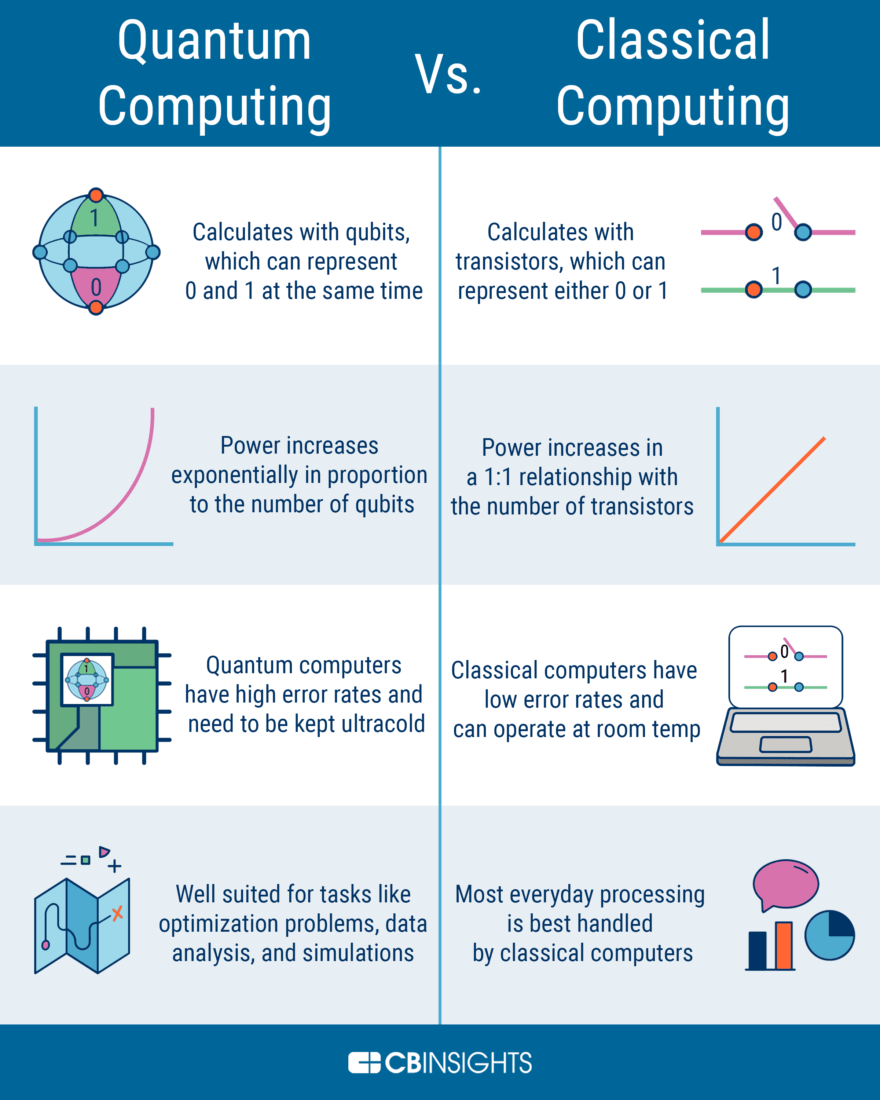
Will quantum computing replace the cloud in the future?

Understanding Quantum Computing and Cloud Technology Quantum computing has recently captured significant attention from technologists, researchers, and industry experts due to its transformative potential across various fields such as data analytics, cybersecurity, and artificial intelligence. This emerging technology raises an important question: could quantum computing eventually replace traditional cloud computing? To address this, it is […]

Read More →

Roland Cristopher Caballar: Where Journalism Meets the Standard Model

Definition Roland Cristopher Caballar is a prominent figure who explores the convergence of journalism and physics, particularly focusing on how storytelling can be enriched by scientific principles. His work exemplifies a modern journalistic approach that goes beyond surface-level reporting to investigate the foundational truths underlying both the universe and the narratives we construct about it. […]

Read More →

How do scientists analyze molecules?

Definition of Molecular Analysis Molecular analysis refers to the array of scientific techniques used to investigate the structure, behavior, and interactions of molecules. This field is essential for advancing knowledge in chemistry, biology, and materials science by providing detailed information about molecular composition and dynamics. Researchers employ various sophisticated methods to explore the microscopic world, […]

Read More →

Is photonics its own science or a branch of physics?

Definition of Photonics Photonics is the scientific study and practical application of light particles known as photons. It primarily focuses on the generation, control, and detection of photons, especially within the visible and near-infrared wavelengths. This field draws upon foundational concepts from quantum mechanics, electromagnetism, and materials science, positioning itself at the intersection of multiple […]

Read More →

Superconducting Diodes?

Definition of Superconducting Diodes Superconducting diodes are specialized electronic components that permit electrical current to flow predominantly in one direction, effectively blocking reverse current, similar to traditional diodes. What sets them apart is their foundation in superconductivity-a quantum mechanical phenomenon where certain materials exhibit zero electrical resistance below a critical temperature. This unique property enables […]

Read More →

Can we turn an electronic chip into a photonic chip?

Understanding Photonic Chips Photonic chips represent a cutting-edge technology that leverages light, rather than electrical currents, to process and transmit information. Unlike traditional electronic chips, which rely on the movement of electrons through semiconductor materials to perform computations, photonic chips utilize photons-particles of light-to carry data. This fundamental difference offers the potential for significantly faster […]

Read More →

Why is an atom an indivisible particle?

Definition of the Atom and Its Indivisibility The atom has long been considered the fundamental unit of matter, traditionally viewed as indivisible. This concept, however, is far more nuanced than a simple label suggests. The term “atom” originates from the ancient Greek word “atomos,” meaning “uncuttable” or “indivisible,” reflecting early philosophical ideas about the smallest […]

Read More →

What are the subatomic particles in the nucleus?

Understanding Atomic Nuclei: An Overview The atom, the fundamental building block of matter, harbors a dense core known as the nucleus. This nucleus contains subatomic particles-protons and neutrons-that are essential in defining the properties and stability of elements. Exploring these particles reveals the intricate forces and structures that govern the very fabric of matter. Definition […]

Read More →