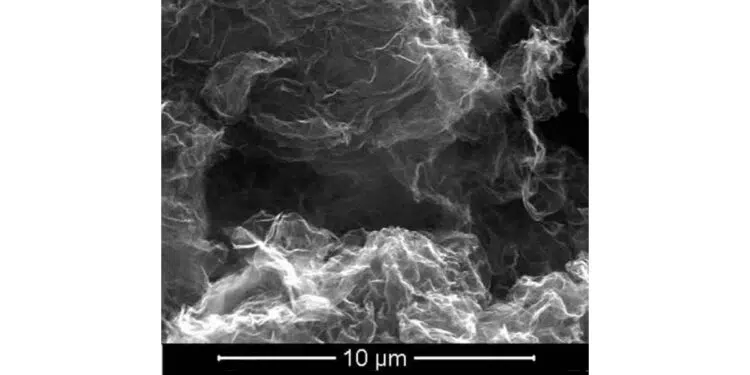
Liu Sheng and the Rise of Layered Material Physics

Definition and Overview of Layered Materials Layered materials are a class of substances characterized by their two-dimensional (2D) atomic arrangements, where individual layers are stacked and held together by weak van der Waals forces. This unique structural feature allows for remarkable tunability in their physical and chemical properties, making them a focal point in modern […]

Read More →

Can string theory explain a strong nuclear force?

Definition of the Strong Nuclear Force The strong nuclear force is a fundamental interaction that governs the behavior of subatomic particles within an atomic nucleus. It is one of the four essential forces in nature, responsible for binding protons and neutrons together despite the repulsive electromagnetic forces between positively charged protons. This force operates over […]

Read More →

Slowing Light with Caesium: Optical Images in Slow Motion

Understanding Light and Its Fundamental Properties Light, a fundamental entity in optical physics, consists of photons and exhibits both wave-like and particle-like characteristics. Traveling at an extraordinary speed of approximately 299,792,458 meters per second in a vacuum-denoted by the constant c-light’s velocity is a cornerstone of modern physics. However, when light passes through various substances […]

Read More →

Is quantum computing based on zero and one?

Understanding Quantum Computing Quantum computing represents a groundbreaking domain within information technology that has garnered significant attention from researchers and industry experts. Central to this field is the question: Does quantum computing fundamentally rely on the binary system of zeros and ones? Addressing this question requires a detailed comparison between classical computing and quantum computing, […]

Read More →

Is natural gas better than electricity for the environment?

Definition of Natural Gas and Electricity Natural gas is a fossil fuel predominantly composed of methane, extracted from underground reservoirs. It serves multiple functions such as heating, cooking, and electricity generation. Electricity, on the other hand, is a versatile energy form produced from diverse sources including fossil fuels, nuclear power, and renewables like solar, wind, […]

Read More →

Can quantum computing change the world?

Understanding Quantum Computing Quantum computing is an innovative computational approach grounded in the principles of quantum mechanics. It has swiftly emerged as a significant area of research and development, promising to revolutionize how complex problems are solved. This technology raises a critical question: can quantum computing fundamentally transform our world? To answer this, it is […]

Read More →

Which state of matter has the highest degree of order?

Definition of Solids and Their Structural Order In classical physics, matter exists in several states: solid, liquid, gas, and plasma. Each state is distinguished by unique physical characteristics and behaviors. Solids, in particular, are notable for their pronounced structural organization, which sets them apart from other states of matter. This article examines the distinctive features […]

Read More →

How can you improve the accuracy of your measurements?

Definition of Measurement Accuracy Measurement accuracy refers to the degree to which a measured value aligns with the true or accepted standard. It is a fundamental aspect of scientific research and experimentation, as the precision of measurements directly impacts the credibility and validity of data and conclusions. Achieving high accuracy involves minimizing errors and uncertainties […]

Read More →

Why do we not have 2-level lasers?

Definition of Laser Systems Lasers are devices that convert energy into a highly organized and coherent beam of light, profoundly impacting fields such as telecommunications, healthcare, and industrial manufacturing. The term “laser” stands for Light Amplification by Stimulated Emission of Radiation, describing the fundamental process by which lasers operate. Central to this process is a […]

Read More →

What is meant in particle physics by the term hermeticity?

Definition of Hermeticity in Particle Physics Hermeticity is a fundamental concept in particle physics that pertains to the mathematical and physical properties of quantum systems. It primarily refers to the hermitian nature of operators that represent physical observables in quantum mechanics. These operators, which correspond to measurable quantities such as energy, momentum, and position, must […]

Read More →