
Short Answer
Understanding Neutrinos
Neutrinos are fundamental subatomic particles characterized by their extremely small mass and lack of electric charge. Generated abundantly through stellar phenomena such as nuclear fusion within the sun, these particles are integral to the study of particle physics and astrophysics. Their elusive nature, stemming from their minimal interaction with matter, makes them both challenging to detect and invaluable for probing the universe’s deepest mysteries.
- Properties:
Neutrinos are nearly massless, electrically neutral, and interact very weakly with other particles. - Origin:
They are primarily produced in vast numbers by nuclear reactions in stars, including our sun. - Significance:
Their behavior and characteristics provide critical insights into fundamental physics and cosmology.
Neutrino Detection at Gran Sasso National Laboratory
Located beneath the Apennine Mountains in Italy, the Gran Sasso National Laboratory (LNGS) is a premier facility dedicated to neutrino research. Its underground position, approximately 1,400 meters below the surface, offers exceptional shielding from cosmic radiation, which is essential for isolating the faint signals produced by neutrino interactions. This strategic location enables experiments to achieve unprecedented sensitivity in detecting these elusive particles.
The Borexino Experiment
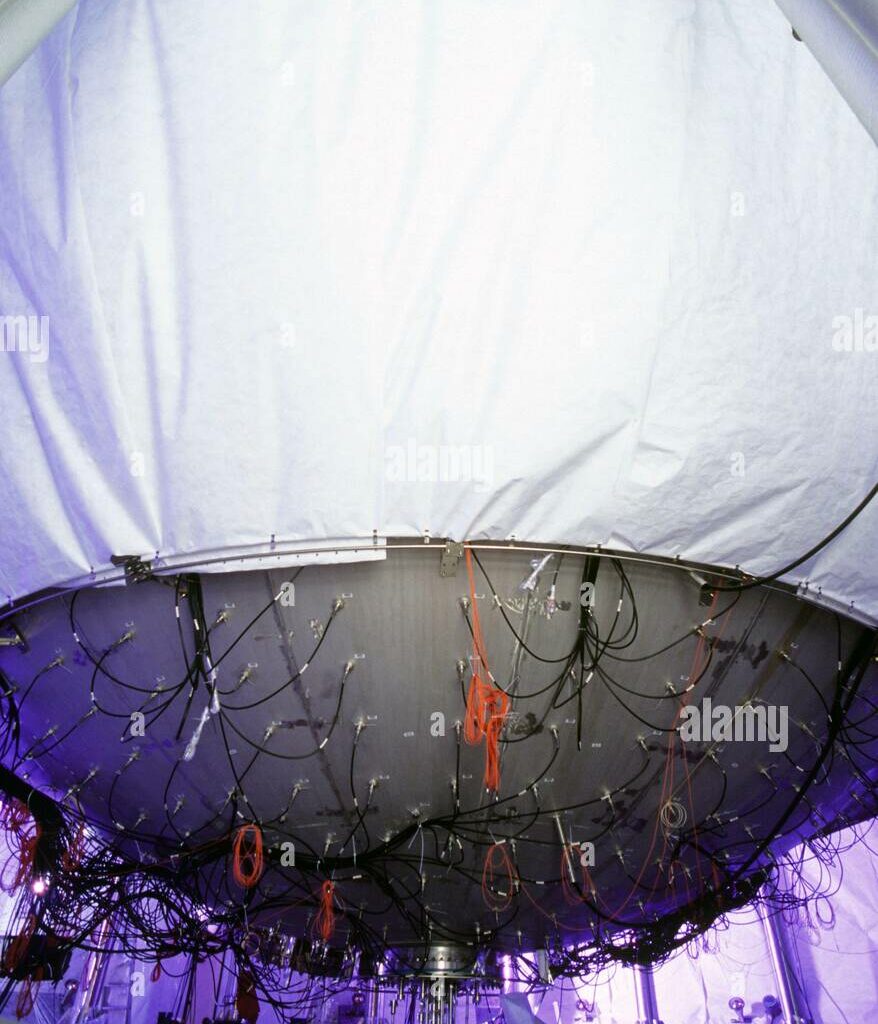
Initiated in 2007, the Borexino experiment is a flagship project at LNGS focused on the precise measurement of solar neutrinos. It utilizes a large spherical detector filled with a liquid scintillator-a substance that emits light when neutrinos interact with its atoms. This innovative detection technique allows scientists to observe neutrinos from various solar fusion processes with remarkable accuracy, providing empirical validation for theoretical models of stellar energy production.
Scientific Breakthroughs from Borexino
The Borexino experiment has yielded several landmark discoveries that have reshaped our understanding of both neutrinos and stellar physics. One of its major achievements is the detection of neutrinos originating from the full range of solar fusion reactions, confirming the complex mechanisms powering the sun.
Additionally, Borexino has contributed to the confirmation of neutrino oscillation-a phenomenon where neutrinos change their type, or “flavor,” as they travel through space. This behavior implies that neutrinos possess mass, a revelation that challenges earlier assumptions within the Standard Model of particle physics and opens new avenues for exploring phenomena such as dark matter and the imbalance between matter and antimatter in the universe.
Expanding the Scope: Geoneutrinos and Earth Sciences
Beyond solar neutrinos, Borexino also investigates geoneutrinos, which are neutrinos emitted by radioactive decay processes occurring within the Earth’s interior. Studying these particles offers a unique window into the planet’s internal heat generation and geological activity, enhancing our understanding of Earth’s composition and dynamic processes.
Philosophical and Cosmological Implications
The study of neutrinos extends beyond physics into profound philosophical questions about the nature of reality. Their pervasive yet nearly undetectable presence challenges our perceptions of time, space, and the fundamental structure of the cosmos. Understanding how such minuscule particles influence large-scale cosmic phenomena invites deeper reflection on the interconnectedness of all matter and energy.
Collaborative Efforts and Future Directions
The ongoing research at Gran Sasso exemplifies a multidisciplinary approach, uniting physicists, cosmologists, geologists, and philosophers in a shared quest for knowledge. International collaborations continue to expand, fostering innovative experimental designs and detection technologies aimed at enhancing sensitivity and broadening the scope of neutrino studies.
Future projects envision exploring higher energy scales and investigating theoretical frameworks such as supersymmetry and force unification, potentially revolutionizing our understanding of fundamental physics.
Why Neutrino Research is Crucial
Neutrino research holds significant importance across multiple scientific domains. It not only deepens our comprehension of particle physics and stellar processes but also informs geological studies and cosmological theories. The insights gained from neutrino experiments contribute to unraveling the universe’s origin, composition, and evolution, making this field a cornerstone of modern scientific inquiry.
Summary and Outlook
As the Borexino experiment embarks on new phases of investigation, the scientific community stands on the threshold of transformative discoveries. This endeavor embodies human curiosity and the power of collaborative research, promising to illuminate the fundamental workings of the universe. The continued exploration of neutrinos invites both experts and enthusiasts to engage with the profound questions at the heart of existence, driving forward our collective understanding of the cosmos.
FAQ
What are neutrinos?
Neutrinos are fundamental subatomic particles with very small mass and no electric charge, produced in nuclear reactions in stars.
What is the Gran Sasso National Laboratory?
The Gran Sasso National Laboratory is an underground research facility in Italy dedicated to neutrino research, providing exceptional shielding from cosmic radiation.
Why is the Borexino experiment significant?
The Borexino experiment measures solar neutrinos with high accuracy, confirming theoretical models of stellar energy production and neutrino oscillation.






Leave a Reply