
Short Answer
Understanding Black Holes and Their Proximity
Could our solar system be quietly orbiting a black hole without our knowledge? While this notion might initially seem like a concept from science fiction or a speculative idea among astrophysicists, it raises a legitimate scientific question about the nature of our galactic environment. Black holes, often depicted as mysterious gravitational traps, are typically thought to reside in distant, obscure regions of space, far from familiar planetary systems. However, the possibility that a black hole might be closer than expected-perhaps subtly influencing the dynamics of our solar system-warrants careful examination.
Definition and Characteristics of Black Holes
Black holes are regions in space where gravity is so intense that nothing, not even light, can escape their pull. Contrary to popular belief, they are not cosmic vacuum cleaners indiscriminately consuming everything nearby. Their gravitational influence depends on their mass and the distance from other objects, following the fundamental laws of physics.
- Mass and Gravity:
The strength of a black hole’s gravitational pull is proportional to its mass and inversely proportional to the square of the distance from it. - Event Horizon:
The boundary around a black hole beyond which nothing can return is called the event horizon. - Types:
Black holes range from stellar-mass black holes formed by collapsing stars to supermassive black holes residing at galactic centers.
Black Holes in Our Galactic Neighborhood
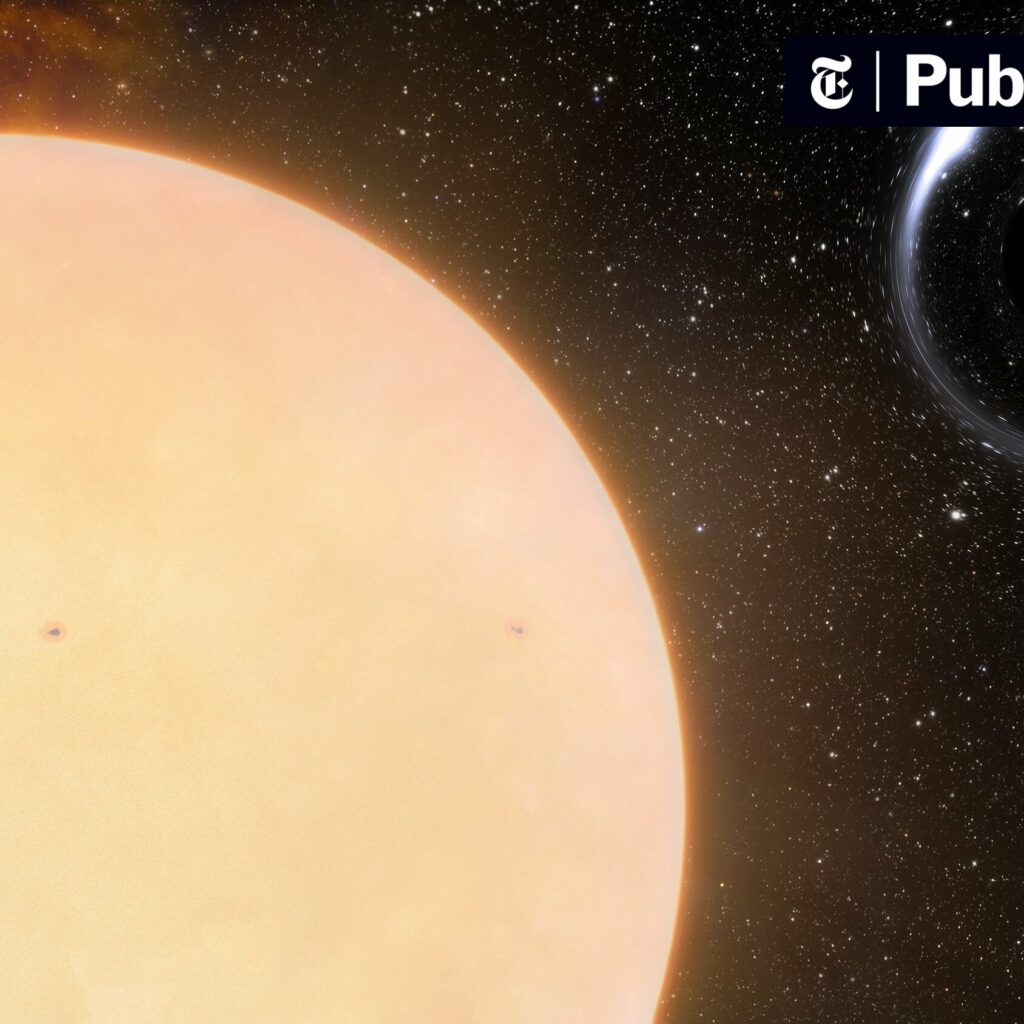
Recent astronomical discoveries have revealed black holes in surprisingly close proximity to other stars and within binary systems. These findings suggest that black holes, remnants of massive stars’ deaths, may be more common in our galaxy than previously assumed. This raises the question of whether a small, undetected black hole could be lurking near our solar system, exerting subtle gravitational effects that have so far escaped detection.
Rogue Black Holes: Cosmic Wanderers
Some black holes travel through interstellar space without being bound to any star, known as rogue black holes. These nomadic objects can drift through dense star fields or near planetary systems like ours. Their transient presence and the limitations of current detection methods make them difficult to observe. Particularly elusive are low-mass, inactive black holes that lack accretion disks and thus emit no detectable electromagnetic radiation.
Orbital Dynamics and Black Holes
To understand what it means to orbit a black hole, one must consider the balance between gravitational forces and orbital velocity. Our solar system itself orbits the Milky Way’s center, where a supermassive black hole named Sagittarius A* resides approximately 26,000 light-years away. This massive black hole governs the motion of stars and nebulae in the galaxy but is too distant to directly disrupt our solar system’s stability.
The possibility of a smaller black hole closer to us remains speculative but intriguing. Such an object, if quiescent and lacking an accretion disk, might resemble a faint star gravitationally or remain invisible against the cosmic backdrop.
Methods for Detecting Nearby Black Holes
Detecting black holes, especially those without active accretion disks, relies on indirect methods such as gravitational microlensing and stellar dynamics analysis.
Gravitational Microlensing
This phenomenon occurs when a massive object, like a black hole, passes between an observer and a distant star, bending and magnifying the star’s light due to gravity. Projects like the Optical Gravitational Lensing Experiment (OGLE) have successfully used this technique to identify black holes within a few thousand light-years of Earth, including isolated and binary systems.
Stellar Dynamics and Astrometry
Precise measurements of stars’ positions and velocities can reveal gravitational disturbances caused by unseen massive objects. Space missions such as Gaia have enhanced our ability to detect subtle orbital anomalies, potentially indicating the presence of nearby black holes. Discovering such an object would significantly deepen our understanding of the local galactic environment.
Implications of a Nearby Black Hole
The existence of a black hole orbiting near our solar system would have profound scientific and existential consequences. It could serve as a natural laboratory for studying gravity, spacetime, and relativistic phenomena. However, it could also pose risks, including tidal forces, radiation from accretion processes, and potential destabilization of planetary orbits. The current stability of our solar system suggests that if such a black hole exists, it is either distant enough or possesses characteristics that minimize its impact.
Significance in Cosmic Context
Contemplating the presence of a hidden black hole near us highlights the vastness and complexity of the universe. Black holes are now recognized as essential components in the evolution of galaxies and the cosmic structure. Their gravitational influence shapes star formation, galactic growth, and the distribution of matter and energy throughout the cosmos.
Common Misconceptions About Black Holes
Black holes suck in everything around them like cosmic vacuum cleaners.
Black holes exert gravitational forces proportional to their mass and distance, similar to any other massive object.
Black holes are always easy to detect because they emit light.
Many black holes, especially dormant ones without accretion disks, emit no light and are detected only through indirect gravitational effects.
A black hole near Earth would immediately cause catastrophic effects.
The absence of disruptions in our solar system indicates that any nearby black hole would either be too distant or have minimal influence.
Conclusion: The Ongoing Quest to Map Our Cosmic Surroundings
The question of whether we are secretly orbiting a black hole bridges curiosity and scientific inquiry, urging us to expand our observational capabilities and theoretical understanding. As astronomical technology advances, our ability to chart the dark and hidden regions of space improves, revealing the intricate dance of celestial bodies. Whether or not a stealthy black hole lurks near us remains an open question, underscoring the universe’s enduring mystery and the continuous journey of discovery.
FAQ
What is a black hole?
A black hole is a region in space where gravity is so strong that nothing can escape from it, including light.
Can we detect black holes?
Yes, black holes can be detected indirectly through methods like gravitational microlensing and observing the motion of stars around them.
What are rogue black holes?
Rogue black holes are black holes that move through space without being bound to any star or system.


Leave a Reply