
Short Answer
Understanding Magnetism: A Comprehensive Overview
Magnetism, commonly encountered in everyday life, encompasses a rich and intricate set of phenomena that bridge classical physics and quantum mechanics. This article aims to dissect the multifaceted nature of magnetism, emphasizing its quantum foundations while preserving the essence of classical interpretations.
Definition of Magnetism
Magnetism refers to the force exerted by magnets when they attract or repel each other or certain materials. It originates from the motion and intrinsic properties of electrons within atoms, manifesting as magnetic fields and magnetic moments.
- Classical Magnetism:
Traditionally observed in magnets and ferromagnetic materials, explained by macroscopic magnetic fields and dipole interactions. - Quantum Magnetism:
Rooted in the quantum mechanical properties of electrons, such as spin and exchange interactions, which govern magnetic behavior at microscopic scales.
Historical Context and Evolution
Initially, magnetism was understood through classical physics, exemplified by the alignment of compass needles with Earth’s magnetic field. However, as experimental techniques advanced, classical theories proved inadequate to explain magnetic phenomena at atomic and subatomic levels. This realization propelled the scientific community toward quantum mechanics, which offered a deeper insight into the origins and mechanisms of magnetism.
Quantum Foundations of Magnetism
Electron Spin and Magnetic Moments
At the heart of quantum magnetism lies the electron’s intrinsic property called spin, a form of angular momentum that does not have a classical counterpart. Each electron behaves like a tiny magnet due to its spin, generating a magnetic moment. When multiple electrons in a material align their spins coherently, they produce a collective magnetic field responsible for various magnetic states.
Exchange Interactions and Spin Alignment
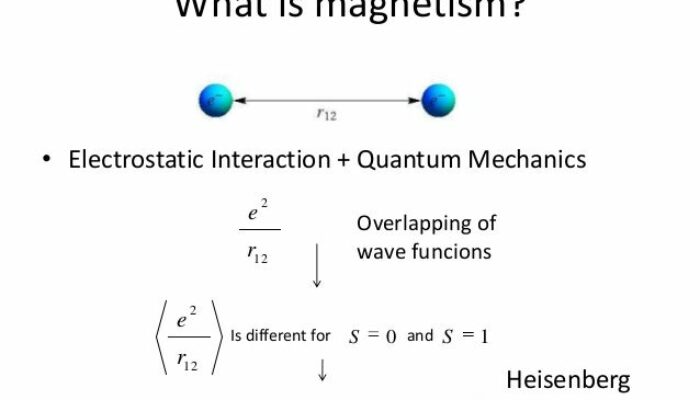
Quantum mechanics introduces the concept of exchange interactions, a phenomenon arising from the quantum superposition and entanglement of electron spins. These interactions energetically favor certain spin configurations, such as parallel alignment in ferromagnets, leading to the emergence of macroscopic magnetism. This effect cannot be explained by classical physics alone.
Heisenberg Uncertainty Principle and Magnetic Behavior
The Heisenberg Uncertainty Principle imposes fundamental limits on simultaneously knowing certain pairs of physical properties, such as position and momentum. This intrinsic uncertainty affects electron spins, contributing to complex collective behaviors in magnetic materials that classical models fail to predict.
Varieties of Quantum Magnetic Phenomena
Ferromagnetism, Antiferromagnetism, and Ferrimagnetism
These magnetic orders arise from different patterns of spin alignment:
- Ferromagnetism:
Electron spins align parallel, producing a strong net magnetic field. - Antiferromagnetism:
Adjacent spins align antiparallel, canceling out the overall magnetization. - Ferrimagnetism:
Similar to antiferromagnetism but with unequal opposing spins, resulting in a net magnetic moment.
Quantum Spin Liquids and Fluctuations
In certain materials at near absolute zero temperatures, spins do not order but remain in a fluctuating, disordered state known as a quantum spin liquid. This state defies classical expectations and highlights the profound influence of quantum fluctuations on magnetism.
Magnetism in Superconductors
Superconductivity exemplifies the quantum nature of magnetism through the formation of Cooper pairs-paired electrons that move coherently without resistance. A hallmark of superconductors is the Meissner effect, where magnetic fields are expelled from the material’s interior below a critical temperature, demonstrating the interplay between quantum coherence and magnetic phenomena.
Topological Magnetism and Emerging Technologies
Topological magnetism explores magnetic structures stabilized by their topological properties rather than energy minimization alone. Examples include magnetic monopole analogs and skyrmions-stable, localized spin textures with potential applications in spintronics and quantum computing. These exotic states open new avenues for manipulating magnetic information at the quantum level.
Applications of Quantum Magnetism
Magnetic Resonance Imaging (MRI)
MRI technology harnesses the quantum magnetic properties of atomic nuclei in strong magnetic fields. By exploiting nuclear spin transitions and quantum angular momentum, MRI produces detailed images of biological tissues, revolutionizing medical diagnostics.
Future Prospects
Advances in understanding quantum magnetism promise transformative impacts on energy storage, magnetic sensors, and quantum information processing. The integration of quantum magnetic principles into technology heralds a new era of innovation across multiple scientific disciplines.
Common Misconceptions About Magnetism
Magnetism is purely a classical phenomenon.
While classical effects are observable, magnetism fundamentally arises from quantum properties like electron spin and exchange interactions.
Electron spin is analogous to a spinning ball.
Electron spin is a quantum property without a direct classical analog; it represents intrinsic angular momentum rather than physical spinning.
All magnetic materials behave like simple bar magnets.
Magnetic behavior varies widely, including complex states like antiferromagnetism and quantum spin liquids that do not resemble classical magnets.
Significance of Quantum Magnetism
Understanding magnetism through the lens of quantum mechanics enriches our comprehension of fundamental physics and drives technological progress. It bridges microscopic quantum phenomena with macroscopic effects, enabling innovations in medical imaging, data storage, and quantum computing. The study of quantum magnetism continues to challenge and expand the boundaries of science, offering profound insights into the nature of matter and energy.
Frequently Asked Questions (FAQ)
Is magnetism exclusively a quantum effect?
Magnetism emerges from quantum mechanical properties such as electron spin and exchange interactions but also exhibits classical manifestations. Therefore, it is best described as a phenomenon with intertwined classical and quantum aspects.
What is the significance of electron spin in magnetism?
Electron spin is a fundamental quantum attribute that generates magnetic moments. The collective alignment of these spins in materials leads to various magnetic phenomena, including ferromagnetism and antiferromagnetism.
How does quantum mechanics explain ferromagnetism?
Ferromagnetism is explained by exchange interactions, where electron spins become entangled and energetically favor parallel alignment, resulting in a large-scale magnetic field.
What is the Meissner effect observed in superconductors?
The Meissner effect describes the expulsion of magnetic fields from a superconductor’s interior when cooled below its critical temperature, a phenomenon arising from the quantum coherence of Cooper pairs.
What are topological magnetic structures?
Topological magnetic structures, such as skyrmions, are stable spin configurations maintained by their topological properties. These structures hold promise for applications in spintronics and quantum computing due to their robustness and unique magnetic characteristics.
FAQ
Is magnetism purely a quantum phenomenon?
Magnetism arises from quantum mechanical properties of electrons, such as spin and exchange interactions, but it also has classical manifestations. Thus, it is best understood as a phenomenon with both classical and quantum aspects.
What role does electron spin play in magnetism?
Electron spin is an intrinsic quantum property that generates magnetic moments. The alignment of these spins in materials leads to various types of magnetism like ferromagnetism and antiferromagnetism.
How does quantum mechanics explain ferromagnetism?
Quantum mechanics explains ferromagnetism through exchange interactions, where electrons' spins become entangled and energetically favor parallel alignment, creating a macroscopic magnetic field.
What is the Meissner effect in superconductors?
The Meissner effect is the expulsion of magnetic fields from the interior of a superconductor when it transitions below its critical temperature, a phenomenon explained by the quantum coherence of Cooper pairs.
What are topological magnetic structures?
Topological magnetic structures, such as skyrmions, are stable, localized spin configurations whose stability arises from their topological properties, and they hold promise for future quantum computing and spintronics applications.



Leave a Reply