
Short Answer
Definition of Gravity and Space-Time Curvature
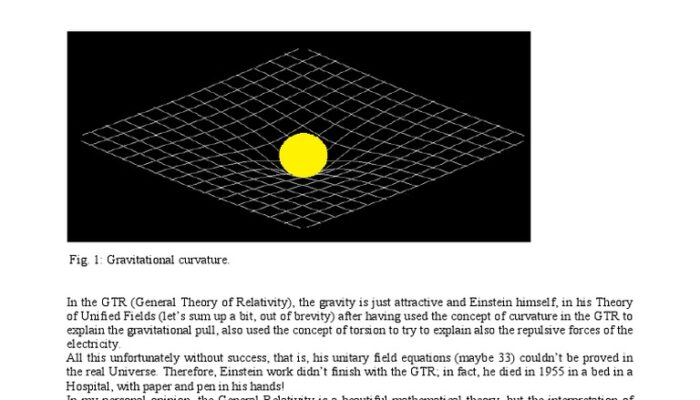
Gravity is a fundamental interaction that governs the attraction between masses, influencing everything from falling objects on Earth to the motion of celestial bodies. Modern physics reinterprets gravity not as a conventional force but as a manifestation of the curvature of space-time-a four-dimensional continuum combining three spatial dimensions with time. This geometric perspective revolutionizes our understanding by describing gravity as the bending of this fabric caused by mass and energy.
Conceptual Framework: From Newtonian Gravity to Einstein’s Geometry
Traditional Newtonian physics viewed gravity as a force acting instantaneously at a distance between two masses. However, this view was superseded by Einstein’s general theory of relativity, which proposes that space and time form a dynamic, flexible manifold known as space-time. Massive objects distort this manifold, creating curves and depressions that influence the motion of other bodies. Instead of being pulled by a mysterious force, objects move along the curved paths-called geodesics-defined by the warped geometry of space-time.
- Space-Time Fabric:
A four-dimensional continuum integrating space and time into a single entity. - Mass-Energy Influence:
Mass and energy cause the space-time fabric to bend, altering the trajectories of objects. - Geodesics:
The straightest possible paths in curved space-time that objects follow under gravity.
How Space-Time Curvature Produces Gravitational Effects
The analogy of a stretched rubber sheet helps visualize this concept: placing a heavy ball on the sheet creates a depression, causing smaller balls nearby to roll inward, not because of a direct force but due to the altered surface guiding their motion. Similarly, in the universe, massive bodies warp space-time, and other objects move along these curved paths. This geometric interpretation explains why planets orbit stars and why objects fall toward Earth without invoking an invisible force acting at a distance.
Propagation of Gravitational Influence and Gravitational Waves
Unlike the classical idea of instantaneous gravitational action, changes in the distribution of mass and energy propagate through space-time at the speed of light. These disturbances travel as gravitational waves-ripples in the fabric of space-time-confirming the local nature of gravitational interaction. The detection of gravitational waves has provided strong empirical support for Einstein’s theory and deepened our understanding of gravity’s dynamic character.
Mathematical Description of Space-Time Curvature
Gravity’s geometric nature is mathematically described by Einstein’s field equations:
Gμν + Λgμν = (8πG/c⁴) Tμν
- Gμν: Einstein tensor representing space-time curvature.
- Λ: Cosmological constant, accounting for the energy density of empty space.
- gμν: Metric tensor describing the geometry of space-time.
- Tμν: Stress-energy tensor representing matter and energy content.
- G: Gravitational constant.
- c: Speed of light.
These equations relate the curvature of space-time to the energy and momentum of whatever matter and radiation are present, forming the foundation of general relativity.
Applications and Phenomena Explained by Space-Time Curvature
The concept of curved space-time elucidates a wide range of physical phenomena:
- Orbital Mechanics:
Planetary orbits arise from objects following geodesics around massive bodies. - Black Holes:
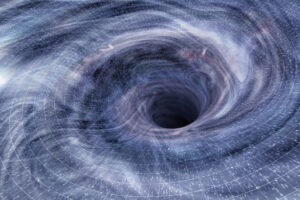
Regions where space-time curvature becomes extreme, preventing even light from escaping. - Cosmic Expansion:
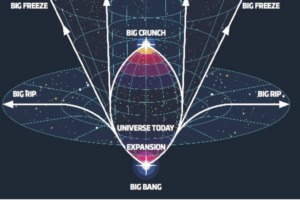
Galaxies move apart not through space but as space-time itself expands. - Gravitational Lensing:
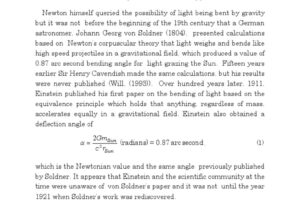
Light bends around massive objects due to curved space-time, producing observable lensing effects.
Common Misconceptions About Gravity and Space-Time
Gravity is a force acting instantaneously across space.
Gravitational effects propagate at the speed of light through changes in space-time curvature.
Space and time are fixed, unchanging backgrounds.
Space-time is a dynamic entity that bends and evolves in response to mass and energy.
Gravity pulls objects through empty space.
Objects move along curved paths defined by the geometry of space-time itself.
Significance of Understanding Gravity as Space-Time Curvature
Recognizing gravity as a geometric property of space-time has profound implications for science and technology. It unifies diverse phenomena under a single theoretical framework, enabling precise predictions of planetary motion, GPS satellite functionality, and the behavior of light near massive bodies. Moreover, it opens pathways to exploring the universe’s most extreme environments, such as black holes and the early cosmos, and guides ongoing efforts to merge gravity with quantum mechanics into a comprehensive theory of quantum gravity.
Future Directions: Gravity and Quantum Mechanics
The intersection of space-time curvature and quantum theory remains one of the most compelling frontiers in physics. Researchers aim to develop a quantum theory of gravity that explains how space-time geometry emerges from quantum processes. This endeavor promises to deepen our understanding of the universe’s fundamental structure and resolve longstanding puzzles about the nature of reality at the smallest scales.
Everyday Manifestations of Space-Time Curvature
Though subtle in daily life, the effects of space-time curvature are constantly at play. The simple act of a dropped object falling, the rhythmic rise and fall of ocean tides, and the stable orbits of satellites all reflect the underlying geometry shaped by Earth’s mass. These familiar experiences connect us to the profound cosmic dance governed by the curvature of space and time.
Summary
The reinterpretation of gravity as the curvature of space-time transforms a familiar force into an elegant geometric principle. Mass and energy sculpt the fabric of the universe, directing the motion of matter and light through curved pathways. This insight not only explains everyday gravitational phenomena but also illuminates the workings of black holes, cosmic expansion, and the fundamental nature of reality, inspiring ongoing scientific discovery and philosophical reflection.
FAQ
What is gravity?
Gravity is the interaction that pulls masses together, explained as the curvature of space-time in Einstein’s general relativity.
How does space-time curvature affect objects?
Massive objects warp space-time, causing other objects to follow curved paths, which is perceived as gravitational attraction.

Leave a Reply