
Short Answer
Definition of Gravity’s Role in Stellar Evolution
Gravity is the fundamental force that governs the formation, structure, and ultimate fate of stars. Far from being mere points of light, stars are dynamic systems where gravity continuously balances against internal pressures, shaping their size, brightness, and lifespan. This invisible force acts as the cosmic architect, orchestrating the life cycle of stars from their birth in molecular clouds to their final remnants.
Star Formation: The Birthplace of Gravity’s Influence
Stars originate within dense molecular clouds scattered throughout galaxies, primarily composed of hydrogen and helium. Gravity initiates star formation by pulling together gas and dust within these clouds, causing them to contract and increase in density. As the core temperature rises due to this compression, conditions become ripe for nuclear fusion. However, this process is complex, influenced by turbulent gas motions, magnetic fields, and external forces that can either promote collapse or cause the cloud to disperse.
Hydrostatic Equilibrium: The Balance of Forces Within a Star
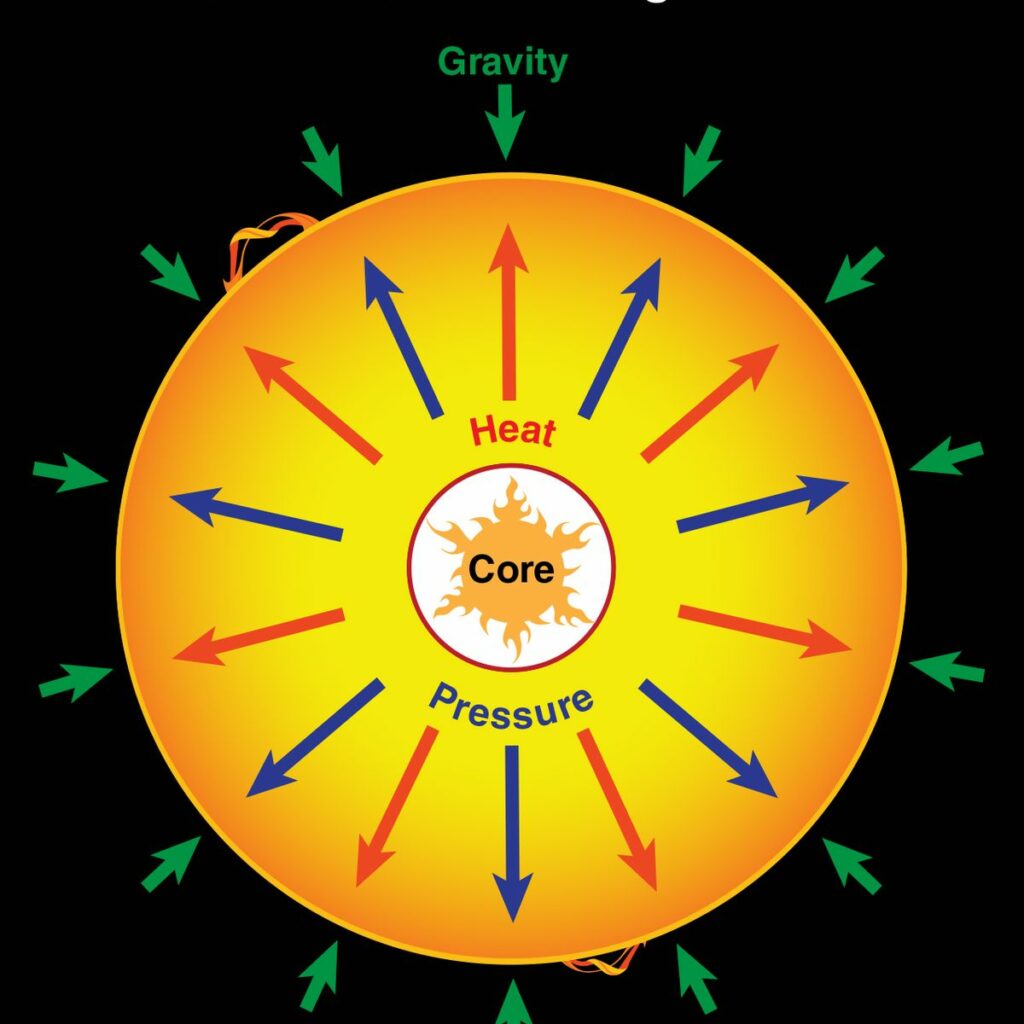
When a contracting cloud reaches a critical density and temperature, nuclear fusion ignites, converting hydrogen into helium. The energy released generates radiation pressure that pushes outward, counteracting gravity’s inward pull. This balance, known as hydrostatic equilibrium, stabilizes the star’s size and prevents it from collapsing or expanding uncontrollably. Gravity thus directly determines the star’s dimensions by maintaining this delicate equilibrium.
Mass and Its Impact on Stellar Destiny
The initial mass of a star, set by the conditions of its birth cloud, is the key factor that gravity influences to determine its evolutionary path. Larger stars possess stronger gravitational forces, leading to higher core pressures and temperatures. These massive stars consume their nuclear fuel rapidly, resulting in shorter, more intense lifespans. Conversely, stars with lower mass experience gentler gravitational compression, slower fusion rates, and consequently, longer lifetimes.
Stellar Mass Categories and Outcomes
- Low to Medium Mass Stars:
These stars, like our Sun, maintain a stable main-sequence phase lasting billions of years, balancing gravitational contraction with fusion pressure. - High Mass Stars:
Stars several times the Sun’s mass undergo dramatic evolutionary stages, expanding into supergiants, shedding outer layers, and ending as supernovae, neutron stars, or black holes.
The Lifecycle of Stars: Gravity’s Enduring Narrative
As nuclear fuel depletes, radiation pressure diminishes, allowing gravity to dominate once more. For smaller stars, this results in contraction into white dwarfs, dense remnants stabilized by quantum mechanical effects that resist further collapse. In contrast, massive stars succumb to their immense gravity, collapsing into neutron stars or black holes-extreme objects where gravity warps space and time itself.
Gravity’s Role Beyond Individual Stars
Gravity also governs the behavior of star clusters and binary star systems. In binary pairs, gravitational interactions can cause mass transfer between stars, altering their brightness and evolutionary timelines. Within star clusters, gravity binds numerous stars into cohesive groups, demonstrating its influence on the organization and evolution of entire stellar populations.
Common Misconceptions About Gravity and Stars
Stars are static, unchanging points of light.
Stars are dynamic systems where gravity and radiation pressure continuously interact, leading to changes in size, brightness, and structure over time.
Gravity only pulls stars inward.
While gravity pulls inward, it also works in balance with outward radiation pressure, shaping stars and maintaining their stability.
Why Understanding Gravity’s Role in Stars Is Crucial
Recognizing gravity as the central force shaping stars enhances our comprehension of cosmic evolution and the universe’s structure. This knowledge informs astrophysics, helping explain phenomena from stellar lifecycles to the formation of exotic objects like black holes. Beyond science, it deepens our appreciation of the intricate balance sustaining the cosmos, highlighting the dynamic interplay of forces that govern existence itself.
FAQ
What is hydrostatic equilibrium?
Hydrostatic equilibrium is the balance between inward gravitational pull and outward radiation pressure in a star.
What happens when a star runs out of nuclear fuel?
When a star depletes its nuclear fuel, gravity causes it to collapse, leading to the formation of white dwarfs, neutron stars, or black holes.


Leave a Reply