
Short Answer
Definition of Space, Time, and Gravity
Space, time, and gravity are fundamental concepts that form the foundation of our understanding of the universe. Together, they create a unified framework that governs the behavior of everything from the smallest particles to the largest cosmic structures.
- Space:
The three-dimensional expanse in which all objects and events occur, often perceived as the “emptiness” between matter. - Time:
The continuous progression in which events happen, providing a sequence from past through present to future. - Gravity:
The force or effect that causes masses to attract one another, shaping the motion of celestial bodies and the structure of the cosmos.
The Interconnected Nature of Space, Time, and Gravity
Rather than existing as isolated phenomena, space, time, and gravity are deeply intertwined aspects of a single entity known as spacetime. This four-dimensional continuum merges the three spatial dimensions with time, creating a dynamic fabric that responds to the presence of matter and energy. The concept of spacetime revolutionized physics by revealing that gravity is not merely a force but a geometric property of this fabric.
Origin of Spacetime and Gravity
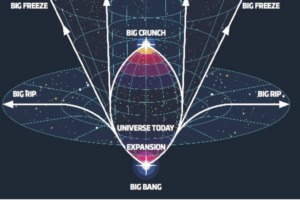
The genesis of space, time, and gravity traces back to the universe’s beginning, approximately 13.8 billion years ago, during the event known as the Big Bang. At this singular moment, all matter, energy, space, and time emerged simultaneously from an infinitely dense and hot point. Prior to this event, the notions of “where” and “when” had no meaning, as space and time themselves did not exist.
This primordial event gave rise to the fabric of spacetime, a seamless blend of spatial dimensions and temporal flow. Gravity emerged concurrently, not as a separate force but as the curvature of spacetime caused by mass and energy. This insight was formalized by Albert Einstein’s General Relativity, which replaced the classical Newtonian view of gravity as a force acting at a distance.
How Spacetime and Gravity Function
Spacetime is not a static backdrop but a flexible, evolving entity that bends and warps in response to the distribution of mass and energy. This curvature directs the paths of objects, creating what we perceive as gravitational attraction. For example, planets orbit stars because they follow the curved geodesics in spacetime shaped by the star’s mass.
In the early universe, quantum fluctuations caused spacetime itself to ripple and fluctuate, setting the stage for the formation of galaxies, stars, and planets. Gravity, as the geometric property of spacetime, orchestrated the aggregation of matter into complex structures.
Mathematical Framework: General Relativity
Einstein’s General Relativity provides the mathematical description of gravity as spacetime curvature. The central equation is:
Gμν + Λgμν = (8πG/c⁴) Tμν
- Gμν: Einstein tensor representing spacetime curvature
- Λ: Cosmological constant, accounting for dark energy
- gμν: Metric tensor describing spacetime geometry
- G: Gravitational constant
- c: Speed of light
- Tμν: Stress-energy tensor representing matter and energy content
This equation links the geometry of spacetime (left side) to the energy and momentum of matter and radiation (right side), encapsulating how gravity emerges from the fabric of spacetime.
Real-World Examples of Space, Time, and Gravity Interactions
The influence of spacetime curvature and gravity is evident in numerous cosmic phenomena:
- Planetary Orbits:
Planets follow curved paths around stars due to spacetime warping. - Black Holes:
Regions where spacetime curvature becomes so extreme that not even light can escape. - Gravitational Waves:
Ripples in spacetime produced by accelerating massive objects, detected by observatories like LIGO. - Cosmic Expansion:
The stretching of spacetime itself causes galaxies to move apart over time.
Common Misconceptions About Space, Time, and Gravity
Space is empty and unchanging.
Space is a dynamic, flexible fabric that evolves and interacts with matter and energy.
Gravity is a force pulling objects through space.
Gravity is the effect of curved spacetime guiding the motion of objects.
Time flows uniformly everywhere.
Time can dilate or contract depending on gravitational fields and relative motion.
Why Understanding Space, Time, and Gravity Is Crucial
Grasping the unified nature of space, time, and gravity is essential for advancing physics, cosmology, and technology. It underpins our comprehension of the universe’s origin, structure, and fate. Technologies such as GPS rely on relativistic corrections accounting for spacetime curvature and time dilation. Moreover, exploring these concepts drives the quest for a unified theory that reconciles gravity with quantum mechanics, potentially unlocking new realms of physics.
Frontiers in Research: Quantum Gravity and Emergent Spacetime
Modern theoretical physics seeks to merge gravity with quantum mechanics, envisioning a quantum spacetime where classical geometry dissolves into probabilistic phenomena. Approaches like string theory and loop quantum gravity propose that space, time, and gravity may arise from deeper, more fundamental entities or principles. This emergent perspective suggests that the familiar fabric of spacetime is a macroscopic manifestation of underlying quantum processes.
Philosophical and Cosmic Significance
The simultaneous emergence of space, time, and gravity invites profound reflection on the nature of reality. Their harmonious interplay enables the complexity of the cosmos, from galaxies to conscious life. This unity challenges us to reconsider causality, existence, and the laws governing the universe, highlighting an elegant cosmic order that has shaped everything since the dawn of time.
Empirical Evidence Supporting the Unity of Space, Time, and Gravity
Observations such as the detection of gravitational waves and the cosmic microwave background radiation provide tangible proof of the dynamic and intertwined nature of spacetime and gravity. These empirical insights allow scientists to peer back to the universe’s earliest moments, confirming that space, time, and gravity were born together and continue to evolve as a cohesive whole.
Conclusion: The Unified Fabric of the Cosmos
Recognizing that space, time, and gravity originated simultaneously transforms our understanding of the universe. Instead of viewing them as separate forces or dimensions, we see them as interdependent aspects of a single, dynamic reality. This perspective enriches our appreciation of the cosmos as a coherent, evolving entity where geometry, matter, energy, and time flow converge to create the astonishing universe we inhabit.
FAQ
What is the relationship between space, time, and gravity?
Space, time, and gravity are interdependent aspects of a single entity known as spacetime, where gravity is the curvature of spacetime caused by mass and energy.
How did space, time, and gravity originate?
They originated simultaneously from the Big Bang, approximately 13.8 billion years ago, when all matter, energy, space, and time emerged.
What is Einstein's contribution to our understanding of gravity?
Einstein’s General Relativity describes gravity as the curvature of spacetime rather than a force acting at a distance.
Leave a Reply