
Short Answer
Understanding Dark Matter
Dark matter is a mysterious and invisible component of the universe that neither emits nor absorbs light, making it undetectable by traditional telescopes. Despite its invisibility, it exerts a significant gravitational pull on visible matter, influencing the structure and evolution of the cosmos. Scientists infer its existence primarily through its gravitational effects, which warp spacetime and affect the motion of galaxies and galaxy clusters.
Gravitational Lensing: A Window into the Invisible
One of the most powerful methods to detect dark matter is gravitational lensing, a phenomenon where the gravity of massive objects bends the path of light traveling from distant sources. This cosmic bending acts like a natural lens, distorting and magnifying the images of faraway galaxies. By analyzing these distortions, researchers can map the distribution of mass-including dark matter-that causes the bending.
- Strong Lensing:
Produces dramatic effects such as multiple images, arcs, or rings of background galaxies. - Weak Lensing:
Causes subtle shape changes in background galaxies, requiring statistical analysis of millions of galaxies to detect.
Mapping Dark Matter with Galaxy Surveys
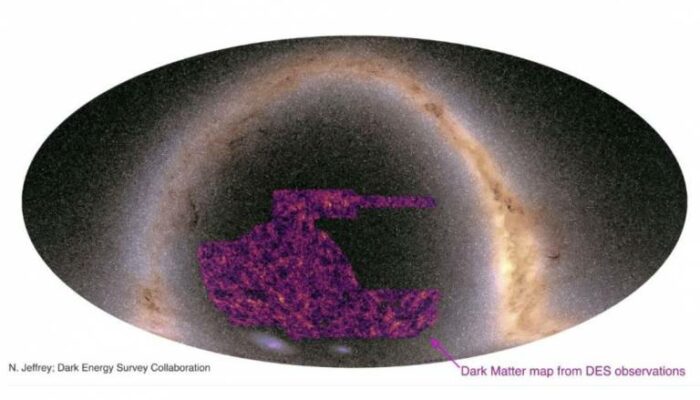
To create a comprehensive map of dark matter, astronomers analyze light from an immense number of galaxies-on the order of 100 million. These galaxies serve as distant beacons whose light has traveled billions of years, carrying information about the intervening mass distribution. Large-scale surveys employ advanced telescopes and detectors to capture this faint light across vast regions of the sky.
The vast dataset enables scientists to detect the minute distortions caused by weak gravitational lensing. By statistically combining these tiny shape changes across millions of galaxies, researchers reconstruct a detailed map of dark matter’s distribution throughout the universe.
Importance of Redshift in Dark Matter Mapping
Redshift measurements are crucial for understanding the three-dimensional structure of dark matter. Redshift indicates how much the wavelength of light from a galaxy has been stretched due to the expansion of the universe, which correlates with the galaxy’s distance and the time at which its light was emitted.
- Distance Estimation:
Redshift allows astronomers to determine how far away each galaxy is. - Cosmic Timeline:
Enables the construction of a 3D map showing how dark matter clumps have evolved over billions of years.
Data Processing and Computational Techniques
Handling the enormous volume of data from galaxy surveys requires sophisticated computational tools. Machine learning algorithms and high-performance simulations play a vital role in refining dark matter models and interpreting gravitational lensing signals.
- Simulations:
Virtual universes are created to test how different dark matter properties affect galaxy formation and lensing patterns. - Machine Learning:
Helps identify subtle lensing signals and correct for observational biases and noise.
Scientific Significance and Applications
Mapping dark matter is fundamental to understanding the universe’s large-scale structure and its evolution. Dark matter shapes the formation of galaxy clusters, influences the cosmic microwave background radiation, and forms the filamentary cosmic web that connects galaxies.
These maps also provide insights into dark energy, the mysterious force driving the accelerated expansion of the universe, by revealing how dark matter structures grow over time. Improved knowledge of dark matter distribution enhances models of galaxy evolution and the overall dynamics of the cosmos.
Challenges and Ongoing Mysteries
Despite advances in mapping dark matter, its true nature remains elusive. Key questions persist:
- What is dark matter made of?
Is it composed of unknown particles, or does it represent a need to modify our understanding of gravity? - How does dark matter interact with ordinary matter?
Beyond gravity, does it have other subtle interactions yet to be discovered?
While gravitational lensing maps provide compelling evidence of dark matter’s presence, unlocking its fundamental properties continues to be a major focus of astrophysical research.
Future Prospects in Dark Matter Research
As observational technology advances and galaxy surveys expand in scale and depth, dark matter maps will become increasingly detailed and precise. Upcoming projects will enhance resolution and extend coverage, bringing us closer to unraveling the mysteries of dark matter.
These efforts promise not only to refine our cosmic maps but also to potentially reveal the particle nature of dark matter, transforming theoretical speculation into concrete scientific understanding.
Summary: Illuminating the Cosmic Invisible
The endeavor to map dark matter using the light from 100 million galaxies exemplifies the synergy of observational astronomy, data science, and theoretical physics. Each photon collected from distant galaxies contributes to a vast cosmic mosaic, revealing the hidden framework that shapes the universe. Through this intricate process, humanity inches closer to comprehending the unseen forces that govern the cosmos.
FAQ
What is dark matter?
Dark matter is an invisible component of the universe that exerts a gravitational pull on visible matter, affecting the structure and evolution of the cosmos.
How do scientists map dark matter?
Scientists map dark matter primarily through gravitational lensing, analyzing light from distant galaxies to detect mass distribution.
Why is redshift important in dark matter research?
Redshift measurements help determine the distance of galaxies and construct three-dimensional maps of dark matter's evolution over time.



Leave a Reply