
Short Answer
Definition of Red Giants
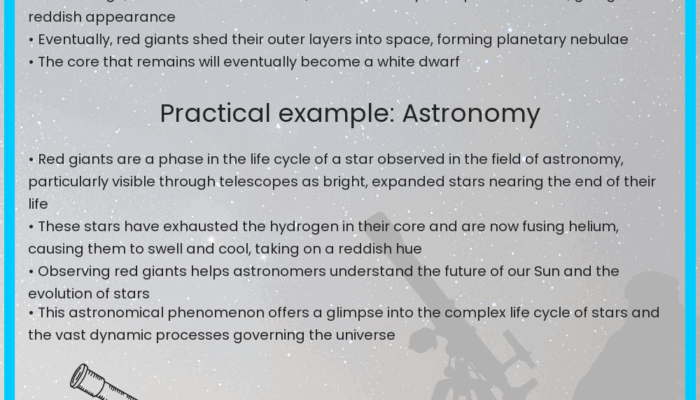
Red giants are a class of evolved stars distinguished by their enormous size, reddish coloration, and advanced stage in stellar evolution. These stars have exhausted the hydrogen fuel in their cores and have expanded significantly, resulting in cooler surface temperatures that give them their characteristic red appearance. Red giants represent a transitional phase in the life cycle of stars with initial masses roughly between 0.3 and 8 times that of the Sun.
Stellar Evolution Leading to the Red Giant Phase
The life of a star is primarily dictated by its initial mass, which determines its evolutionary path. Stars spend the majority of their lives fusing hydrogen into helium in their cores, a period known as the main sequence. Once the hydrogen supply in the core is depleted, the star undergoes dramatic structural changes. The core contracts and heats up, while hydrogen fusion continues in a shell surrounding the core. This shell burning causes the star’s outer layers to expand and cool, transforming it into a red giant.
Mass-Dependent Evolutionary Paths
- Low to Intermediate-Mass Stars (0.3-8 Solar Masses):
These stars swell into red giants after core hydrogen exhaustion, with their outer envelopes expanding and cooling. Their red giant phase is relatively brief compared to their main sequence lifetime. - High-Mass Stars (Above 8 Solar Masses):
These stars evolve into red supergiants, progressing beyond helium fusion to synthesize heavier elements until iron accumulates in the core, leading to a supernova explosion.
Mechanisms Governing the Red Giant Phase
After the core hydrogen is exhausted, the star’s core contracts under gravity, increasing in temperature until hydrogen fusion ignites in a shell around the core. This shell burning causes the star’s outer layers to expand dramatically, lowering the surface temperature and producing the red hue. Eventually, the core temperature reaches approximately 100 million Kelvin, triggering helium fusion in a process called the helium flash. This event marks the transition to the horizontal branch phase, where helium fuses into carbon and oxygen.
Duration of the Red Giant Stage
The length of time a star spends as a red giant varies significantly based on its mass and chemical composition:
- Stars with 1 to 3 Solar Masses:
These stars typically spend about a billion years on the main sequence but only a few hundred million years as red giants. - More Massive Stars:
Stars exceeding 8 solar masses may remain in the red supergiant phase for just a few million years before ending their lives in supernova explosions.
Helium Fusion and Post-Red Giant Evolution
Once helium fusion ignites in the core, the star enters the horizontal branch phase, where it fuses helium into heavier elements like carbon and oxygen. This stage can last tens to hundreds of millions of years and is considered part of the broader red giant or post-red giant evolutionary phases. The processes during this time significantly influence the star’s lifespan and chemical output.
Contribution to Cosmic Chemical Enrichment
Red giants play a crucial role in enriching the interstellar medium with heavier elements such as carbon and nitrogen. Through stellar winds and mass loss, these elements are expelled into space, seeding future generations of stars and planetary systems. This stellar recycling is fundamental to the chemical evolution of galaxies and the emergence of complex matter necessary for life.
Astrophysical Importance of Red Giants
Due to their distinctive luminosity and spectral characteristics, red giants serve as valuable tools in astrophysics. They are used as standard candles to measure cosmic distances and as tracers to study the formation and evolution of galaxies. Understanding their lifespans and behaviors enhances our knowledge of stellar populations and galactic dynamics.
Factors Influencing Red Giant Lifespans
Several variables affect the duration and characteristics of the red giant phase:
- Metallicity:
The abundance of elements heavier than helium influences the star’s opacity and fusion efficiency, thereby impacting its evolutionary timescale. - Mass Loss and Stellar Winds:
Material expelled from the star during the red giant phase alters its mass and structure, complicating lifespan predictions.
Common Misconceptions About Red Giants
Red giants are old stars that have always been large.
Red giants expand dramatically only after exhausting core hydrogen; they were much smaller during their main sequence phase.
All red giants end their lives as supernovae.
Only massive stars (above ~8 solar masses) undergo supernova explosions; lower-mass red giants typically shed their outer layers and become white dwarfs.
Why Understanding Red Giants Is Essential
Red giants represent a pivotal stage in stellar evolution, bridging the gap between youthful hydrogen-burning stars and their final evolutionary outcomes. Their relatively short but luminous phase provides insights into nuclear fusion processes, element formation, and the lifecycle of matter in the universe. Studying red giants deepens our comprehension of cosmic history, the chemical enrichment of galaxies, and the conditions that ultimately foster planetary systems and life.
Summary
In essence, red giants are luminous, expanded stars marking a transient yet transformative phase in stellar evolution. Their lifespan in this stage ranges from millions to hundreds of millions of years, heavily influenced by their initial mass and composition. Beyond their striking appearance, red giants are fundamental to the cosmic cycle of matter, contributing to the chemical diversity that shapes the universe. Each red giant stands as a testament to the dynamic processes that govern stellar life and death, illuminating the intricate workings of the cosmos.
FAQ
What are red giants?
Red giants are stars that have expanded and cooled after exhausting the hydrogen in their cores, representing a later stage of stellar evolution.
How long do red giants live?
Red giants can live from a few million to hundreds of millions of years, depending on their initial mass and composition.
What is the significance of red giants in the universe?
Red giants play a crucial role in enriching the interstellar medium with heavier elements, essential for forming new stars and planetary systems.



Leave a Reply