
Short Answer
Definition of Cosmic Dust and Its Role
Cosmic dust refers to tiny solid particles dispersed throughout space, composed of elements heavier than hydrogen and helium. These microscopic grains, often smaller than a micron, consist of silicates, carbon-based compounds, ices, and metals. Far from being inert debris, cosmic dust serves as a fundamental component in the formation and evolution of celestial structures such as stars, planets, and galaxies.
- Composition:
Silicates, carbonaceous materials, ices, and metallic elements. - Size range:
From molecular clusters to grains less than a micron in diameter. - Function:
Acts as a catalyst for chemical reactions and a building block in astrophysical processes.
Origins of Cosmic Dust in the Universe
The universe originated approximately 13.8 billion years ago with the Big Bang, which created a hot, expanding environment primarily filled with hydrogen and helium. Over time, gravitational instabilities caused denser regions to collapse, allowing the first stars to form. These early stars synthesized heavier elements through nuclear fusion, which were later expelled into space via stellar winds and supernova explosions, seeding the cosmos with the dust particles essential for subsequent cosmic development.
Mechanisms of Dust-Driven Cosmic Formation
The transformation of dust into complex cosmic structures is governed by the interplay of gravity, momentum, and electromagnetic forces. Within cold, diffuse clouds of gas and dust known as the interstellar medium, dust grains provide surfaces that enable atoms to stick, bond, and form complex molecules such as water and organic compounds-precursors to life. Gravity pulls these particles together, causing collisions and gradual accumulation through a process called accretion, which leads to the formation of larger bodies like planetesimals and eventually planets.
Accretion and Aggregation
Accretion is the gradual growth of particles through successive collisions and sticking. Starting from tiny dust grains, this process builds up larger aggregates-pebbles, rocks, and planetesimals-within protoplanetary disks surrounding young stars, setting the stage for planet formation.
Star Formation and Dust
Dense molecular clouds, often referred to as stellar nurseries, are rich in dust that shields gas from intense radiation, allowing temperatures to drop and gravitational collapse to proceed. This cooling effect is crucial for the formation of stars, as it enables the core of the cloud to reach the high pressures and temperatures necessary to ignite nuclear fusion. Dust also influences stellar winds and feedback mechanisms that regulate star formation rates within galaxies.
Dust in Galactic Evolution
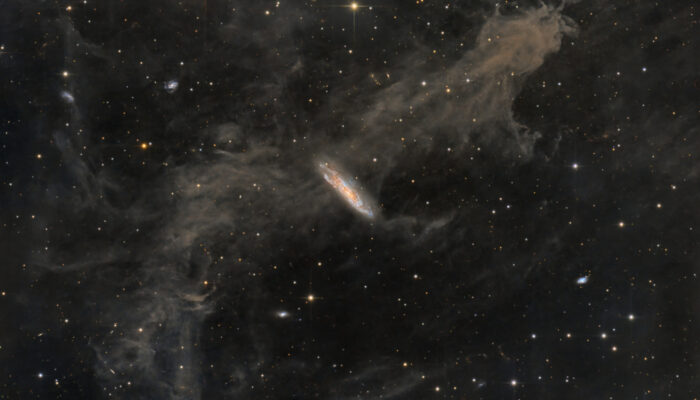
Galaxies are massive systems composed of stars, gas, dust, and dark matter bound by gravity. The distribution of dust within galaxies shapes their structure and evolution. Dust lanes-dark, obscuring bands visible in many galaxies-trace the flow and density of interstellar material. These dust-rich regions are active sites of star formation, where matter recycling and cosmic dynamics interplay. Additionally, dust facilitates the cooling of galaxies by emitting infrared radiation, which promotes further gas collapse and sustained star formation.
Complex Physical Processes Affecting Dust Dynamics
The journey from dust grains to large-scale cosmic bodies involves numerous intricate physical phenomena:
- Turbulence:
Turbulent motions within molecular clouds can either hinder or accelerate the aggregation of dust particles depending on local conditions. - Electromagnetic Forces:
At microscopic scales, electromagnetic interactions help dust grains overcome electrostatic repulsion, enabling them to stick together. - Shock Waves:
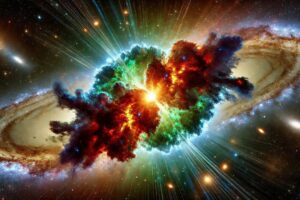
Explosions from supernovae generate shock waves that compress surrounding material, triggering new waves of star formation and enriching the interstellar medium with heavy elements.
Observational and Theoretical Insights
Advances in astronomy, including infrared and submillimeter observations, have unveiled the hidden dusty regions where stars are born. These wavelengths penetrate dust clouds, revealing the processes occurring within stellar nurseries. Complementary numerical simulations model the evolution of dust from microscopic grains to galactic scales, providing a comprehensive understanding of the physical laws that govern cosmic structure formation.
Significance of Cosmic Dust in Our Existence
The atoms that compose our bodies were once part of ancient cosmic dust, forged in the hearts of long-extinct stars. This dust initiated a chain of events leading to the formation of planets capable of supporting life and galaxies that populate the universe. Recognizing dust as an active agent in cosmic evolution reshapes our understanding of the universe and highlights the profound connection between the smallest particles and the grandest celestial phenomena.
Summary: From Dust to the Cosmos
The narrative of cosmic dust evolving into planets, stars, and galaxies exemplifies the intricate interdependence of matter, energy, and time in the universe. This process reveals that vast celestial structures emerge from the aggregation and interaction of minuscule dust grains through a complex cosmic dance. Appreciating this transformation enriches our knowledge of astrophysics and deepens our sense of belonging in the cosmos: from dust we originate, and to dust many cosmic wonders owe their existence.

Leave a Reply