
Short Answer
Definition of Gravitational Lensing and Black Holes
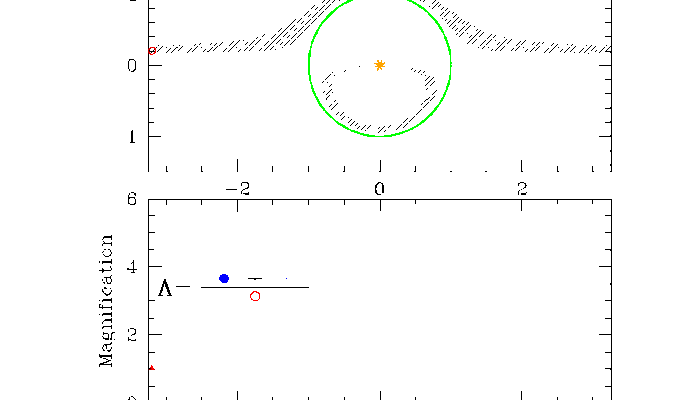
Black holes are often portrayed as mysterious cosmic voids that consume everything nearby. However, the phenomenon of gravitational lensing has provided a novel way to study these enigmatic objects. Gravitational lensing occurs when a massive celestial body, such as a galaxy or black hole, bends the path of light traveling near it due to its intense gravitational field. This bending distorts and magnifies the images of objects behind the massive body, offering astronomers a unique observational tool to investigate black holes and their surroundings.
- Black Holes:
Extremely dense regions in space with gravitational pulls so strong that not even light can escape. - Gravitational Lensing:
The deflection and magnification of light caused by the gravitational influence of massive objects, allowing distant celestial bodies to be observed more clearly.
Mechanism Behind Gravitational Lensing
According to Einstein’s general theory of relativity, gravity is a manifestation of the curvature of space-time caused by mass and energy. When light from distant stars or galaxies passes near a massive object, the curvature of space-time alters its trajectory. This effect is analogous to ripples spreading out when a stone is dropped into a calm pond, where the ripples represent the distortion of space-time. As a result, the light is bent, producing multiple images, arcs, or magnified views of the background objects. This phenomenon not only reveals details about the distant universe but also allows scientists to probe the properties of the lensing mass, including black holes.
Mathematical Explanation of Gravitational Lensing
The bending angle of light, α, caused by a gravitational lens can be approximated by the formula:
α = (4GM) / (c²b)
- G: Gravitational constant
- M: Mass of the lensing object
- c: Speed of light
- b: Impact parameter (closest approach of the light to the mass)
This equation quantifies how the mass of an object influences the deflection of light passing nearby, enabling astronomers to estimate the mass and other characteristics of black holes through observed lensing effects.
Insights into Black Holes Through Gravitational Lensing
Gravitational lensing has revolutionized the way black holes are observed. Traditionally, black holes were considered invisible due to their event horizons preventing light from escaping. However, when a black hole acts as a gravitational lens or is part of a lensing galaxy, its mass, spin, and the structure of its accretion disk can be inferred by analyzing the distorted light patterns. This method effectively reduces the apparent size of black holes, making them more accessible to study and challenging previous assumptions about their scale and influence.
Real-World Applications and Examples
One of the most famous examples of gravitational lensing is the observation of Einstein rings, where the light from a distant galaxy is bent around a massive foreground galaxy, creating a ring-like image. In cases where black holes are involved, such lensing effects help astronomers measure their mass and spin indirectly. Additionally, gravitational lensing aids in mapping dark matter distribution in galaxies and clusters, as dark matter’s gravitational influence also bends light despite being invisible.
Common Misconceptions About Black Holes and Gravitational Lensing
Black holes are simply cosmic vacuum cleaners that indiscriminately suck in everything.
Black holes exert gravitational pull like any other massive object; objects must cross the event horizon to be irreversibly captured.
Gravitational lensing only magnifies objects behind the lens.
Lensing can produce multiple images, distortions, and magnifications depending on the alignment and mass distribution of the lensing object.
Significance of Gravitational Lensing in Astrophysics
Gravitational lensing is a powerful tool that enhances our understanding of the universe’s structure and evolution. By revealing the properties of black holes and the distribution of dark matter, it provides critical insights into cosmic phenomena that are otherwise hidden. This technique also helps astronomers trace the history of galaxy formation and interactions, as black holes are often central to these processes. Moreover, gravitational lensing contributes to the ongoing quest to unravel the mysteries of dark energy and the universe’s accelerated expansion.
Black Holes as Cosmic Time Capsules
Black holes serve as windows into the past, encapsulating the history of their host galaxies. The gravitational lensing effect allows scientists to study the violent events such as galactic collisions and mergers that lead to the formation of complex galactic structures. By examining these lenses, researchers can reconstruct the evolutionary pathways of galaxies and better understand the dynamic processes shaping the cosmos.
Conclusion: A New Perspective on Black Holes
Far from being mere cosmic voids, black holes are intricate components of the universe’s grand design. Gravitational lensing offers a multidimensional approach to studying these objects, revealing their characteristics and their role in cosmic evolution. As observational technologies advance, the synergy between black holes and gravitational lensing will continue to deepen our comprehension of the universe, inspiring further exploration into the fundamental nature of reality beyond the event horizon.
FAQ
What is gravitational lensing?
Gravitational lensing is the bending of light from distant objects due to the gravitational field of a massive body, allowing for clearer observation of those objects.
How do black holes relate to gravitational lensing?
Black holes can act as gravitational lenses, allowing astronomers to infer their properties by analyzing the light patterns distorted by their immense gravitational pull.

Leave a Reply