
Short Answer
Definition of Quantum Computing
Quantum computing is an innovative computational approach that harnesses the principles of quantum mechanics to execute calculations at speeds unattainable by classical computers. Unlike traditional computing, which uses binary bits representing either 0 or 1, quantum computing employs quantum bits, or qubits. These qubits can exist in a superposition of states, meaning they can represent multiple values simultaneously. This unique characteristic underpins the potential of quantum computers to outperform classical systems in various complex tasks.
Fundamental Principles and Mechanisms
At the core of quantum computing lies the concept of superposition, where qubits can be in multiple states at once, and entanglement, a phenomenon that links qubits such that the state of one instantly influences another, regardless of distance. These quantum properties enable quantum computers to process a vast number of possibilities concurrently, vastly accelerating problem-solving capabilities compared to classical computers that process bits sequentially.
Applications in Cryptography
Quantum computing poses both challenges and opportunities in the field of cryptography. Traditional encryption methods rely on the computational difficulty of problems like factoring large numbers or computing discrete logarithms. Quantum algorithms, notably Shor’s algorithm, can efficiently solve these problems, threatening the security of current cryptographic protocols. This vulnerability has spurred the development of post-quantum cryptography, which aims to create encryption techniques resistant to quantum attacks, ensuring data security in the quantum era.
Impact on Materials Science
Simulating molecular structures and interactions at the quantum level is a demanding task for classical computers, as the required computational resources increase exponentially with system complexity. Quantum computers, however, can naturally model quantum states, enabling more accurate and efficient simulations. This capability accelerates the discovery and design of new materials, with significant implications for pharmaceuticals, energy storage solutions, and nanotechnology advancements.
Optimization Problem Solving
Many industries face complex optimization challenges, such as determining the most efficient routes in logistics or optimizing supply chain operations. Quantum computing offers a powerful tool through quantum annealing and other techniques that explore large solution spaces more effectively than classical methods. This advantage can lead to substantial improvements in operational efficiency across sectors including transportation, manufacturing, and finance.
Enhancements in Financial Modeling
Quantum computing holds promise for transforming financial analysis by improving risk assessment and portfolio optimization. Quantum algorithms can process complex variables and predict market behaviors with greater precision, enabling financial institutions to manage risks more effectively and devise more sophisticated investment strategies. These advancements could significantly influence market dynamics and financial decision-making processes.
Advancements in Artificial Intelligence
Artificial intelligence (AI) benefits from quantum computing through accelerated processing of large datasets and faster training of machine learning models. Quantum-enhanced machine learning can improve capabilities in pattern recognition, natural language understanding, and decision-making. These improvements have the potential to advance technologies such as autonomous vehicles, intelligent personal assistants, and other AI-driven applications.
Transformative Potential in Healthcare
Quantum computing can revolutionize healthcare by expediting drug discovery and enabling personalized medicine. The ability to simulate molecular interactions rapidly allows researchers to identify promising compounds more efficiently. Additionally, quantum algorithms can analyze complex genetic data to tailor treatments to individual patients, enhancing the effectiveness of medical interventions and advancing precision medicine.
Contributions to Environmental Science
Modeling climate change and environmental systems involves managing numerous interacting variables, a task well-suited to quantum computing’s capabilities. Quantum simulations can provide more accurate climate predictions and support the development of effective mitigation strategies. Furthermore, optimizing energy systems, particularly those integrating renewable resources, can benefit from quantum optimization techniques, promoting sustainable energy solutions.
Challenges and Ethical Considerations
Despite its vast potential, quantum computing faces significant technical challenges, including maintaining qubit coherence and reducing error rates. The technology is still in early development stages, requiring ongoing research to enhance hardware and refine algorithms. Additionally, the ethical implications, particularly concerning data security and privacy, demand careful consideration. As quantum computing evolves, establishing frameworks for responsible use and security is essential to maximize benefits while minimizing risks.
Summary and Future Outlook
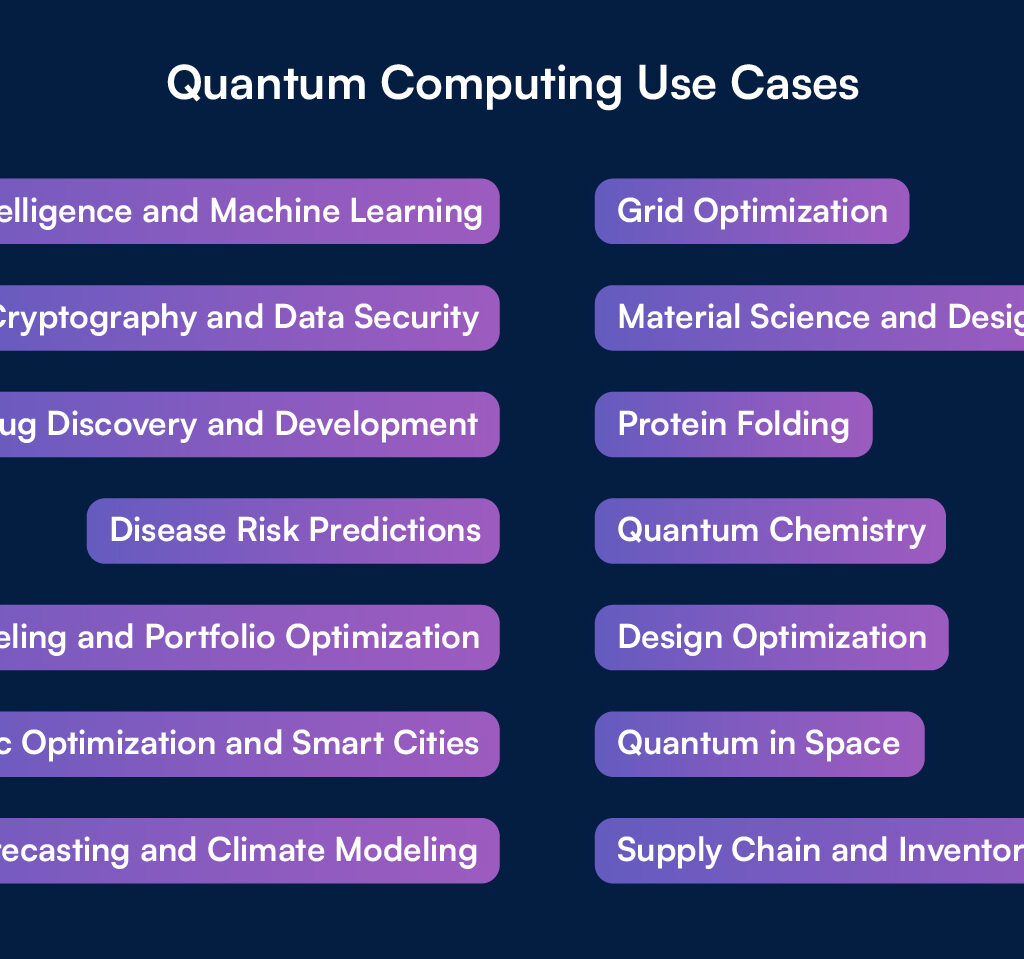
Quantum computing is poised to impact a wide array of fields, from cryptography and materials science to finance, AI, healthcare, and environmental studies. Its ability to solve complex problems more efficiently than classical computers promises transformative advancements and increased operational efficiencies. However, realizing these benefits requires overcoming technical hurdles and addressing ethical challenges to ensure that quantum computing serves the broader interests of society.
FAQ
What is quantum computing?
Quantum computing is a type of computation that uses quantum mechanics to process information at much higher speeds than traditional computers.
What are the main applications of quantum computing?
Quantum computing has applications in cryptography, materials science, artificial intelligence, healthcare, and environmental science.
What challenges does quantum computing face?
The main challenges include maintaining qubit coherence, reducing error rates, and addressing ethical implications.






Leave a Reply