
Short Answer
Definition of the Dynamo Effect
The dynamo effect is a fundamental concept in electromagnetism that describes how magnetic fields are generated and maintained within electrically conductive fluids. This phenomenon is particularly significant in astrophysics, where it helps explain the magnetic properties of celestial bodies, including the complex environments surrounding black holes. Essentially, the dynamo effect involves the conversion of kinetic energy from moving conductive materials into magnetic energy, sustaining magnetic fields over time.
Magnetic Field Generation in Conductive Fluids
At its core, the dynamo effect arises when an electrically conductive fluid moves through an existing magnetic field, or when a magnetic field moves through such a fluid. This interaction induces electric currents within the fluid, which in turn generate new magnetic fields. Originally developed to explain Earth’s magnetosphere, this principle extends to various astrophysical contexts, including the turbulent plasma around black holes.
- Conductive Medium:
Ionized gases or plasmas that can carry electric currents. - Induced Currents:
Movement of the conductive fluid through magnetic fields creates electric currents. - Magnetic Field Amplification:
These currents generate magnetic fields that can reinforce the original field, sustaining it over time.
Black Holes and the Dynamo Effect
Black holes, far from being mere voids, exhibit intricate physical processes influenced by their mass and spin. According to the Kerr solution in general relativity, rotating black holes cause a phenomenon known as frame-dragging, where space-time itself is twisted around the rotating mass. This effect plays a crucial role in the dynamo mechanism within the accretion disks of black holes.
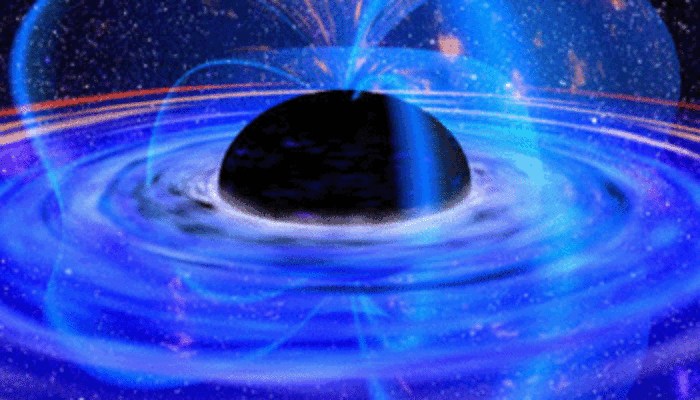
The accretion disk, composed of ionized stellar material spiraling inward at relativistic speeds, acts as a conductive fluid. The interaction between the disk’s motion and the twisted space-time generates electric currents, which then produce and sustain magnetic fields through dynamo action. This process facilitates the transfer of energy from the black hole’s vicinity into the surrounding universe.
Role of Frame-Dragging and Relativistic Effects
Frame-dragging, a direct consequence of a black hole’s rotation, causes the surrounding space-time to rotate as well. This twisting motion influences the conductive plasma in the accretion disk, enhancing the dynamo effect by increasing the complexity and intensity of fluid motions. The relativistic velocities involved further amplify electromagnetic interactions, creating a dynamic environment where magnetic fields can grow and persist.
Magnetic Reconnection and Energy Release
Magnetic reconnection is a critical process linked to the dynamo effect, where magnetic field lines with opposite directions converge, break, and reconnect. This reconfiguration releases substantial amounts of energy, which can drive energetic outflows from the accretion disk around black holes.
- Energy Outflows:
Magnetic reconnection events can accelerate particles to high energies, enabling them to escape the intense gravitational pull of the black hole. - Astrophysical Jets:
These energetic particles often form narrow, high-speed jets that extend far beyond the black hole’s immediate environment.
Extension to Other Astrophysical Objects
While the dynamo effect is prominently studied in the context of rotating black holes, it also applies to other compact objects such as neutron stars and magnetars. These bodies possess conductive plasma environments where similar magnetic field generation mechanisms occur. However, black holes remain uniquely fascinating due to their ability to produce highly collimated jets and convert gravitational energy into electromagnetic energy with remarkable efficiency.
Turbulence and Magnetic Field Amplification
The turbulent nature of the accretion disk plays a vital role in sustaining the dynamo effect. Collisions and interactions among ionized particles at relativistic speeds create complex fluid motions that amplify magnetic fields beyond levels seen in more stable astrophysical settings. This turbulence establishes a feedback loop, continuously reinforcing the magnetic field and maintaining the dynamo process.
Significance in Cosmology and Astrophysics
The dynamo effect’s role in black hole physics reshapes our understanding of these enigmatic objects. Rather than being purely destructive, black holes act as powerful engines that transform gravitational energy into magnetic and electromagnetic energy. This transformation influences cosmic phenomena such as star formation, galactic evolution, and the distribution of energy across the universe.
Implications for Fundamental Physics and Future Research
Studying the dynamo effect in extreme environments like black holes offers insights into the interplay between gravity and electromagnetism. It challenges and enriches theoretical models, encouraging the development of more comprehensive frameworks for plasma behavior under intense conditions. As observational technology advances, bridging theoretical predictions with empirical data will deepen our grasp of these complex processes, highlighting the dynamo effect as a cornerstone in modern astrophysical research.
FAQ
What is the dynamo effect?
The dynamo effect is a process that generates and maintains magnetic fields in electrically conductive fluids, crucial for understanding astrophysical phenomena.
How does the dynamo effect relate to black holes?
In black holes, the dynamo effect explains how magnetic fields are generated in the accretion disks, facilitating energy transfer to the surrounding universe.
What role does frame-dragging play in this effect?
Frame-dragging, caused by a rotating black hole, enhances the dynamo effect by influencing fluid motion in the accretion disk.





Leave a Reply