
Short Answer
Definition of Double-Negative Metamaterials
Double-negative metamaterials (DNMMs) are artificially engineered materials that exhibit simultaneously negative values of permittivity and permeability. This unique combination results in a negative refractive index, a property not found in naturally occurring substances. DNMMs challenge traditional optical principles by enabling unusual electromagnetic behaviors such as reverse wave propagation and imaging beyond the diffraction limit.
- Negative Permittivity:
The material’s electric response to an external electromagnetic field is opposite to that of conventional materials. - Negative Permeability:
The magnetic response is similarly inverted, allowing for novel interactions with magnetic components of light. - Negative Refractive Index:
The simultaneous negativity of permittivity and permeability leads to a refractive index less than zero, causing light to bend in unconventional ways.
Fundamental Principles and Structure
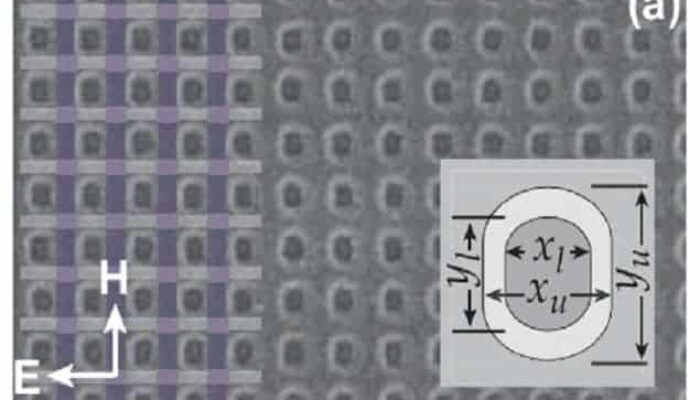
The extraordinary electromagnetic characteristics of DNMMs stem from their meticulously designed nanostructures, which manipulate light at scales smaller than its wavelength. These structures often incorporate metallic elements arranged in complex patterns that resonate with specific frequencies of electromagnetic waves. When these resonances occur at optical wavelengths, the material exhibits properties that defy classical optics, effectively rewriting the rules governing light propagation.
- Nanostructuring:
Precise fabrication at the nanoscale enables control over electromagnetic responses. - Resonant Behavior:
Metallic inclusions create resonances that produce negative permittivity and permeability. - Scale Matching:
Dimensions are tailored to correspond with the wavelength of incident light, crucial for achieving negative refractive indices.
Historical Development and Frequency Range Evolution
The exploration of materials with negative refractive indices has been a long-standing scientific pursuit, initially focused on microwave and terahertz frequencies. These lower-frequency ranges allowed for easier fabrication and reduced absorption losses. However, as technological demands in telecommunications, imaging, and sensing have grown, the push to extend DNMM functionality into the visible spectrum has intensified. Achieving this transition promises to unlock revolutionary capabilities in photonics.
- Early Research:
Concentrated on microwave and terahertz bands due to manageable losses and fabrication feasibility. - Transition Challenges:
Moving to visible light frequencies introduces increased absorption and scattering losses. - Technological Impetus:
Applications in high-resolution imaging and advanced communication drive the shift toward visible spectrum DNMMs.
Superlensing and Overcoming Diffraction Limits
One of the most remarkable applications of DNMMs is their ability to surpass the diffraction limit, a fundamental barrier in conventional optics that restricts resolution to approximately half the wavelength of light. DNMMs enable “superlensing,” which leverages near-field effects to focus light with unprecedented precision, revealing details smaller than the wavelength itself. This capability opens new horizons in microscopy, lithography, and optical data storage.
- Diffraction Limit:
Traditional lenses cannot resolve features smaller than about half the wavelength of light. - Near-Field Imaging:
DNMMs capture evanescent waves that carry subwavelength information, enabling hyper-resolution. - Superlens Design:
Tailored material morphology allows focusing beyond classical constraints.
Advanced Applications: Cloaking and Multifunctional Devices
Beyond imaging, DNMMs have catalyzed innovations in cloaking technologies and multifunctional sensors. By precisely controlling electromagnetic wave propagation, these materials can render objects invisible to specific wavelengths, creating illusions of absence. This capability has profound implications for stealth technology, secure communications, and sensor design, where controlling wave interactions at a fine scale is paramount.
- Invisibility Cloaks:
DNMMs guide light around objects, making them undetectable to certain electromagnetic frequencies. - Stealth Applications:
Potential to revolutionize defense and privacy technologies by masking objects from detection. - Multifunctional Sensors:
Enhanced sensitivity and selectivity through engineered wave manipulation.
Challenges in Extending DNMMs to the Visible Spectrum
Transitioning DNMMs into the visible light range presents significant obstacles, primarily due to increased material losses from scattering and absorption at higher frequencies. These losses degrade performance and limit practical applications. Overcoming these issues requires advances in nanofabrication precision and the discovery or synthesis of novel low-loss materials capable of operating efficiently across the visible spectrum.
- Material Losses:
Scattering and absorption intensify at visible wavelengths, reducing efficiency. - Fabrication Complexity:
Nanoscale precision is critical to maintain desired electromagnetic properties. - Material Innovation:
Development of new compounds and composites to minimize losses and broaden operational bandwidth.
Nonlinear Optical Effects in DNMMs
DNMMs also exhibit enhanced nonlinear optical phenomena when interacting with light under resonant conditions. These nonlinearities enable frequency mixing, generation of optical solitons, and other effects essential for creating new wavelengths and manipulating light within integrated photonic circuits. Such capabilities are vital for advancing optical computing, communication technologies, and on-chip light sources spanning diverse spectral regions.
- Frequency Mixing:
Interaction of multiple light waves to produce new frequencies. - Optical Solitons:
Stable, self-reinforcing wave packets that maintain shape during propagation. - Integrated Photonics:
Potential for compact, efficient light sources and signal processors on chips.
Significance and Future Outlook
The advancement of double-negative metamaterials toward visible light applications represents a pivotal frontier in modern optics and materials science. Their extraordinary ability to manipulate electromagnetic waves promises to revolutionize imaging, sensing, communication, and stealth technologies. As research continues to unravel their complexities, DNMMs stand poised to redefine the interaction between light and matter, heralding a new era of photonic innovation that will profoundly impact science and technology.
FAQ
What are double-negative metamaterials?
Double-negative metamaterials (DNMMs) are materials that have negative values of permittivity and permeability, enabling unique optical properties.
What are the applications of DNMMs?
DNMMs are used in imaging, telecommunications, cloaking technologies, and advanced optical computing.
What challenges exist in developing DNMMs for the visible spectrum?
Key challenges include increased absorption and scattering losses at visible wavelengths and the complexity of nanofabrication.




Leave a Reply