What is a cross section in nuclear physics?

Definition of Cross Section in Nuclear Physics In nuclear physics, the term cross section refers to a quantitative measure that expresses the probability of interaction between an incoming particle and a target particle. It is conceptualized as an effective area that represents how likely a specific nuclear reaction or scattering event will occur. Cross sections […]

Read More →

How is an atomic bomb made?

Definition of an Atomic Bomb An atomic bomb is a powerful explosive device that derives its destructive force from nuclear reactions, specifically nuclear fission. This weapon releases an immense amount of energy by splitting heavy atomic nuclei into smaller fragments, resulting in a rapid chain reaction. The development and use of atomic bombs have had […]

Read More →

Nuclear Chemistry Explained: Where Physics Meets Reactions

Definition of Nuclear Chemistry Nuclear chemistry is a specialized branch of science that merges principles from both physics and chemistry to study the behavior and transformations of atomic nuclei. It investigates the interactions and changes occurring within the nucleus of atoms, focusing on phenomena such as radioactivity, nuclear reactions, and the forces that govern subatomic […]

Read More →

What are the mathematics needed for nuclear physics?

Definition of Nuclear Physics and Its Mathematical Foundations Nuclear physics is the scientific discipline focused on investigating the fundamental constituents and interactions within atomic nuclei. This field combines both theoretical frameworks and experimental methods to unravel the complexities of nuclear matter. Central to nuclear physics is a comprehensive mathematical structure that not only explains nuclear […]

Read More →

What are sub-atomic particles made of?

Definition of Subatomic Particles Subatomic particles are the fundamental constituents that form the building blocks of matter at a scale far smaller than atoms. These particles exist at dimensions around 10-15 meters or less, a realm beyond the reach of direct human perception. While atoms are often considered the smallest units of matter, they themselves […]

Read More →

Why are there protons and neutrons in a nucleus?

Definition of Atomic Nucleus and Nucleons The atomic nucleus is the dense, central core of an atom, primarily composed of two types of subatomic particles: protons and neutrons. Collectively referred to as nucleons, these particles form the foundation of atomic structure. Protons carry a positive electric charge, while neutrons are electrically neutral. Together, they create […]

Read More →

What is the importance of the 3 subatomic particles?

Definition of Subatomic Particles Subatomic particles are the fundamental constituents that form atoms, the basic units of matter. The three principal subatomic particles-protons, neutrons, and electrons-collectively establish the structure and properties of atoms, thereby shaping the material universe. Protons: Positively charged particles residing in the atomic nucleus, defining the element’s identity through their count. Neutrons: […]

Read More →

How do gluons hold together quarks in a proton or neutron?

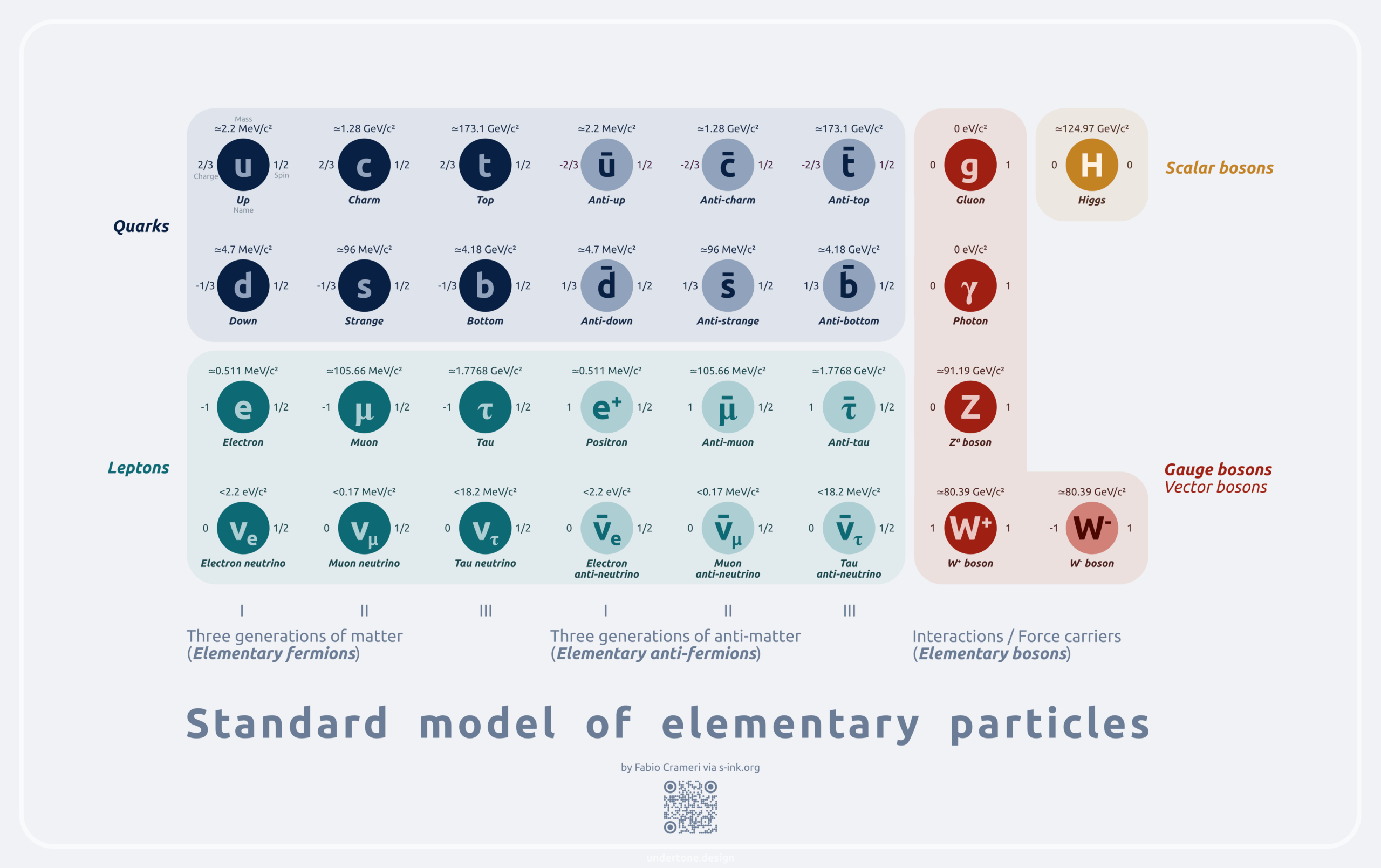
Definition of Quarks and Gluons Quarks and gluons are fundamental components within the atomic nucleus, playing essential roles in forming protons and neutrons, collectively known as baryons. These particles are central to the Standard Model of particle physics, which describes the fundamental forces and constituents of matter. Quarks: Elementary particles that come in six varieties […]

Read More →

What is the most amazing accomplishment of CERN?

Overview of CERN and Its Scientific Significance The European Organization for Nuclear Research, commonly known as CERN, represents a pinnacle of scientific innovation and international cooperation. Renowned for its groundbreaking contributions to particle physics, CERN has profoundly influenced our comprehension of the universe. Among its most celebrated achievements is the identification of the Higgs boson, […]

Read More →