
Short Answer
Understanding Matter-Antimatter Asymmetry
The universe presents a vast and intricate array of cosmic phenomena, among which the imbalance between matter and antimatter stands as one of the most profound puzzles. This disparity challenges our comprehension of the universe’s origins and fundamental laws. The BaBar experiment, conducted at the SLAC National Accelerator Laboratory, has been instrumental in shedding light on this enigma, providing critical evidence that supports theories about how our universe came to be dominated by matter.
Definition and Background
Matter-antimatter asymmetry refers to the observed dominance of matter over antimatter in the universe. According to prevailing cosmological models, the Big Bang should have produced equal quantities of both. However, the visible cosmos is overwhelmingly composed of matter, with antimatter being exceedingly rare.
- Matter:
Substances composed of particles such as protons, neutrons, and electrons that form the physical objects we observe. - Antimatter:
Composed of antiparticles corresponding to matter particles but with opposite charges, such as positrons (antielectrons) and antiprotons. - Asymmetry:
The imbalance where matter vastly outnumbers antimatter, a phenomenon that remains unexplained by the Standard Model alone.
The BaBar Experiment: Purpose and Setup
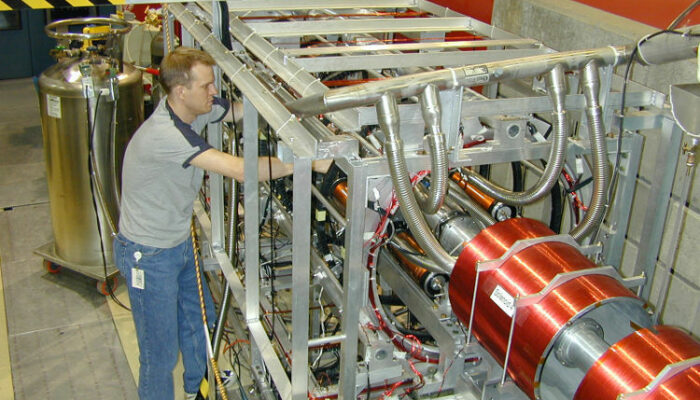
Initiated in 1999, the BaBar collaboration was designed to investigate the subtle differences in behavior between matter and antimatter by studying B mesons-particles containing beauty (bottom) quarks. The experiment employed a particle accelerator to collide electrons and positrons, producing B mesons and their antiparticles. By analyzing the decay patterns of these mesons, researchers aimed to detect violations of CP symmetry, a fundamental symmetry relating particles to their antiparticles.
Mechanism of CP Violation
CP symmetry implies that the laws of physics should be the same if a particle is replaced by its antiparticle (C symmetry) and left and right are swapped (P symmetry). However, certain processes involving B mesons demonstrate CP violation, where this symmetry is broken. This violation is crucial because it provides a mechanism that could explain why matter prevailed over antimatter after the Big Bang.
Experimental Techniques and Data Analysis
The BaBar detector was engineered to capture the fleeting existence of B mesons with exceptional precision. Advanced instrumentation recorded the decay products of these particles, while sophisticated computational algorithms sifted through enormous datasets to identify patterns indicative of CP violation. This combination of cutting-edge technology and data science was essential for uncovering the subtle asymmetries hidden within the particle interactions.
Significance of BaBar Findings
The results from BaBar confirmed the presence of CP violation in B meson decays, reinforcing the idea that nature does not treat matter and antimatter identically. This discovery has profound implications:
- Beyond the Standard Model:
The observed CP violation suggests the existence of new physics phenomena not accounted for in the current theoretical framework. - Cosmological Impact:
It provides a plausible explanation for the matter-dominated universe, addressing one of the key questions in cosmology. - Theoretical Advancements:
The findings have stimulated the development of grand unification theories and models proposing new particles and forces.
Collaborative Efforts and Complementary Research
The insights gained from BaBar have been complemented by experiments at other major facilities, such as CERN’s Large Hadron Collider. These collaborative endeavors enhance the global scientific effort to decode the universe’s fundamental properties, fostering a synergistic environment where data and theories are shared and refined.
Broader Implications and Philosophical Reflections
Beyond the technical achievements, the BaBar experiment symbolizes humanity’s relentless pursuit of knowledge. The study of B mesons and their asymmetrical behavior mirrors the larger cosmic narrative of opposing forces and the emergence of complexity from primordial chaos. It invites reflection on the nature of reality and our place within the cosmos.
Why Matter-Antimatter Asymmetry Is Crucial
Understanding why matter dominates antimatter is essential not only for particle physics but also for comprehending the universe’s evolution and fate. This asymmetry underpins the existence of galaxies, stars, planets, and ultimately life itself. Without it, the universe would be a vastly different place, potentially devoid of the structures necessary for our existence.
Common Misconceptions About Matter-Antimatter Imbalance
Matter and antimatter annihilate completely, so none should remain.
While matter and antimatter do annihilate upon contact, the early universe’s conditions and CP violation allowed a slight excess of matter to survive.
CP violation alone fully explains the matter-antimatter asymmetry.
CP violation observed so far is insufficient to account for the entire imbalance, indicating that additional mechanisms or new physics may be involved.
Conclusion: The Continuing Quest
The BaBar collaboration epitomizes the spirit of scientific exploration, confirming critical aspects of matter-antimatter asymmetry and opening new avenues for inquiry. As research progresses, the quest to unravel the universe’s deepest mysteries continues, driven by the interplay of experimental innovation and theoretical insight. The universe remains a vast frontier, inviting us to explore and understand the fundamental principles that govern existence.
FAQ
What is matter-antimatter asymmetry?
Matter-antimatter asymmetry refers to the observed dominance of matter over antimatter in the universe, despite theories suggesting equal amounts should have been produced.
How did the BaBar experiment detect CP violation?
By analyzing decay patterns of B mesons produced in electron-positron collisions, BaBar identified violations of CP symmetry.
Why is CP violation important to cosmology?
CP violation provides a mechanism that explains how matter came to dominate antimatter after the Big Bang, influencing the formation of the universe.
Are BaBar's findings the final explanation for matter-antimatter imbalance?
No, while BaBar confirmed CP violation, additional mechanisms beyond the Standard Model are likely needed to fully explain the imbalance.






Leave a Reply