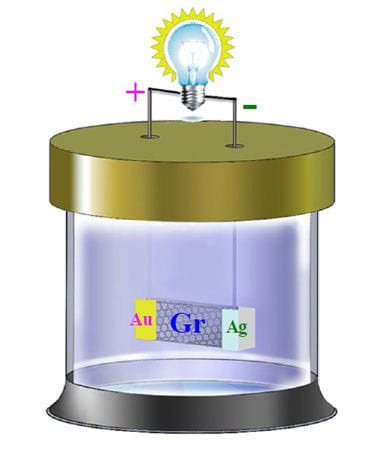
The Shocking Truth About Graphene: How Electrons Become Magnets

Definition and Overview of Graphene Graphene is a unique allotrope of carbon characterized by a single atomic layer arranged in a two-dimensional honeycomb lattice. Since its groundbreaking isolation in 2004, graphene has attracted immense interest due to its exceptional physical and chemical properties. Its atomic configuration imparts extraordinary electrical, mechanical, and thermal characteristics, making it […]

Read More →

Gecko Feet Get Sticky from Static Electricity

Definition and Overview of Gecko Adhesion Geckos, small lizards belonging to the family Gekkonidae, are renowned for their extraordinary ability to cling to and navigate a variety of surfaces, including vertical walls and ceilings. This remarkable adhesive capability has intrigued scientists and enthusiasts alike, prompting investigations into the biological and physical principles underlying their grip. […]

Read More →

Fuel Cells Are Turning to Alcohol

Definition of Alcohol-Based Fuel Cells Alcohol-based fuel cells are a category of electrochemical devices that convert the chemical energy stored in alcohol fuels directly into electrical energy. These fuel cells primarily utilize alcohols such as methanol or ethanol as their fuel source, distinguishing them from traditional hydrogen fuel cells. Known as direct alcohol fuel cells […]

Read More →

Flawed by Design: When Defects Make Lasers Work Better

Understanding Laser Functionality Lasers are sophisticated devices that generate coherent light through the process known as stimulated emission. Central to their operation is the gain medium, which can be a solid, liquid, or gas, energized to achieve a population inversion-a state where more electrons occupy excited energy levels than the ground state. This inversion enables […]

Read More →

Graphene and a New Battery Breakthrough

Definition of Graphene and Its Role in Battery Technology Graphene is a single-atom-thick layer of carbon atoms arranged in a two-dimensional honeycomb lattice, making it a crystalline allotrope of carbon. This unique atomic configuration endows graphene with exceptional electrical conductivity, superior thermal management capabilities, and remarkable mechanical strength. These properties position graphene as a revolutionary […]

Read More →

Double Helix Becomes an Electric Slide for Proteins

Definition of the Double Helix The double helix is the iconic structural form of DNA, consisting of two complementary strands twisted around each other. This configuration serves as the fundamental framework for storing and transmitting genetic information in living organisms. Each strand is composed of nucleotides paired through specific base pairs, creating a stable yet […]

Read More →

Good News for Negative Index Materials

Definition of Negative Index Materials Negative index materials (NIMs) are engineered substances characterized by a refractive index that is less than zero. This unique property causes light waves to refract in the opposite direction compared to conventional materials, defying traditional optical principles. Such materials challenge established concepts in optics and metamaterials, opening new avenues for […]

Read More →

Tiny Reactors Big Potential: DOE Backs Next-Gen Nuclear

Definition of Small Modular Reactors (SMRs) Small Modular Reactors (SMRs) are a class of nuclear reactors distinguished by their reduced physical footprint and modular construction approach. Typically, these reactors generate electrical power outputs up to 300 megawatts (MW), which is significantly lower than traditional large-scale nuclear plants that often exceed 1,000 MW. The modular design […]

Read More →

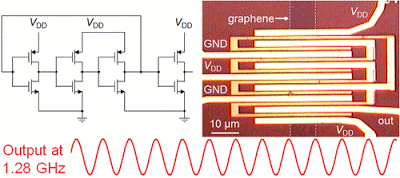
A Graphene Circuit is a First

Understanding Graphene Circuits Graphene circuits represent a groundbreaking advancement in electronic engineering, comparable to the evolution from rudimentary sketches to the refined artistry of watercolor painting. At the heart of this innovation lies graphene-a single layer of carbon atoms arranged in a two-dimensional honeycomb lattice. This extraordinary material embodies both futuristic potential and a scientific […]

Read More →

Making a Heavy Fermion Material in 2D

Understanding Heavy Fermion Materials Heavy fermion materials are distinguished by charge carriers whose effective mass far exceeds that of free electrons. This unusual property stems from intense electron-electron interactions and the hybridization between localized f-electrons and mobile conduction electrons. These interactions give rise to complex electronic behaviors that have intrigued condensed matter physicists for decades. […]

Read More →