
Short Answer
Understanding Graphene Circuits
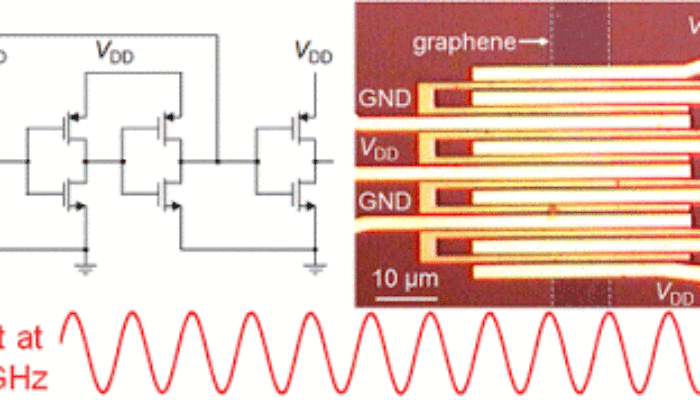
Graphene circuits represent a groundbreaking advancement in electronic engineering, comparable to the evolution from rudimentary sketches to the refined artistry of watercolor painting. At the heart of this innovation lies graphene-a single layer of carbon atoms arranged in a two-dimensional honeycomb lattice. This extraordinary material embodies both futuristic potential and a scientific enigma, challenging established principles in physics and materials science. The development of graphene circuits capable of operating at gigahertz frequencies exemplifies cutting-edge progress, unlocking capabilities that could transform the landscape of high-speed electronics.
Definition and Key Properties of Graphene
Graphene is a one-atom-thick sheet of carbon atoms tightly bonded in a hexagonal pattern. Its unique structure endows it with remarkable characteristics that distinguish it from conventional materials used in electronics.
- Electrical Conductivity:
Graphene exhibits exceptional ability to conduct electricity, surpassing traditional semiconductors like silicon. - Mechanical Strength:
Despite its thinness, graphene is incredibly strong and flexible, making it ideal for nanoscale applications. - Thermal Conductivity:
It efficiently dissipates heat, reducing energy loss and improving device longevity.
How Graphene Circuits Operate at Gigahertz Frequencies
The operation of graphene circuits at gigahertz frequencies is not merely an incremental enhancement but a transformative leap in electronic speed. These frequencies are essential for high-performance fields such as telecommunications and advanced computing, where rapid data transmission and processing are critical. Unlike silicon-based circuits, which face limitations due to heat generation and slower electron mobility, graphene allows electrons to move with minimal resistance, akin to gliding on a frictionless surface. This property enables the seamless and rapid flow of electronic signals, facilitating unprecedented processing speeds.
Advantages Over Traditional Semiconductor Technologies
Graphene circuits offer several advantages compared to conventional silicon-based electronics:
- Higher Electron Mobility:
Electrons travel faster in graphene, enabling quicker signal transmission. - Reduced Thermal Issues:
Superior heat conduction minimizes overheating, allowing for more compact and efficient designs. - Enhanced Flexibility:
Graphene’s mechanical properties support flexible and wearable electronic devices.
Applications and Practical Implications
Graphene circuits pave the way for significant advancements across various technological domains:
- Telecommunications:
Ultra-fast data transfer and improved signal integrity can revolutionize mobile networks and internet connectivity. - Computing:
Processors built with graphene circuits could perform complex calculations at unprecedented speeds. - Wearable Technology:
Lightweight, flexible devices with enhanced performance and energy efficiency become feasible.
Visualize traditional circuits as congested highways with traffic jams, while graphene circuits resemble smooth, high-speed expressways where electronic signals travel unhindered, dramatically boosting system performance.
Energy Efficiency and Miniaturization Potential
Beyond speed, graphene circuits hold promise for reducing energy consumption and enabling device miniaturization. Conventional circuits often generate excessive heat, necessitating bulky cooling systems and limiting efficiency. Graphene’s excellent thermal conductivity helps dissipate heat more effectively, supporting sustainable and eco-friendly electronic designs. This capability also facilitates the creation of smaller, more powerful devices such as smartphones that respond instantaneously, computers capable of rapid data processing, and discreet yet potent wearable gadgets.
Design Flexibility and Future Innovations
The architecture of graphene circuits is highly adaptable, allowing for diverse configurations tailored to specific applications. Advanced modulation techniques can be integrated to optimize performance across different environments. This versatility mirrors natural adaptability, akin to a chameleon adjusting its colors, and underscores the dynamic potential of graphene technology to foster new ecosystems of innovation at the intersection of materials science and electrical engineering.
Challenges in Commercialization and Production
Despite its promising attributes, the widespread adoption of graphene circuits faces significant hurdles. Producing high-quality graphene at scale while maintaining cost-effectiveness remains a major challenge. Researchers and engineers must overcome these barriers through increased funding, interdisciplinary collaboration, and technological breakthroughs to transition graphene circuits from laboratory prototypes to commercially viable products.
Significance and Future Outlook
The advent of gigahertz graphene circuits signals a pivotal moment in electronics, blending traditional engineering with revolutionary materials to usher in a new era of speed and efficiency. This innovation not only redefines the boundaries of what electronic devices can achieve but also inspires ongoing scientific inquiry and technological exploration. As research progresses, the impact of graphene circuits is expected to extend beyond electronics, influencing society and various scientific fields profoundly.
Summary
In summary, gigahertz graphene circuits epitomize the fusion of human creativity and advanced material science, overcoming previous limitations in electronic speed and efficiency. They represent both the culmination of efforts to enhance digital technology and the beginning of new possibilities for interconnected, high-performance devices. As this technology matures, it promises to be a cornerstone of future innovations, inviting continued exploration and development in the realm of next-generation electronics.
FAQ
What are graphene circuits?
Graphene circuits are electronic circuits that use graphene, a single layer of carbon atoms, to achieve high performance and efficiency in electronic devices.
What are the advantages of graphene circuits over traditional silicon circuits?
Graphene circuits offer higher electron mobility, reduced thermal issues, and enhanced flexibility, making them superior for high-speed applications.




Leave a Reply