
Short Answer
Definition of Bose-Einstein Condensates
Bose-Einstein condensates (BECs) represent a unique state of matter formed when a group of bosons-particles with integer spin-occupy the same quantum state at extremely low temperatures. This phenomenon, first predicted by physicists Satyendra Nath Bose and Albert Einstein in the early 20th century, results in the particles behaving collectively as a single quantum entity visible on a macroscopic scale. BECs reveal the extraordinary quantum mechanical properties of matter that are otherwise hidden at higher temperatures.
- Bosons:
Particles with integer spin that follow Bose-Einstein statistics, including photons, gluons, and certain atoms like rubidium-87. - Quantum State:
A specific set of quantum numbers describing the energy and other properties of particles; in BECs, many bosons share this identical state. - Macroscopic Quantum Phenomenon:
The collective behavior of particles that manifests quantum effects on a scale visible to the naked eye.
Fundamental Principles Behind BEC Formation
The formation of a Bose-Einstein condensate hinges on the unique statistical behavior of bosons, which contrasts sharply with fermions-particles with half-integer spin. While fermions obey the Pauli exclusion principle, preventing identical particles from occupying the same quantum state, bosons are not restricted by this rule. This allows bosons to accumulate in the lowest energy state when cooled to temperatures near absolute zero.
Experimentally, BECs are created by cooling dilute gases of bosonic atoms, such as rubidium-87 or sodium-23, to temperatures just fractions of a degree above 0 Kelvin. At these ultra-cold temperatures, the thermal de Broglie wavelength of the atoms becomes comparable to the distance between them, causing their wave functions to overlap significantly. This overlap triggers a phase transition where a large fraction of the atoms collapse into the ground quantum state, forming the condensate.
Quantum Coherence and Macroscopic Effects
One of the defining features of Bose-Einstein condensates is their quantum coherence, where the wave functions of individual particles synchronize to produce a unified quantum state extending over macroscopic distances. This coherence underpins several remarkable phenomena:
- Superfluidity:
A frictionless flow of fluid that arises from the coherent quantum state, allowing the condensate to move without viscosity. - Josephson Effect:
When two BECs are separated by a barrier, particles can tunnel between them, causing oscillations in particle number and phase. This effect is analogous to phenomena observed in superconductors and has implications for quantum technologies.
These macroscopic quantum behaviors provide valuable insights into quantum hydrodynamics and the fundamental principles governing quantum systems.
Experimental Techniques for Creating BECs
The realization of Bose-Einstein condensates in the laboratory relies on advanced cooling and trapping methods designed to reach the ultra-low temperatures necessary for condensation:
- Laser Cooling:
Utilizes the Doppler effect to slow down atoms by tuning laser frequencies, thereby reducing their kinetic energy. - Magnetic Trapping:
Employs spatially varying magnetic fields to confine atoms in a defined region of space. - Optical Lattices:
Creates periodic potential wells using intersecting laser beams, allowing precise control over atomic positions. - Evaporative Cooling:
Removes higher-energy atoms from the trap, enabling the remaining atoms to cool further through thermalization.
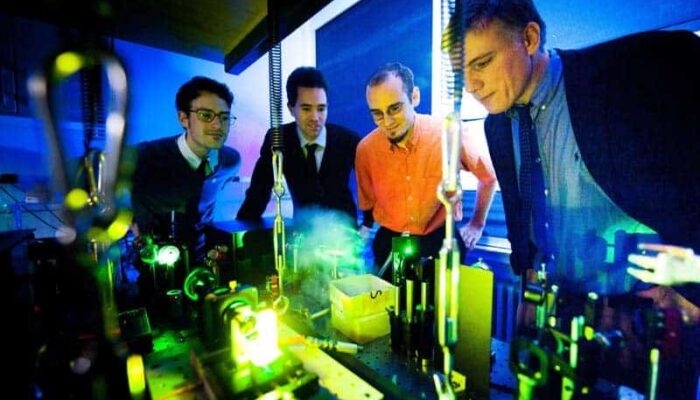
These techniques collectively enable researchers to manipulate atomic gases with exquisite precision, facilitating the study of BECs and their properties.
Applications and Significance of Bose-Einstein Condensates
Bose-Einstein condensates have far-reaching implications across multiple scientific and technological domains:
- Quantum Computing:
BECs provide platforms for exploring quantum superposition and entanglement, essential for developing qubits and quantum information processing. - Precision Measurement:
The sensitivity of BECs to external perturbations makes them ideal for high-precision sensors and interferometers. - Fundamental Physics Research:
BECs serve as model systems to investigate quantum many-body phenomena, phase transitions, and exotic states of matter such as topological phases. - Material Science Insights:
Studying excitations and collective behaviors in BECs can shed light on complex materials like high-temperature superconductors and two-dimensional materials.
Common Misunderstandings About Bose-Einstein Condensates
- Misconception: BECs are simply very cold gases.
Correction: While BECs are formed at ultra-low temperatures, they represent a distinct quantum phase where particles act collectively as a single quantum entity, not just a cold gas. - Misconception: Only photons can form Bose-Einstein condensates.
Correction: Although photons are bosons, BECs have been experimentally realized with various bosonic atoms, such as rubidium and sodium.
Importance of Bose-Einstein Condensates in Science and Technology
The study of Bose-Einstein condensates bridges fundamental quantum mechanics and practical applications, offering a window into the quantum world on a macroscopic scale. By enabling the exploration of quantum coherence, superfluidity, and tunneling phenomena, BECs deepen our understanding of matter under extreme conditions. Moreover, their role in advancing quantum technologies, from computing to sensing, highlights their transformative potential in shaping future scientific and technological landscapes.
FAQ
What is a Bose–Einstein condensate?
A Bose–Einstein condensate is a state of matter formed when bosons are cooled to temperatures near absolute zero, causing them to occupy the same quantum state and behave as a single macroscopic quantum entity.
What types of particles can form Bose–Einstein condensates?
Bosons, which are particles with integer spin such as photons, gluons, and certain atoms like rubidium-87 or sodium-23, can form Bose–Einstein condensates.
What experimental techniques are used to create BECs?
BECs are created using laser cooling, magnetic traps, optical lattices, and evaporative cooling to reach ultra-low temperatures necessary for condensation.
What are some applications of Bose–Einstein condensates?
Applications include quantum computing, precision measurement, exploration of quantum many-body physics, and fundamental tests of quantum mechanics.



Leave a Reply