
Short Answer
Definition of Newton’s Law of Universal Gravitation
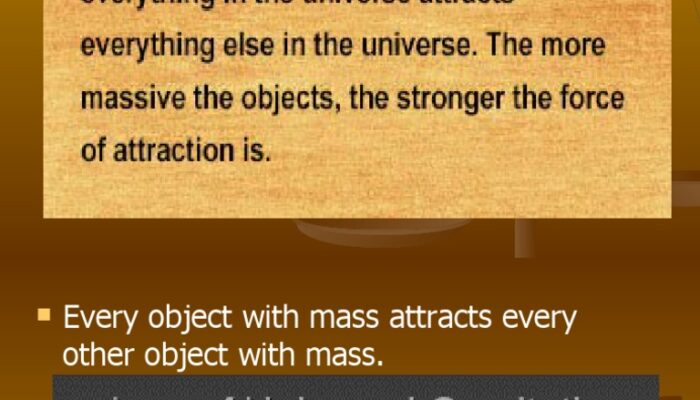
Newton’s Law of Universal Gravitation describes the fundamental force by which every object with mass attracts every other object with mass in the universe. This principle explains why objects fall toward the Earth and governs the motion of celestial bodies such as planets, moons, and comets. It is a foundational concept in classical physics that reveals the invisible force binding matter together across vast distances.
- Universal Attraction:
Every mass exerts a gravitational pull on every other mass, regardless of their location in the cosmos. - Dependence on Mass and Distance:
The strength of this force depends directly on the masses involved and inversely on the square of the distance separating them.
Fundamental Principles and Formula
The law states that the gravitational force (F) between two objects is proportional to the product of their masses (m₁ and m₂) and inversely proportional to the square of the distance (r) between their centers. This relationship is mathematically expressed as:
F = G × (m₁ × m₂) / r²
- F: Gravitational force between the two masses
- m₁, m₂: Masses of the two objects
- r: Distance between the centers of the two masses
- G: Gravitational constant, a universal value that quantifies the strength of gravity
This formula encapsulates the inverse-square law, meaning the force decreases rapidly as the distance increases, not in a linear fashion but by the square of the distance.
How Newton’s Law Explains Everyday and Cosmic Phenomena
From the simple act of dropping a pencil to the complex orbits of planets, Newton’s law provides a unified explanation for gravitational interactions. On Earth, gravity gives objects weight and influences the behavior of fluids, projectiles, and atmospheric retention. In the cosmos, it governs the paths of planets around stars, the motion of moons, and the trajectories of comets.
For example, when a pencil falls, it is pulled toward Earth due to the planet’s mass warping the space around it, causing the pencil to accelerate downward. Similarly, the Moon remains in orbit because Earth’s gravitational pull continuously alters its trajectory, preventing it from drifting away into space.
Historical Context and Deeper Understanding
While Newton’s law accurately describes the magnitude and direction of gravitational forces, it does not explain the underlying cause of gravity. This question was later addressed by Albert Einstein’s General Theory of Relativity, which interprets gravity as the curvature of spacetime caused by mass and energy. Despite this advancement, Newton’s formulation remains essential for most practical calculations and initial studies of gravitational effects.
Applications in Science and Technology
Newton’s Law of Universal Gravitation is not only a theoretical cornerstone but also a practical tool in various fields:
- Astronomy and Space Exploration:
Enables precise predictions of planetary orbits, satellite trajectories, and space mission planning. - Engineering:
Guides the design of stable structures and transportation systems by accounting for gravitational forces. - Global Positioning Systems (GPS):
Relies on accurate gravitational calculations to maintain satellite positioning and timing.
Gravity’s Role Across Different Scales
Gravity’s influence spans from the microscopic to the cosmic scale. On Earth, it determines weight and affects natural phenomena such as ocean tides, which result from the Moon’s gravitational pull. On a grander scale, gravity binds galaxies together, shapes their formation, and drives the evolution of the universe’s large-scale structure.
Common Misconceptions About Gravity
Gravity only acts on Earth.
Gravity is a universal force acting between all masses, everywhere in the universe.
Gravity pulls objects downward because Earth “sucks” them in.
Gravity is an attractive force between masses, not a suction; Earth’s mass creates a gravitational field that pulls objects toward its center.
Gravity’s strength is the same everywhere.
Gravity’s force decreases with the square of the distance between objects, so it weakens as objects move farther apart.
Significance of Newton’s Law of Universal Gravitation
This law is pivotal in bridging everyday experiences with the grand mechanics of the universe. It provides a coherent framework to understand how matter interacts across distances, from the fall of an apple to the orbits of distant planets. Newton’s insight laid the groundwork for modern physics, enabling advancements in astronomy, engineering, and technology that continue to shape our understanding of reality and our place within the cosmos.



Leave a Reply