
Short Answer
Definition of Planetary Orbit
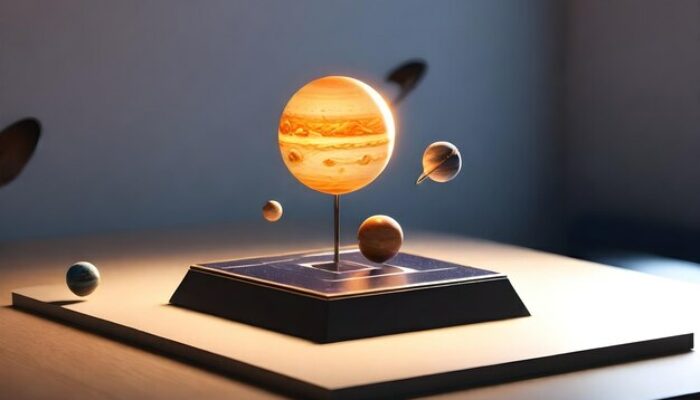
Planets appear to hover effortlessly in the vast expanse of space, neither crashing into their stars nor drifting away into the void. This phenomenon, often perceived as planets “floating,” is actually a complex balance of forces that keeps them in stable paths around their stars. Rather than being suspended, planets are continuously moving in orbits shaped by gravitational attraction and their own momentum.
Fundamental Principles Behind Orbital Motion
To understand why planets do not fall into their stars or escape into space, it is essential to grasp two key physical concepts: inertia and gravity.
- Inertia:
The property of an object to maintain its velocity and direction unless influenced by an external force. - Gravitational Force:
The attractive force exerted by massive bodies, such as stars, pulling planets toward them.
The interplay between these forces results in a continuous freefall of the planet toward the star, but because of the planet’s forward velocity, it perpetually misses the star, creating a stable orbit.
How Planetary Orbits Function
In space, the concept of “down” as we know it on Earth does not exist. Instead, planets are in a constant state of falling toward their stars, but their tangential velocity causes them to move along curved paths rather than straight lines. This can be likened to swinging a stone tied to a string: the tension pulls the stone inward, but its forward motion keeps it moving in a circle.
Newton’s law of universal gravitation explains that every mass attracts every other mass with a force proportional to their masses and inversely proportional to the square of the distance between them. This gravitational pull acts as a centripetal force, accelerating the planet inward. Simultaneously, the planet’s inertia propels it forward, resulting in an elliptical orbit rather than a direct collision.
Mathematical Description of Orbital Motion
Newton’s law of universal gravitation is expressed as:
F = G * (m₁ * m₂) / r²
- F: Gravitational force between two masses
- G: Gravitational constant
- m₁, m₂: Masses of the two objects (e.g., star and planet)
- r: Distance between the centers of the two masses
The balance of this force with the planet’s velocity determines the shape and stability of the orbit.
Kepler’s Laws and Orbital Characteristics
Johannes Kepler’s three laws of planetary motion provide a detailed framework for understanding orbits:
- First Law (Elliptical Orbits):
Planets move in ellipses with the star at one focus. - Second Law (Equal Areas):
A line segment joining a planet and its star sweeps out equal areas during equal intervals of time, meaning the planet moves faster when closer to the star and slower when farther away. - Third Law (Harmonic Law):
The square of a planet’s orbital period is proportional to the cube of the semi-major axis of its orbit.
These laws reveal that orbits are dynamic and vary in speed, adding complexity to the planetary motion.
Long-Term Stability and Perturbations
Planetary orbits remain stable over immense timescales despite disturbances caused by gravitational influences from other celestial bodies, stellar winds, and cosmic events. This stability arises from the self-regulating nature of gravitational interactions and resonances that dampen perturbations. In some cases, orbits can evolve, causing planets to migrate closer or farther from their stars, but the overall system maintains a delicate balance.
Relativity and the Geometry of Space-Time
Einstein’s theory of general relativity offers a deeper understanding of gravity as the curvature of space-time caused by mass. Instead of viewing gravity as a force, this theory describes planets as following curved paths-geodesics-in the warped fabric of space-time around stars. Their forward momentum combined with this curvature results in the orbital motion we observe, effectively “falling” along these curved trajectories without colliding with the star.
Orbital Velocity and Centripetal Force
The precise speed at which a planet travels is critical to maintaining its orbit:
- Too Slow:
Gravity dominates, pulling the planet inward, potentially causing it to spiral into the star. - Too Fast:
The planet’s inertia overcomes gravitational pull, allowing it to escape into space. - Orbital Velocity:
The exact speed where gravitational pull and inertia balance, enabling the planet to continuously “fall around” the star without collision or escape.
Applications Beyond Planets: Moons and Spacecraft
The same principles governing planetary orbits apply to moons orbiting planets and artificial satellites orbiting Earth. Moons maintain their orbits through the balance of gravitational attraction and their tangential velocities. Similarly, spacecraft achieve stable orbits by reaching specific velocities that prevent them from falling back to Earth or drifting away into space, demonstrating the universality of orbital mechanics.
Common Misconceptions About Planetary Motion
Planets are stationary and simply float in space.
Planets are in constant motion, orbiting stars due to the balance of gravitational pull and their forward velocity.
Gravity pulls planets straight into stars.
Gravity acts as a centripetal force, causing planets to follow curved paths rather than falling directly inward.
Orbits are perfect circles.
Most orbits are elliptical, with varying speeds depending on the planet’s distance from the star.
Significance of Orbital Mechanics
Understanding how planets maintain their orbits is fundamental to astrophysics, space exploration, and our comprehension of the universe’s structure. This knowledge enables the prediction of planetary positions, the design of satellite trajectories, and the study of celestial dynamics. The elegant balance of forces that govern orbital motion exemplifies the intricate harmony underlying cosmic phenomena and inspires ongoing scientific inquiry into the nature of gravity and motion.


Leave a Reply