
Short Answer
Definition of Gravity and Acceleration Equivalence
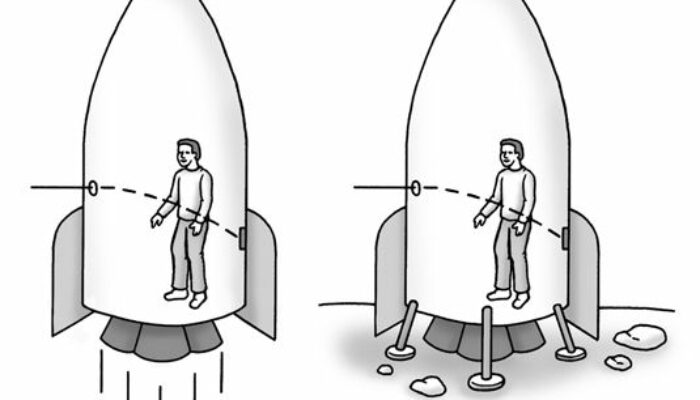
The equivalence between gravity and acceleration is a foundational concept in modern physics, asserting that the effects experienced due to gravitational forces are locally indistinguishable from those caused by uniform acceleration. This principle, central to Albert Einstein’s General Relativity, redefines gravity not as a conventional force but as a manifestation of curved spacetime geometry intimately linked to acceleration.
- Gravity:
Traditionally viewed as an invisible force pulling objects toward massive bodies like Earth. - Acceleration:
The change in velocity of an object, which can produce sensations similar to gravitational pull. - Equivalence Principle:
The assertion that gravitational effects and acceleration effects are locally identical and cannot be distinguished by an observer in a closed system.
Historical Context and Paradigm Shift
Isaac Newton’s classical mechanics described gravity as an instantaneous force acting at a distance, binding objects to Earth and governing celestial motions. However, as physics advanced into the 20th century, inconsistencies in this framework prompted new interpretations. Einstein’s revolutionary insight emerged from contemplating the experience inside an accelerating elevator or spacecraft, where the sensation of weight remains the same whether caused by gravity or acceleration. This thought experiment laid the groundwork for a profound shift in understanding gravity’s nature.
The Equivalence Principle Explained
The equivalence principle posits that within a small, enclosed environment, it is impossible to differentiate between the effects of a gravitational field and those of uniform acceleration. For example, an astronaut inside a spacecraft accelerating through empty space would feel a force pushing them toward the floor, indistinguishable from the pull of gravity on Earth. This principle is not merely theoretical but serves as the conceptual cornerstone for General Relativity, linking acceleration and gravity as two facets of the same phenomenon.
Gravity as Curvature of Spacetime
Einstein extended the equivalence principle to propose that gravity arises from the curvature of spacetime caused by mass and energy. Massive objects like planets and stars deform the fabric of spacetime, creating “valleys” or indentations analogous to a heavy ball placed on a stretched trampoline. Objects moving nearby follow these curved paths, or geodesics, which appear to us as gravitational attraction. Thus, gravity is not a force transmitted across space but the natural motion along curved spacetime.
Geodesics and Free Fall
When an object is in free fall, such as an astronaut orbiting Earth, it moves along a geodesic-the straightest possible path in curved spacetime-experiencing no force or acceleration relative to gravity. The sensation of weight arises only when a surface, like the ground, prevents this natural motion, exerting a reaction force. This explains why astronauts feel weightless in orbit despite Earth’s gravity acting upon them.
Interrelation of Gravity and Acceleration
Einstein’s framework elegantly unites gravity and acceleration, challenging the Newtonian view of gravity as an instantaneous force acting at a distance. Locally, free-falling frames experience no acceleration, and the feeling of weight is a result of resisting the natural curved motion of spacetime. This blurring of gravity and acceleration reveals a deeper understanding of inertia and motion, where both phenomena are manifestations of the same underlying geometry.
Experimental Evidence Supporting the Equivalence Principle
The equivalence principle has been rigorously tested and confirmed through numerous experiments and observations, which include:
- Light Bending:
Light rays curve when passing near massive bodies, consistent with spacetime curvature. - Gravitational Redshift:
Light escaping gravitational fields loses energy, shifting toward longer wavelengths. - Time Dilation:
Clocks run slower in stronger gravitational fields, demonstrating the influence of gravity on time itself.
These phenomena arise naturally from the geometric interpretation of gravity and distinguish Einstein’s theory from Newtonian gravity, providing enhanced predictive accuracy and conceptual clarity.
Visualizing Spacetime and Gravity
One can imagine spacetime as a flowing river disrupted by islands representing masses. Objects move along the currents shaped by these masses, analogous to marbles rolling on a warped surface. Observers anchored to a fixed point feel forces opposing the flow, similar to the sensation of weight on Earth. Conversely, freely drifting objects follow the river’s natural course, embodying free-fall motion governed by spacetime geometry without experiencing force.
Significance of the Equivalence Principle in Physics
Einstein’s insight transforms gravity from a mysterious force into an emergent property of spacetime geometry, fundamentally altering our understanding of the universe. This principle not only reshapes concepts of motion and inertia but also underpins modern technologies such as GPS, which must account for relativistic effects to maintain accuracy. It invites us to perceive the cosmos as a dynamic interplay of geometry and motion, where acceleration and gravity are inseparable threads woven into the fabric of reality.
Summary
In essence, gravity and acceleration are indistinguishable phenomena when observed locally, a truth encapsulated by Einstein’s equivalence principle and realized through the geometric framework of General Relativity. This paradigm shift replaces the classical notion of gravity as a force with the elegant concept of curved spacetime guiding the natural paths of objects. The unity of acceleration and gravity not only advances scientific understanding but also enriches our appreciation of the universe’s intricate and harmonious design.
FAQ
What is the equivalence principle?
The equivalence principle states that gravitational effects and acceleration effects are locally indistinguishable, meaning an observer in a closed system cannot tell whether they are experiencing gravity or acceleration.
How does Einstein's theory differ from Newton's?
Einstein’s theory redefines gravity as a curvature of spacetime caused by mass, rather than a force acting at a distance as described by Newton.


Leave a Reply