
Short Answer
Definition of the Sun’s Spatial Magnitude
The Sun is a massive, glowing sphere of hot plasma that serves as the central star of our solar system. Its spatial magnitude refers to the vast physical space it occupies, encompassing not only its immense size but also its extended atmospheric layers and gravitational influence. Understanding the Sun’s spatial presence involves appreciating its dimensions, volume, and the reach of its energy and gravity throughout the solar system.
Physical Dimensions and Volume
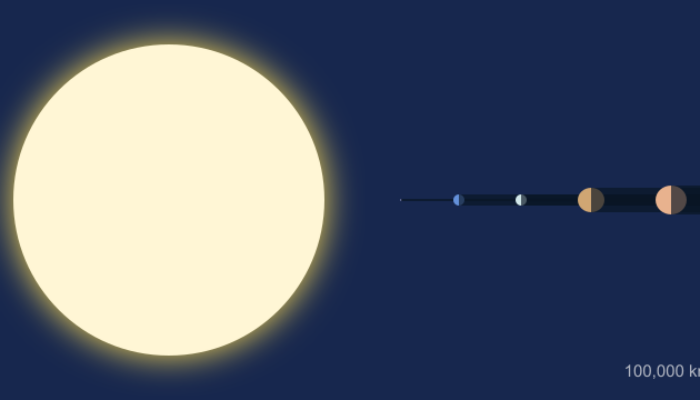
The Sun’s size is truly colossal when compared to Earth. It has a diameter of roughly 1.39 million kilometers (about 864,000 miles), which is approximately 109 times larger than Earth’s diameter. To visualize this scale, if the Sun were represented by a basketball, Earth would be no larger than a small pea orbiting nearby. In fact, over one hundred Earths could be lined up across the Sun’s face.
In terms of volume, the Sun occupies an astronomical space of about 1.41 × 10¹⁸ cubic kilometers. This immense volume could contain nearly 1.3 million Earths inside it. To put this into perspective, if Earth were a tiny grain of sand, the Sun would be comparable to the vast expanse of the Sahara Desert, highlighting the Sun’s overwhelming spatial dominance.
The Sun’s Extended Atmosphere: The Corona
Beyond its dense interior, the Sun is surrounded by the corona, a tenuous outer layer of plasma that extends millions of kilometers into space. This ethereal halo becomes visible during solar eclipses as a faint, glowing aura enveloping the Sun. The corona is not just a visual spectacle; it plays a crucial role in emitting solar winds-streams of charged particles that interact with planetary magnetospheres and influence space weather throughout the solar system.
Gravitational Influence and Solar System Boundaries
The Sun’s spatial significance extends far beyond its physical size due to its immense mass, which constitutes about 99.8% of the entire solar system’s mass. This concentration of mass generates a powerful gravitational field that governs the orbits of planets, comets, asteroids, and cosmic dust. The Sun’s gravitational reach defines the outer limits of the solar system, including distant regions such as the Kuiper Belt and the Oort Cloud, which are reservoirs of icy bodies and the origin of many long-period comets.
Conceptualizing the Sun’s Spatial Role
Space is often imagined as an empty void, but the Sun occupies a dynamic and dense region within this vastness. Acting like a colossal whirlpool in an ocean, the Sun’s gravity pulls and sustains all objects within its domain, shaping the spatial relationships of the solar neighborhood. Its presence is not passive; it actively molds the structure and behavior of the surrounding space.
Solar Radiation and the Habitable Zone
The Sun’s energy output transforms the spatial environment around it. The habitable zone, or “Goldilocks zone,” is a spatial region around the Sun where conditions are just right for liquid water to exist on planetary surfaces-a key ingredient for life as we know it. This zone is relatively narrow compared to the vast distances between planets but is essential for creating environments capable of supporting life, such as Earth.
Scaling the Sun and Earth: A Visual Analogy
To better grasp the Sun’s spatial dominance, consider a scale model where the Sun is the size of a basketball. In this model, Earth would be a tiny marble orbiting approximately 25 meters away. This analogy helps illustrate the immense scale differences and the spatial relationships within the solar system, emphasizing the Sun’s overwhelming presence in both size and influence.
Why the Sun’s Spatial Presence Is Crucial
The Sun’s vast volume, dominant mass, and radiant energy make it the central fulcrum of the solar system. It orchestrates the orbits of planets, drives solar winds, and provides the essential energy that sustains life on Earth. The space the Sun occupies is not merely a physical expanse but a dynamic environment that shapes the very nature of our cosmic neighborhood.
Reflection on the Sun’s Cosmic Significance
Contemplating the Sun’s spatial magnitude inspires awe and humility. This incandescent giant commands space not only through its physical dimensions but also through its gravitational and energetic influence, forming the backbone of the solar system’s architecture. Understanding the true scale of the Sun offers a glimpse into the grandeur of the universe and the intricate design of celestial mechanics.
Summary of Key Points
- Diameter:
Approximately 1.39 million kilometers, about 109 times Earth’s diameter. - Volume:
Roughly 1.41 × 10¹⁸ cubic kilometers, enough to contain 1.3 million Earths. - Corona:
An extended plasma atmosphere visible during eclipses, influencing space weather. - Mass and Gravity:
Contains 99.8% of solar system mass, governing planetary orbits and system boundaries. - Habitable Zone:
A spatial region where conditions support liquid water and potential life.
FAQ
What is the diameter of the Sun?
The Sun has a diameter of approximately 1.39 million kilometers.
How many Earths could fit inside the Sun?
About 1.3 million Earths could fit inside the Sun.
What is the significance of the Sun's corona?
The corona is an outer layer of plasma that influences space weather and is visible during solar eclipses.
What defines the habitable zone around the Sun?
The habitable zone is the region around the Sun where conditions are just right for liquid water to exist.

Leave a Reply