
Short Answer
Understanding the Mass of the Universe
Envision the universe as an immense cosmic ocean, vast beyond comprehension and extending far beyond what the mind can grasp. Determining its mass is comparable to measuring the weight of this boundless celestial sea-a challenge both awe-inspiring and complex. Although the universe seems infinite and intangible, astrophysicists have crafted sophisticated techniques to estimate its mass, unraveling cosmic enigmas through the principles of physics and celestial dynamics. This endeavor combines meticulous observation with deep theoretical understanding, unveiling not only the universe’s magnitude but also the fundamental nature of existence itself.
Gravitational Influence: The Key to Cosmic Mass
Central to the measurement of the universe’s mass is the concept of gravity. In the cosmic arena, mass warps the fabric of spacetime, directing the intricate movements of galaxies and stars. Scientists decode this grand cosmic ballet by analyzing how celestial bodies move, as their trajectories reveal the gravitational forces shaping their paths. Much like a dancer’s spin reveals their strength and form, the velocity and orbit of stars and galaxies disclose the presence of unseen gravitational forces at work.
Galactic Rotation Curves and Dark Matter
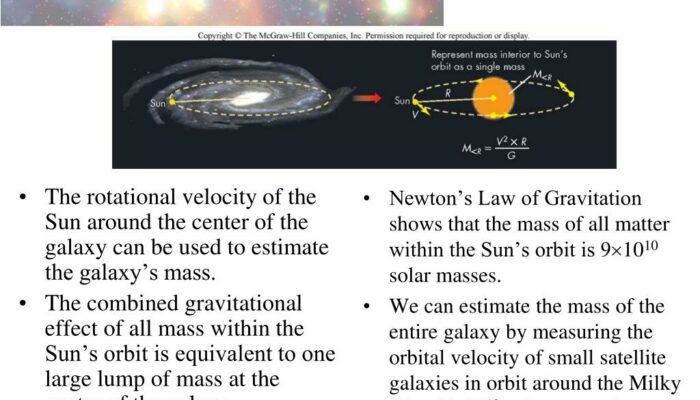
One primary method involves studying the rotation curves of spiral galaxies. Astronomers observe how stars orbit the galactic center at varying distances. According to Newtonian physics, orbital speeds should decrease with distance from the core, similar to the planets in our solar system. However, observations show that these velocities remain constant or even increase, suggesting the presence of an invisible mass surrounding galaxies-known as dark matter. This discovery revolutionized our understanding, revealing that visible matter represents only a small fraction of the total mass. By charting these rotational speeds and applying Newton’s laws and Keplerian dynamics, researchers infer the gravitational pull exerted by this hidden mass, which holds galaxies together.
Galaxy Clusters as Cosmic Scales
Beyond individual galaxies, galaxy clusters serve as crucial reference points for estimating universal mass. These massive assemblies, containing hundreds or thousands of galaxies, act as gravitational anchors with far-reaching influence. By examining the velocity dispersion-the range and spread of galaxy speeds within clusters-astronomers estimate the total mass required to keep these clusters gravitationally bound. This approach relies on the virial theorem, which treats clusters like giant cosmic metronomes, where the rhythm of galactic motion reveals the underlying gravitational mass.
Gravitational Lensing: Nature’s Cosmic Scale
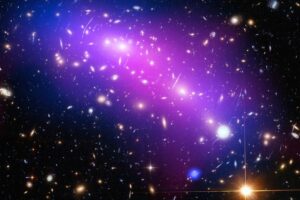
Another powerful technique is gravitational lensing, where massive objects bend and focus light from more distant sources. These natural lenses distort the images of background galaxies, creating arcs and multiple images. This effect provides a direct measurement of mass regardless of whether the matter emits light. By carefully mapping these distortions, scientists reconstruct the mass distribution of the lensing object with high precision. Gravitational lensing thus acts as a cosmic scale sensitive to both visible and invisible matter, offering compelling evidence for the widespread presence of dark matter.
The Cosmic Microwave Background and Universal Composition
The universe’s total mass-energy content extends beyond galaxies and clusters. Cosmologists study the cosmic microwave background (CMB)-the faint afterglow of the Big Bang-to gain insight into the universe’s composition. This relic radiation carries subtle temperature and polarization fluctuations that reflect the primordial density variations from which all large-scale structures formed. Using data from satellite missions and advanced detectors, scientists compare these observations with theoretical models of cosmic evolution to determine key parameters such as total matter density, baryonic matter, dark matter, and dark energy fractions with remarkable accuracy.
Integrating Methods: A Comprehensive Picture of Universal Mass
The combination of galactic rotation curves, velocity dispersion in clusters, gravitational lensing, and CMB analysis creates a detailed and nuanced understanding of the universe’s mass. Current cosmological models indicate that ordinary baryonic matter constitutes only a small portion of the total mass-energy budget, while dark matter and dark energy dominate. Accurately quantifying mass on such vast scales is essential for understanding cosmic evolution, the formation of structures, and the ultimate destiny of the universe.
Historical Context and Human Curiosity
The quest to measure the universe’s mass echoes humanity’s ancient efforts to understand the Earth and the heavens. Just as Eratosthenes used the sun’s shadows to estimate Earth’s circumference, modern astronomers track the shadows cast by gravity and light to weigh the cosmos. This progression from terrestrial measurements to cosmic scales exemplifies humanity’s relentless curiosity and intellectual boldness.
The Significance of Measuring Universal Mass
Determining the mass of the universe transcends mere numerical calculation. It invites reflection on the nature of reality, embraces the unknown, and reveals the invisible framework that brings order to cosmic vastness. Each measurement technique-from analyzing stellar motions to tracing photon paths-adds depth to our cosmic narrative, weaving fragments of knowledge into a coherent whole. This pursuit highlights scientific creativity and the enduring human spirit, demonstrating that despite the universe’s enormity and complexity, we can confidently estimate its mass with wonder and precision.
Conclusion: The Ongoing Journey of Cosmic Discovery
In summary, calculating the universe’s mass is a voyage through contrasts-light and shadow, motion and stillness, visible and invisible. It represents a form of celestial detective work that transforms the abstract idea of “mass” into a tangible parameter guiding theoretical frameworks and inspiring further exploration. As observational tools improve and our understanding deepens, the weight of the cosmic ocean will become clearer, yet its mysteries will continue to beckon us into the endless dance of discovery.
FAQ
What methods are used to calculate the mass of the universe?
Methods include studying galactic rotation curves, galaxy clusters, gravitational lensing, and analyzing the cosmic microwave background.
Why is measuring the universe's mass important?
It helps us understand cosmic evolution, the formation of structures, and the overall nature of the universe.



Leave a Reply