
Short Answer
Definition of Dark Matter and Dark Energy
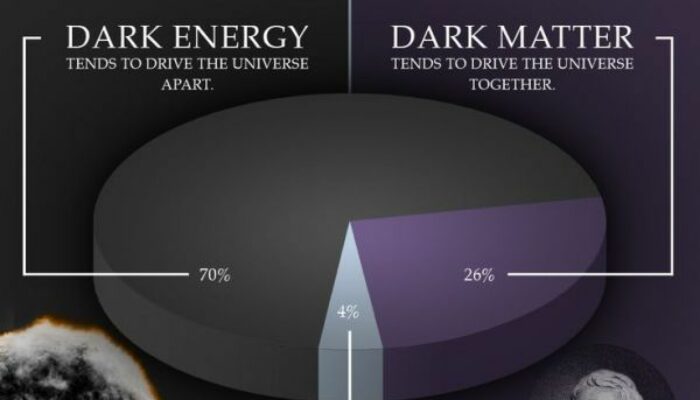
Dark matter and dark energy are two fundamental yet mysterious components that dominate the universe’s composition. Unlike ordinary matter, which interacts with light and can be observed directly, these entities neither emit nor absorb electromagnetic radiation, making them invisible to conventional detection methods. Together, they constitute approximately 95% of the universe’s total mass-energy content, profoundly influencing its structure and evolution.
- Dark Matter:
A form of matter that does not interact with electromagnetic forces, rendering it invisible but detectable through its gravitational effects on visible matter and cosmic structures. - Dark Energy:
A mysterious force responsible for the accelerated expansion of the universe, acting as a form of anti-gravity that pushes galaxies apart.
Understanding Dark Matter
Dark matter is an elusive substance that does not emit, absorb, or reflect light, making it undetectable by traditional telescopes. Its presence is inferred primarily through gravitational influences on visible objects and radiation. For instance, galaxies rotate at speeds that cannot be explained solely by the gravitational pull of their observable stars; without additional unseen mass, these galaxies would fly apart. This unseen mass, known as dark matter, acts as a gravitational framework that holds galaxies and larger cosmic structures together.
Unlike ordinary matter composed of protons, neutrons, and electrons, dark matter is believed to consist of unknown particles that interact very weakly with normal matter. Leading candidates include Weakly Interacting Massive Particles (WIMPs) and axions, though despite extensive experimental efforts, direct detection remains elusive.
The Role and Nature of Dark Energy
In contrast to dark matter’s gravitational binding, dark energy is a mysterious force driving the universe’s accelerated expansion. Discovered in the late 20th century through observations of distant supernovae receding faster than anticipated, dark energy constitutes about 68% of the universe’s total energy density. It behaves like a repulsive force, counteracting gravity and influencing the ultimate fate of the cosmos.
The precise nature of dark energy is still unknown. It is often linked to the cosmological constant, a concept introduced by Einstein representing a constant energy density inherent to space itself. Alternatively, it might be a dynamic field, sometimes called “quintessence,” that evolves over time. Understanding dark energy challenges existing physics frameworks, particularly the reconciliation of quantum mechanics with general relativity.
Cosmic Significance and Interrelation
Dark matter and dark energy together shape the universe’s large-scale structure and destiny. While dark matter forms gravitational wells that guide the formation of galaxies and clusters, dark energy drives the accelerated expansion of space. This duality raises profound questions about the nature of reality, as the ordinary matter familiar to us comprises only a small fraction of the cosmos.
The balance between these components influences whether the universe will continue expanding indefinitely, slow down, or eventually collapse in a “big crunch.” Their interplay is central to modern cosmological models and our understanding of the universe’s past, present, and future.
Methods of Investigation
Scientists employ various observational and experimental techniques to study dark matter and dark energy. Gravitational lensing, where light bends around massive objects, serves as an indirect method to map dark matter distribution by revealing mass concentrations invisible to telescopes. Measurements of the cosmic microwave background radiation provide insights into the early universe’s conditions, leaving imprints of dark matter and dark energy.
On the experimental front, underground detectors and particle accelerators aim to capture rare interactions between dark matter particles and ordinary matter. Large-scale sky surveys monitor galaxy movements and distributions to refine models of dark energy, seeking to determine whether it is a constant or a dynamic phenomenon.
Mathematical Framework and Formulas
The cosmological constant (Λ) is a key parameter in Einstein’s field equations of general relativity, representing dark energy’s energy density:
Gμν + Λgμν = (8πG/c⁴) Tμν
- Gμν: Einstein tensor describing spacetime curvature
- Λ: Cosmological constant representing dark energy density
- gμν: Metric tensor of spacetime
- Tμν: Energy-momentum tensor of matter and radiation
- G: Gravitational constant
- c: Speed of light
Dark matter’s gravitational effects are modeled through Newtonian gravity and general relativity, influencing galaxy rotation curves and large-scale structure formation.
Practical Examples in Astronomy
One of the most compelling evidences for dark matter is the rotation curves of spiral galaxies, which remain flat at large radii instead of declining as expected if only visible matter were present. This indicates additional unseen mass.
Gravitational lensing observed in galaxy clusters, such as the Bullet Cluster, reveals mass distributions inconsistent with visible matter alone, providing strong evidence for dark matter’s existence.
Observations of distant Type Ia supernovae have demonstrated the universe’s accelerated expansion, leading to the discovery of dark energy.
Common Misconceptions
Dark matter is just ordinary matter that is hidden.
Dark matter is fundamentally different from ordinary matter and does not interact electromagnetically, making it invisible and undetectable by conventional means.
Dark energy is the same as dark matter.
Dark energy and dark matter are distinct; dark matter exerts gravitational attraction, while dark energy causes the accelerated expansion of the universe.
Importance in Science and Daily Life
Understanding dark matter and dark energy is crucial for comprehending the universe’s composition, structure, and ultimate fate. These phenomena challenge existing physical theories and may lead to revolutionary advances in physics, cosmology, and technology. Insights gained could transform our grasp of fundamental forces, influence future energy solutions, and reshape philosophical perspectives on existence.
Future Prospects and Exploration
Ongoing and future research endeavors aim to unravel the mysteries of dark matter and dark energy. Enhanced observational instruments, more sensitive detectors, and refined theoretical models promise to deepen our knowledge. As these cosmic enigmas gradually come into focus, humanity’s understanding of the universe will expand, revealing a reality far more complex and wondrous than previously imagined.
FAQ
What is dark matter?
Dark matter is a form of matter that does not interact with light, making it invisible but detectable through its gravitational effects.
What role does dark energy play in the universe?
Dark energy is a force that drives the accelerated expansion of the universe, counteracting gravitational attraction.
How do scientists study dark matter and dark energy?
Scientists use methods such as gravitational lensing, cosmic microwave background radiation measurements, and underground detectors to study these phenomena.


Leave a Reply